
ISO 27001 & SOC 2 Penetration Testing: What Auditors Want
Hisham Mir
August 24, 2026
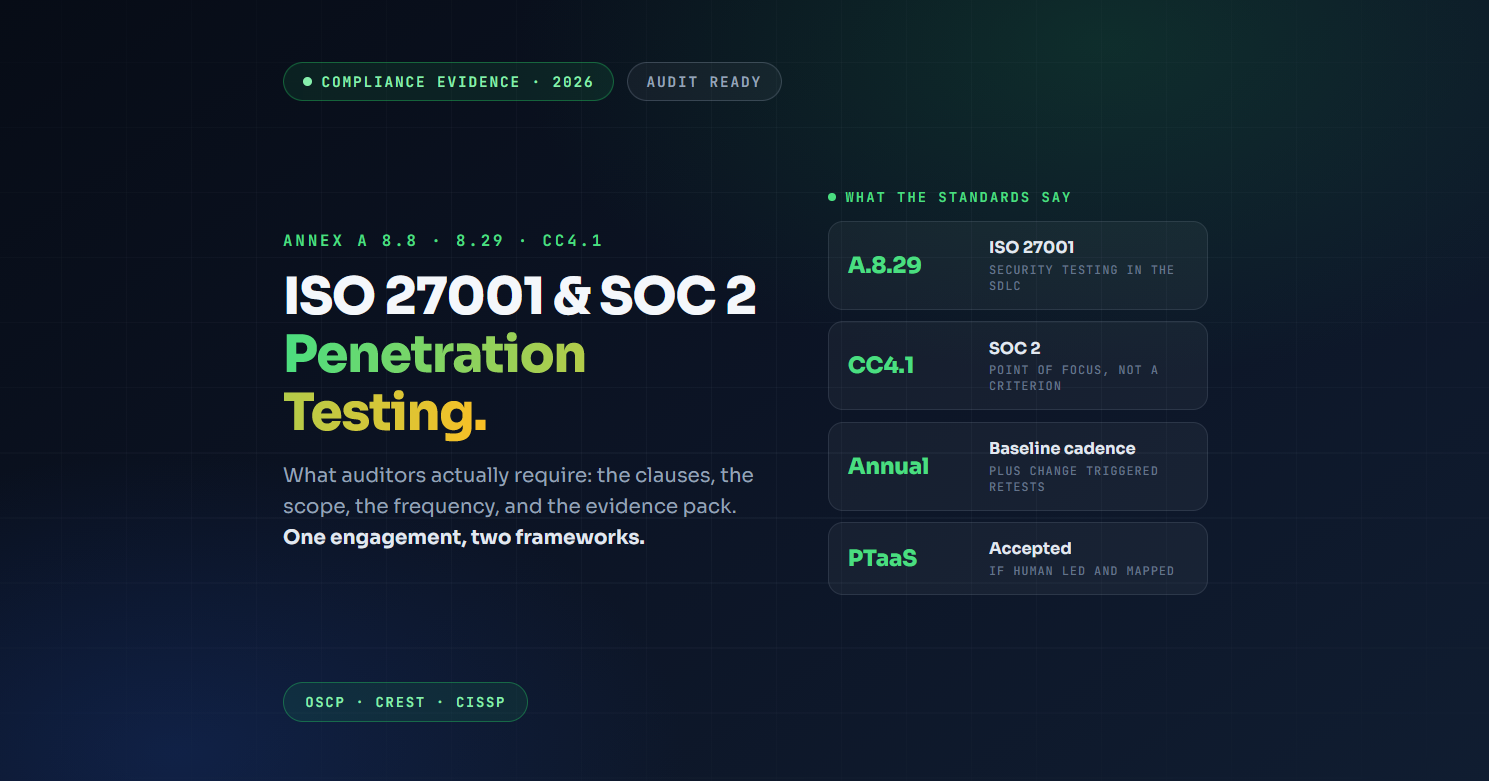
Does ISO 27001 require a penetration test? Not by name. ISO/IEC 27001:2022 is risk based, but Annex A 8.8 (management of technical vulnerabilities) and Annex A 8.29 (security testing in development and acceptance) are the applicable controls, and ISO/IEC 27002:2022 names penetration testing in its implementation guidance. If those controls are marked applicable in your Statement of Applicability and you cannot show test evidence, that is a Stage 2 nonconformity.
Does SOC 2 require a penetration test? Not in the criteria. The phrase appears once, inside a point of focus under CC4.1 in the AICPA 2017 Trust Services Criteria (revised points of focus, 2022). Points of focus are design aids, not criteria. In practice, Type II auditors ask for a test to evidence CC4.1 and the CC7 series, and rarely accept scanner output alone.
The operational translation: optional in the text, expected in the room. Budget for one well scoped annual test plus change triggered retests, and make the report do double duty across both frameworks.
Two frameworks, one recurring confusion. Search volume for "pentest ISO 27001" and "SOC 2 penetration testing requirements" keeps climbing, and almost every result answers half the question: it tells you whether a test is required, then stops before the part that actually decides your audit, which is whether the report you hand over is accepted.
This page is the consolidated answer. It covers the exact clause and criterion basis for each framework, what scope an auditor considers adequate, how frequently you have to test, what has to be inside the report, and the question buyers now ask most often: whether an automated or PTaaS report will be accepted at all.
Why 2026 is different from 2024
Three things changed, and none of them are a rewrite of either framework.
The ISO 27001:2013 transition window closed on 31 October 2025. Every valid certificate now sits on the 2022 edition, which means Annex A 8.29 is assessed on every certified organisation rather than only on early movers. Surveillance and recertification audits running through 2026 are the first full cycle where an inadequate answer on security testing is a routine finding rather than a novelty.
SOC 2 itself did not change. The operative document is still the 2017 Trust Services Criteria with revised points of focus published in 2022. What moved is auditor behaviour: evidence quality, scope traceability, and subservice organisation review are all under sharper scrutiny than they were two years ago. If an audit firm tells you there are "new 2026 SOC 2 requirements", ask them to cite the criterion number. They should be able to.
AI systems entered scope without a new control. Neither the AICPA nor ISO has issued an AI specific criterion for these frameworks, yet auditors increasingly fold model vendors, retrieval pipelines, and shadow AI tooling into existing risk assessment, access, and vendor management criteria. If an LLM feature sits inside your system boundary, expect it to be inside your test scope too.
Does ISO 27001 require penetration testing?
No clause in ISO/IEC 27001:2022 states that you must run a penetration test. The standard is outcome based: it defines what has to be achieved and leaves the method to your risk assessment. That flexibility is exactly why so many teams get caught out.
Four places in the standard do the work:
| Reference | What It Says | What a Pentest Evidences |
|---|---|---|
| Annex A 8.8 | Obtain information about technical vulnerabilities, evaluate exposure, take appropriate measures | Independent discovery and exploitation of real exposure, not just CVE matching |
| Annex A 8.29 | Security testing shall be defined and implemented in the development lifecycle | Testing as a release gate, with acceptance criteria |
| Clause 9.1 | Determine what is monitored and measured, by what method, and analyse results | Documented, repeatable measurement of control effectiveness |
| Clause 6.1.2 and the SoA | Systematic risk assessment, and justification of every applicable control | Findings that feed the risk register and treatment plan |
Control references from ISO/IEC 27001:2022 Annex A, with implementation guidance in ISO/IEC 27002:2022. Clause numbers from the management system requirements.
The Statement of Applicability is where this becomes binding. If 8.29 is marked applicable, and for any organisation that develops software or runs internet facing systems it almost always is, the auditor will ask to see the test report for your last major release. There is no third option between producing evidence and raising a nonconformity.
Full detail on control mapping lives in our ISO 27001 penetration testing requirement guide and on the ISO 27001 compliance service page.
Does SOC 2 require penetration testing?
Also no, and the textual basis is even thinner than most articles imply. Across the entire Trust Services Criteria, penetration testing appears inside a single point of focus under CC4.1, which asks the entity to select, develop, and perform ongoing or separate evaluations to determine whether components of internal control are present and functioning. The point of focus lists penetration testing alongside independent certifications and internal audit assessments as example evaluation types.
Points of focus are not criteria. You can, in principle, satisfy CC4.1 with an ISO certification, internal audit programme, or a mature bug bounty, and some auditors have accepted exactly that.
In practice, three things push almost every SaaS company toward a test:
- CC4.1 needs evidence that someone independently evaluated whether controls function. A report describing attempted control bypass is the cleanest form of that evidence.
- The CC7 series, particularly CC7.1 and CC7.2, requires detection of newly introduced and newly discovered vulnerabilities. Scanning maps here naturally.
- Type II is a period opinion. A single artifact dated outside the observation window does not describe the period under examination.
The distinction worth memorising: vulnerability scanning maps most naturally to CC7.1; penetration testing maps to CC4.1. Auditors routinely ask which one you did, and submitting a scan report labelled as a pentest is one of the most common reasons for a supplemental evidence request. Our SOC 2 penetration testing requirements breakdown and SOC 2 compliance page go deeper on the criteria themselves.
One correctly scoped engagement can produce a single evidence pack that maps to Annex A 8.8, Annex A 8.29, CC4.1 and the CC7 series. Doing it twice is a budget decision, not a compliance one.
Book a free compliance pentest scoping call →What type of penetration test satisfies each framework
Neither framework prescribes a test type. Both judge whether the scope you chose matches the boundary you claimed.
- ISO 27001 anchors scope to the ISMS boundary declared in your scope statement and SoA. Anything inside that boundary that could be attacked is fair game for the auditor's question.
- SOC 2 anchors scope to the system description in Section III of your report. The auditor will read your system description and your rules of engagement side by side.
That gives you a workable rule: test everything that stores, processes, or transmits in scope data, plus everything that controls access to it. For a typical B2B SaaS that means the external perimeter, the production web application in an authenticated grey box configuration, the APIs behind it, the cloud control plane, and role boundaries between tenants and privilege levels.
The scope adequacy test auditors actually run
Auditors are rarely security engineers. They do not evaluate technique. They evaluate traceability, using roughly five questions:
Answer all five in the report and its appendices and scope is settled. Miss two and you will be answering emails during fieldwork.
- Does the tested asset list reconcile to the system description or ISMS scope statement, item by item?
- If something in the boundary was excluded, is the exclusion documented with a risk based rationale?
- Was testing authenticated, and across which roles? An unauthenticated test of an authenticated product is a scope gap.
- Were APIs tested directly, or only through the web front end?
- Does the test date fall inside the audit period or the current certification cycle?
For scoping specifics by asset type, see our guides on web application penetration testing, API penetration testing scope and methodology, cloud penetration testing across AWS, Azure and GCP, and internal and external network testing.
How often do you have to test?
Annual is the accepted baseline for both. The frameworks diverge on the second trigger and on how timing is judged.
| Dimension | ISO 27001 | SOC 2 |
|---|---|---|
| Stated interval | None. Risk based | None. Risk based |
| Practical baseline | Annual, aligned to the surveillance cycle | Annual, aligned to the observation period |
| Second trigger | Significant change, per 8.8 and 8.29. Major release, architecture change, cloud migration | Significant change, plus the report must describe the period examined |
| Hard timing rule | Evidence should be current at Stage 2 and at each surveillance visit | For Type II, the test should fall inside the observation window |
| Release cadence pressure | 8.29 pushes testing into the SDLC as a gate, not only as an annual event | Continuous evidence strengthens CC4.1 across a 6 to 12 month period |
Neither framework publishes a mandated interval. The baselines above reflect what certification bodies and Type II audit firms consistently request as evidence.
The Type II timing rule is the one that costs companies real money. A test completed two months before a twelve month observation window opens is a fine security exercise and a weak audit artifact. Read SOC 2 Type 1 vs Type 2 if you are still choosing.
The ISO 8.29 nuance matters differently. A full external test is not expected for every minor release. A risk based split is what auditors want documented: automated scanning and code review for minor changes, focused testing for significant releases, one full independent test annually. Write that cadence down with its risk rationale. "We test annually because everyone does" is a weaker answer than "we test annually as a baseline and after any change that materially alters the attack surface of in scope systems."
Will my auditor accept an automated or PTaaS penetration test report?
This is the question buyers now ask before they ask about price, and the honest answer has two halves.
Yes, most modern SOC 2 and ISO 27001 auditors accept PTaaS reports, provided the engagement was human led and the report meets the same scope and methodology bar as a traditional consultancy report. Delivery format is not what auditors assess. A findings platform with a live dashboard, continuous retest, and exportable point in time reports is, from an evidence standpoint, a better artifact than a static PDF, because it can demonstrate remediation across the observation period rather than on one day.
No, fully autonomous or scanner only output generally does not clear the bar, and this is where the market's terminology does buyers real harm. Two very different products share the PTaaS label:
| Capability | Human Led PTaaS | Autonomous or Scanner Only |
|---|---|---|
| Business logic flaws | Tested | Not tested |
| Chained exploitation | Demonstrated across findings | Rarely |
| Authorisation and tenant boundaries | Manual, role by role | Partial at best |
| Proof of exploitation | Working proof of concept per finding | CVE and version inference |
| Named, credentialed testers | Yes | No |
| CC4.1 acceptance | Generally accepted | Usually treated as CC7.1 scanning |
Acceptance behaviour reflects how auditors classify evidence under AICPA TSP Section 100 criteria CC4.1 and CC7.1, and under ISO/IEC 27001:2022 Annex A 8.8 and 8.29.
The practical test to apply before you buy: ask the provider to show one finding with a working proof of exploit and a named tester attached. If they cannot, you are buying a scanner subscription with a PTaaS label, and your auditor will classify it as CC7.1 vulnerability scanning no matter what the cover page says.
Worth naming the uncomfortable version of this too. Because framework auditors assess whether testing occurred and whether findings were managed, rather than whether the tester was skilled, a weak report often does pass. Passing is not the same as being tested. The better question is not whether your auditor will accept the report, but whether that engagement would have found a serious vulnerability had one been sitting in the environment while it ran.
SLASH runs human led testing on a continuous cycle with retest built in, so a Type II observation window is covered end to end rather than by a single dated PDF. Findings export mapped to Trust Services Criteria and Annex A control numbers.
See how SLASH covers the audit period →What a compliant penetration test report must contain
Most rejected reports are not rejected for weak testing. They are rejected for missing artifacts. Use this as an evidence ledger.
| Artifact | Why the Auditor Needs It | What Its Absence Looks Like |
|---|---|---|
| Executive summary | Non technical statement of posture and residual risk for management | Auditor cannot form a view without reading raw findings |
| Scope statement and asset list | Reconciles to system description or ISMS scope | Scope gap, supplemental evidence request |
| Methodology and standard used | Shows a structured, repeatable process. OWASP WSTG, PTES, NIST SP 800-115 | Vague methodology is a top reason for follow up questions |
| Tester identity and credentials | Demonstrates independence and competence | Independence cannot be established |
| Engagement dates | Places the test inside the audit period or certification cycle | Stale evidence for a Type II period opinion |
| Findings with severity and business impact | Supports the risk register and treatment plan | Findings cannot be traced into the ISMS |
| Control mapping | Ties findings to Annex A numbers and Trust Services Criteria | Auditor has to build the mapping, and may not agree with yours |
| Remediation plan with owners and dates | Evidences that risk treatment is real | Incomplete treatment plan under Clause 6.1.3 |
| Retest report | Proves high and critical findings actually closed | The single most common gap in otherwise strong evidence packs |
Methodology standards referenced are NIST SP 800-115, the OWASP Web Security Testing Guide, and PTES. Naming one of them in the report is what converts a test into an auditable process.
The retest is the artifact teams skip and auditors notice. Without it you have proof that vulnerabilities were found and no proof anything was done, which is a weaker position than not having tested at all in some auditors' eyes, because the finding is now documented.
One engagement, two frameworks
If you are pursuing both, scope once and map twice. No authority guarantees that a single test satisfies both frameworks automatically, but a report written with both mappings is one evidence pack instead of two audit preparation cycles.
| Finding Type | ISO 27001 Annex A | SOC 2 Criteria |
|---|---|---|
| Unpatched service, outdated component | A.8.8 | CC7.1 |
| Authentication or authorisation bypass | A.8.5, A.5.15 | CC6.1, CC6.3 |
| Pre release application flaw | A.8.29, A.8.25 | CC8.1 |
| Exposed service on perimeter | A.8.20, A.8.22 | CC6.6 |
| Missing detection of test activity | A.8.16 | CC7.2 |
| Remediation and retest evidence | A.8.8, Clause 10.2 | CC4.1, CC7.4 |
Mapping is indicative. Applicability depends on your Statement of Applicability and on which Trust Services categories are in scope for your examination.
Our SOC 2 vs ISO 27001 comparison covers the wider overlap between the two programmes, and the cost guide covers what scope does to price.
Frequently Asked Questions
Is penetration testing mandatory for ISO 27001? Not by name. Annex A 8.8 and A.8.29 make it the expected evidence, and ISO/IEC 27002:2022 implementation guidance references penetration testing directly. If those controls are applicable in your SoA and no test evidence exists, the auditor has grounds for a nonconformity.
Is penetration testing mandatory for SOC 2? No. Penetration testing appears once, in a point of focus under CC4.1, as one example of an evaluation activity. Most Type II auditors expect a test in practice and rarely accept scanner output alone for CC4.1.
Will a vulnerability scan satisfy ISO 27001 or SOC 2? Usually not on its own. Scanning maps to CC7.1 and supports A.8.8, but neither auditor community treats automated output as evidence of independent control evaluation under CC4.1 or as security testing under A.8.29.
Will my ISO 27001 auditor accept an automated penetration test report? If the engagement was human led and the report carries scope reconciliation, stated methodology, named testers, control mapping, and retest evidence, then yes, delivery platform is irrelevant. Fully autonomous scanner output with no human validation is normally classified as vulnerability scanning instead.
How often do we need to test? Annually as a baseline for both, plus after any significant change to in scope systems. For SOC 2 Type II, schedule the test inside the observation window.
Can one penetration test cover both frameworks? Yes, if the scope covers both the ISMS boundary and the system description, and findings are mapped to Annex A control numbers and Trust Services Criteria in the same report.
Does the tester have to be external? Neither framework mandates it. Independence is far easier to demonstrate with a third party, and internal testing invites questions about objectivity under CC4.1 and Clause 9.2.
What about AI features in our product? There is no AI specific criterion in either framework yet, but auditors are folding AI systems into existing risk, access, and vendor management criteria. If a model or retrieval pipeline sits inside your boundary, keep it inside your test scope.
Getting this scoped correctly
The failure mode in both frameworks is identical: the test was fine, the evidence pack was incomplete. Scope reconciliation, control mapping, and retest evidence are what convert a security exercise into an audit artifact.
SecurityWall runs human led testing scoped to your ISMS boundary or SOC 2 system description, with findings mapped to Annex A control numbers and Trust Services Criteria, and retest included so high and critical findings are provably closed before your auditor asks. If you want continuous coverage across a Type II observation period rather than a single dated report, SLASH extends the same testing into a PTaaS model.
Book a free compliance pentest scoping call
Bring your ISMS scope statement or draft system description. We will tell you what has to be in scope, what your auditor will ask for, and what the evidence pack needs to contain.
Schedule a meeting →
Get your scope, control mapping and evidence pack checked before your auditor does.
Schedule a meeting →Tags
About Hisham Mir
Hisham Mir is a cybersecurity professional with 10+ years of hands-on experience and Co-Founder & CTO of SecurityWall. He leads real-world penetration testing and vulnerability research, and is an experienced bug bounty hunter.