
Web App Penetration Testing: Methodology, Scope & What a Report Looks Like (2026)
Babar Khan Akhunzada
February 24, 2026
If you're evaluating web application penetration testing providers, you've probably already realised that the market is full of firms offering "pentests" that aren't really pentests automated scanner runs dressed up with a cover report. This guide is written for the people making the buying decision: CISOs, CTOs, InfoSec managers, and security leads who need to understand what a real web app pentest involves, what it should cost, and how to tell the difference between a genuine assessment and a compliance checkbox.
We won't teach you how to hack. We'll tell you what to buy, what to demand in a report, and what questions separate the serious providers from the rest.
- What Web Application Penetration Testing Actually Is
- Pentest vs Vulnerability Scan: Why It Matters for Your Budget
- What the Testing Methodology Should Cover
- Web App Penetration Testing Scope: What's Included and What's Not
- What a Real Web App Pentest Report Contains
- Web Application Penetration Testing Cost in 2026
- How to Evaluate and Choose a Provider
- Get a Web App Pentest Quote
What Web Application Penetration Testing Actually Is
Web application penetration testing is a manual security assessment of a web application conducted by a human tester, not an automated tool that attempts to find and exploit security vulnerabilities the way a real attacker would.
The operative word is manual. A skilled tester probes your application's authentication flows, business logic, API endpoints, session handling, and access controls using the same techniques and mindset as an adversary. They chain vulnerabilities together, test for logic flaws that no scanner can detect, and deliver findings that reflect actual exploitability not theoretical risk.
The output is a report that tells you what was found, what an attacker could do with it, how to fix it, and evidence that the finding is real.
What web app pentesting is not: Running OWASP ZAP, Burp Suite in automated mode, or Nessus against your application and generating a report from the output. That's a vulnerability scan. It has value as a baseline hygiene check, but it does not satisfy the requirement for a penetration test under SOC 2, HIPAA, ISO 27001, or any mature compliance framework and it won't find your most dangerous vulnerabilities.
Pentest vs Vulnerability Scan: Why It Matters for Your Budget
This distinction matters practically, not just technically, because the market is full of firms selling vulnerability scans at pentest prices.
| Factor | Vulnerability Scan | ⚡ Manual Pentest |
|---|---|---|
| Executed by | Automated tool | Human security tester |
| Business logic flaws | ✕ Not detected | ✓ Core focus |
| Authentication bypass | ◑ Partial — known patterns only | ✓ Manual flows tested end-to-end |
| API security testing | ✕ Misses unauthenticated & BOLA | ✓ Full REST/GraphQL/SOAP coverage |
| Accepted for SOC 2 / HIPAA | ✕ Not accepted as pentest evidence | ✓ Accepted with methodology evidence |
| Typical cost | $200 – $2,000/year | $6,000 – $25,000 |
If a provider quotes you $1,000–$2,000 for a "web application pentest," they are selling you an automated scan. At that price point, the economics of human testing don't work. A qualified tester's time alone costs more than that. Know what you're buying before you sign.
Web App Penetration Testing Methodology: Step-by-Step
The industry standard for web application security testing is the OWASP Testing Guide the same framework that maps to the OWASP Top 10, the most widely referenced list of critical web application vulnerabilities. When you're evaluating providers, ask whether their methodology is OWASP-aligned and what that means in practice.
Here's what a methodology-sound web app pentest should cover:
Reconnaissance and application mapping. Before a tester can exploit anything, they need to understand the attack surface all endpoints, input fields, authentication mechanisms, and third-party integrations. Providers who skip this phase produce incomplete coverage.
Authentication and session management. How does your application handle login, multi-factor authentication, password reset flows, and session tokens? These are among the most commonly exploited attack surfaces. Weaknesses here often lead to full account takeover affecting every user in your system.
Authorisation and access control. Can a logged-in user access data or functions they shouldn't? Broken Object Level Authorisation (BOLA) the number one API security vulnerability is a classic example: a user who can access their own records manipulates a parameter to access someone else's. Automated scanners almost never find this.
Injection vulnerabilities. SQL injection, command injection, template injection, and other input-handling flaws that allow an attacker to manipulate your application's backend. These remain on the OWASP Top 10 because they remain prevalent and because the most dangerous variants require manual testing to surface.
Business logic testing. This is what separates a genuine pentest from everything else. Business logic flaws are vulnerabilities in how your application is designed to work a checkout flow that allows negative quantities, a subscription upgrade that doesn't validate payment, a multi-step process that can be skipped. No tool finds these. They require a tester who understands your application's intended behaviour and probes for deviations.
API security. If your application has a REST, GraphQL, or SOAP API and almost all modern web applications do the API should be in scope and tested with the same depth as the web interface. API security is where the most significant undiscovered vulnerabilities tend to live, particularly in applications that have grown through multiple development cycles.
File upload and storage handling. Applications that accept file uploads are frequently vulnerable to malicious file execution, path traversal, and insecure storage exposure. Testing covers both the upload mechanism and what happens to files after they're received.
Infrastructure and configuration issues. Security headers, TLS configuration, error message exposure, and server configuration issues that leak information or weaken the application's security posture.
Web App Penetration Testing Scope: What's Included and What's Not
Scope misalignment is the most common source of disappointment after a web app pentest. You expected comprehensive coverage; what you received was a test of the main login page and three public-facing forms.
What should be in scope for a complete web app pentest:
The authenticated application not just the public-facing pages. The most significant vulnerabilities in most applications sit behind the login wall: user dashboards, admin panels, data export functions, and account management flows. A pentest that only tests unauthenticated endpoints is missing the majority of your attack surface.
All API endpoints. If your application has a documented or discoverable API, it needs to be in scope. This includes undocumented or legacy endpoints that are still accessible these are disproportionately likely to have security issues because they haven't been maintained with the same attention as documented functionality.
Multiple user roles. A single-role test misses authorisation vulnerabilities that only appear when a lower-privileged user attempts to access resources owned by a higher-privileged one. Testing should cover all distinct user roles your application supports.
File upload and download functionality, admin panels, third-party integrations, and password/MFA reset flows.
What providers sometimes leave out without telling you:
API testing billed separately. Admin panel excluded from scope without being explicit. Multi-role testing reduced to a single authenticated role. Mobile app interface tested as a web app when it calls a different API backend. These are scope reductions that matter and they should be explicit in the statement of work before the engagement begins.
What a Real Web App Pentest Report Contains
The report is the deliverable you're paying for. Before you select a provider, ask to see a sample report redacted is fine. What you're looking for:
Executive summary. Written for non-technical readers: overall risk rating, key findings in plain language, and the most critical actions required. If the executive summary requires a security background to understand, it's written for the wrong audience.
Finding-level detail that proves exploitability. Each finding should include: a clear description of the vulnerability, the affected endpoint or function, step-by-step reproduction instructions, a proof-of-concept screenshot or video demonstrating the issue, a CVSS score or equivalent severity rating with justification, and the business impact if exploited. A finding without a PoC is an unverified claim it might be a false positive, and your development team can't prioritise a fix without knowing it's real.
Remediation guidance that developers can act on. Not "fix the SQL injection" specific guidance on what the code change or configuration fix should look like, with references to secure coding practices. Your development team will use this directly; vague recommendations generate back-and-forth that delays fixes.
A remediation status and retest section. The first report is the raw findings. After your team remediates, the provider should retest all critical and high findings and document that they're resolved. For compliance purposes SOC 2, HIPAA, ISO 27001 retest evidence is what auditors look for to confirm the engagement produced real security improvement, not just a list of issues.
Methodology documentation. What testing phases were executed, what tools were used alongside manual testing, and what was out of scope. This is what your auditor reads to determine whether the pentest was thorough enough to satisfy the relevant compliance criteria.
Web Application Penetration Testing Cost in 2026
Cost varies by application complexity, scope, and testing depth. Here's what realistic market rates look like:
| Application Type | Price Range | What's Included |
|---|---|---|
| Simple web app (low complexity, single role) | $5,000 – $10,000 | Web app + basic API, OWASP Top 10, 1 user role, retest |
| Mid-complexity SaaS (API-heavy, multi-role) | $10,000 – $20,000 | Full web + REST/GraphQL API, multi-role auth, business logic, retest |
| Complex enterprise app (multiple apps, microservices) | $20,000 – $50,000+ | Multiple apps, API gateway, admin portal, SSO, deep business logic |
The biggest driver of cost is scope — specifically the number of distinct functional areas, API endpoints, and user roles that need to be tested. A thorough scoping call before the engagement begins is the most effective way to get an accurate quote. Providers who quote without scoping are estimating blind.
For organisations running SOC 2 or other annual compliance cycles, the SLASH platform provides continuous web application testing rather than a point-in-time engagement typically reducing the per-year cost of maintaining compliance coverage while improving depth and cadence.
How to Evaluate and Choose a Web App Pentest Provider
The questions that matter when shortlisting providers:
Ask for a sample report. This is the single most revealing thing you can request. A real pentest report has detailed PoC evidence, step-by-step reproduction instructions, developer-actionable remediation guidance, and a retest section. An automated scan report has vulnerability titles, CVSS scores, and references to CVE databases. The difference is immediately visible.
Ask whether the engagement is primarily manual or automated. The honest answer from any quality provider is "manual testing with tool-assisted reconnaissance." An answer that leads with tooling is a red flag.
Ask who specifically will be testing your application. Credentials matter OSCP, OSWE, CREST, CEH but experience with your application type matters more. A tester with a background in healthcare application security will find different things in an EHR integration than a generalist. Ask about relevant application experience, not just certifications.
Ask what's explicitly in and out of scope in writing, before the engagement begins. Authenticated vs unauthenticated testing. API coverage. Number of user roles. Admin panel inclusion. These are the scope items that determine whether you get a comprehensive assessment or a partial one.
Ask whether retest is included. Some providers charge for retest separately. For compliance purposes, retest evidence is not optional make sure it's in the scope of work.
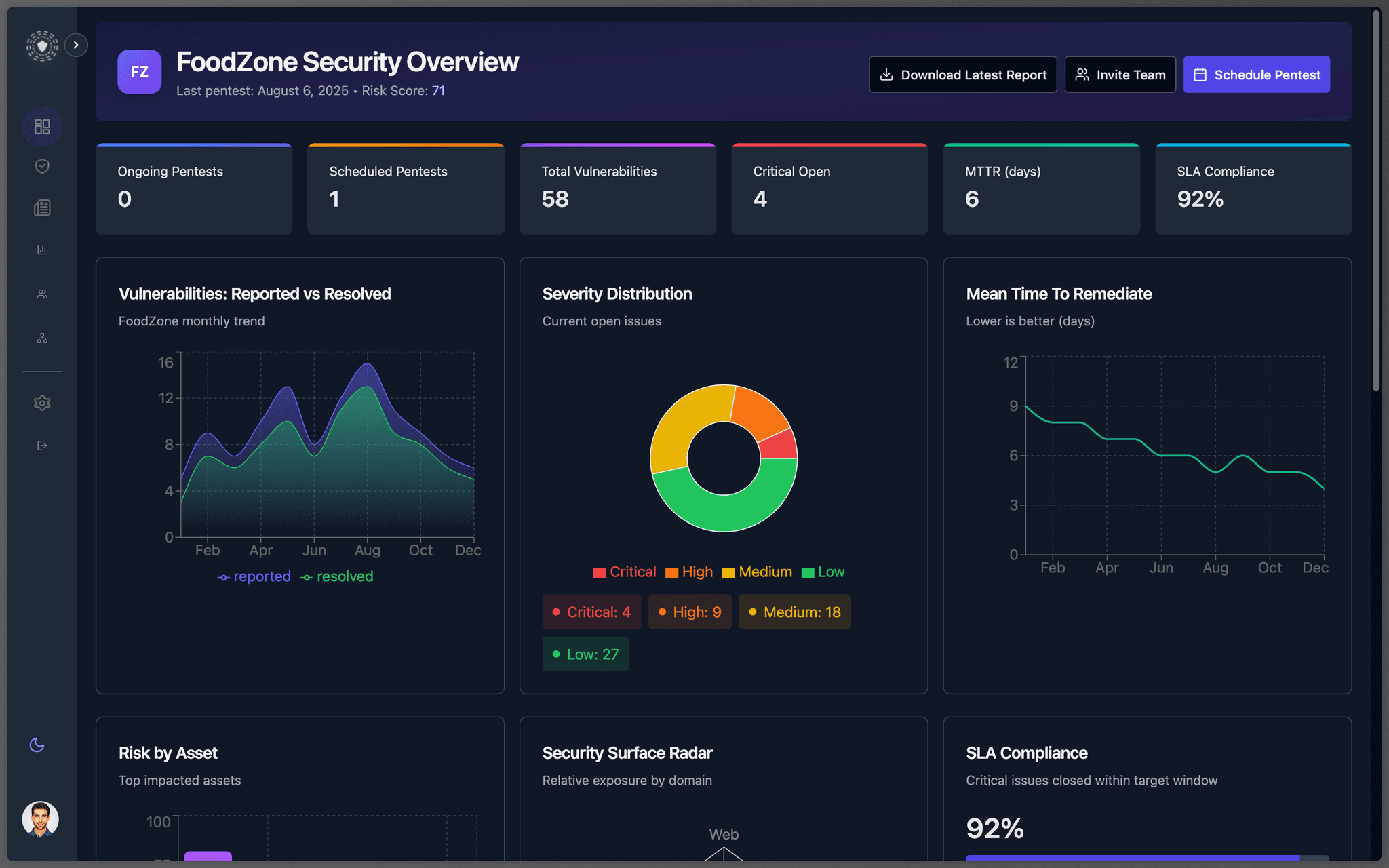
Ask how findings are delivered. Are they available during the engagement in a portal, or as a PDF at the end? For development teams that want to start remediating before the engagement closes, real-time finding access matters. SecurityWall's findings are delivered through the SLASH platform in real time your team can begin addressing critical findings on day two of the engagement rather than waiting for a final PDF.
For compliance-specific requirements what SOC 2 and HIPAA auditors specifically look for in a web app pentest see our SOC 2 penetration testing requirements guide and HIPAA penetration testing requirements guide.
The web application penetration testing market has a quality problem. The distance between a rigorous manual assessment by a skilled tester and an automated scan with a cover report is vast and both are sold as "pentests." The buying criteria that matter are report quality, methodology transparency, scope definition, and tester credentials. Everything else is noise.
What you're ultimately buying is confidence: that someone with real adversarial skill has looked at your application the way an attacker would, found what's there to find, and given you evidence-backed guidance to fix it. That's worth paying for. An automated scan that checks a compliance box is not.
Get a Web App Pentest Quote
Related reading:
- Penetration Testing Services
- SOC 2 Penetration Testing Requirements
- HIPAA Penetration Testing Requirements
- PTaaS: The Complete Buyer's Guide
- SOC 2 Pentest Cost Guide
Web Application Penetration Testing, Web App Pentest, OWASP Top 10, API Security Testing, Manual Penetration Testing, SOC 2, HIPAA, Application Security, Pentest Services
Tags
About Babar Khan Akhunzada
Babar Khan Akhunzada leads security strategy, offensive operations. Babar has been featured in 25-Under-25 and has been to BlackHat, OWASP, BSides premiere conferences as a speaker.