SOC 2 vs ISO 27001: Differences and Which You Need
Hisham Mir
May 24, 2026
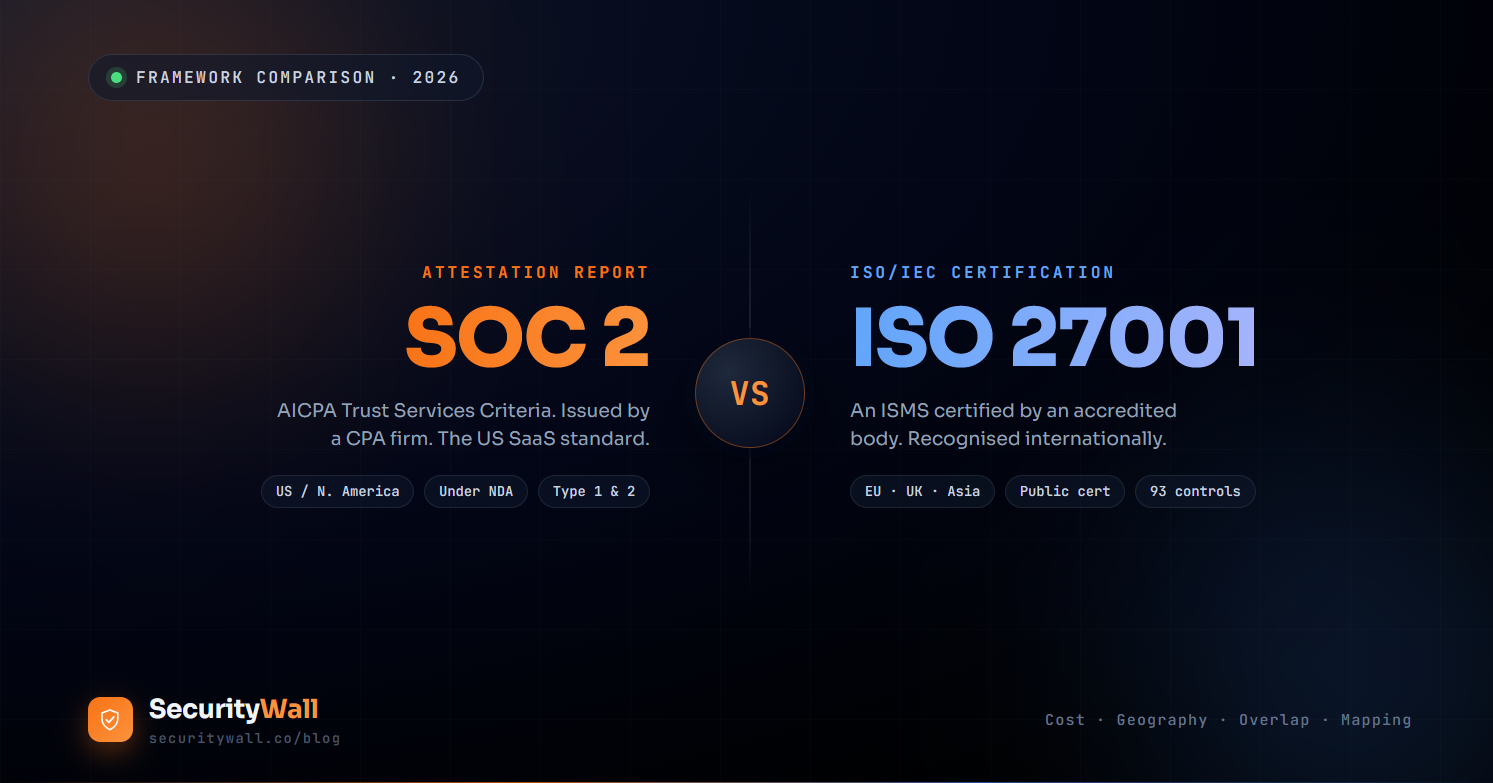
"SOC 2 vs ISO 27001" is one of the most-searched questions in compliance and it is usually the wrong question. People type it expecting to learn which framework is better, as if one were a stronger version of the other. They are not competing tiers of the same thing. They are two different instruments, built by different bodies, recognised in different markets, that happen to cover a heavily overlapping set of security controls.
The better question is not "which is better" it is "which one are my customers actually asking for, and where are they?" A US enterprise SaaS buyer's procurement team will ask for your SOC 2 report. A European, UK, or Asian enterprise or a government tender, or a multinational will often require ISO 27001 certification. The framework you need is determined far less by the two standards' relative merits than by who is sitting across the table asking you for proof.
If you are still working out the basics of SOC 2 itself, our guide to SOC 2 compliance is the place to start, then come back here to weigh it against ISO 27001.
- The Core Difference in One Sentence
- What SOC 2 Actually Is
- What ISO 27001 Actually Is
- SOC 2 vs ISO 27001 — Side by Side
- The Real Decision Driver — Who's Asking, and Where
- Cost and Timeline Compared
- Should You Do Both?
- How SOC 2 and ISO 27001 Controls Map
- How SecurityWall Helps With Both
The Core Difference in One Sentence
SOC 2 is an attestation report; ISO 27001 is a certification. A SOC 2 engagement produces a detailed report in which a licensed CPA firm gives its opinion on your controls. An ISO 27001 engagement produces a one-page certificate, issued by an accredited certification body, confirming that your information security management system meets an international standard.
That single distinction drives almost everything else. SOC 2 gives your customer a long, detailed document they read under NDA. ISO 27001 gives your customer a certificate they can verify publicly. SOC 2 is the dominant expectation in US technology and SaaS procurement. ISO 27001 is the internationally recognised standard, routinely required across the EU, the UK, Asia, and in government and enterprise tenders worldwide.
Underneath, the two cover a substantial overlap of the same security controls — access management, risk assessment, incident response, change management, vendor oversight. The difference is in the form of the proof, the body that issues it, and the market that recognises it not in whether your security is fundamentally good or bad.
What SOC 2 Actually Is
SOC 2 (System and Organization Controls 2) is an attestation framework developed by the American Institute of Certified Public Accountants (AICPA). It is not a regulation and not, strictly, a certification it is an independent auditor's report on whether your controls meet the AICPA's Trust Services Criteria. Read more What Is SOC 2 Compliance? Guide for SaaS Companies.
Key Characteristics
- Issued by a licensed CPA firm: Only an independent licensed CPA firm can perform a SOC 2 audit and issue the report
- Based on the Trust Services Criteria: Security (the mandatory Common Criteria) plus optional categories: Availability, Processing Integrity, Confidentiality, and Privacy
- Two report types: Type 1 assesses control design at a point in time; Type 2 assesses control effectiveness over a period of 3–12 months (see our Type 1 vs Type 2 guide)
- A detailed report, not a certificate: Typically dozens of pages, including the auditor's opinion, system description, controls, and (for Type 2) test results and any exceptions
- Confidential: The report contains sensitive detail about your systems, so it is shared with customers under NDA, not published
- An opinion, not a pass/fail: The report can be clean or contain noted exceptions; there is no "certified" stamp
Where SOC 2 Dominates
SOC 2 is the default expectation in US and North American technology procurement. If you are a SaaS company selling to US enterprises, their security questionnaire will almost certainly ask for your SOC 2 report. It carries less weight in markets where ISO 27001 is the established norm.
What ISO 27001 Actually Is
ISO/IEC 27001 is an international standard for an Information Security Management System (ISMS), published jointly by the International Organization for Standardization (ISO) and the International Electrotechnical Commission (IEC). The current version is ISO/IEC 27001:2022. Unlike SOC 2, it is a certification you either achieve it or you do not.
Key Characteristics
- Issued by an accredited certification body: Not a CPA firm; an accredited registrar audits you and issues the certificate
- Built around an ISMS: ISO 27001 requires a documented management system: a defined scope, a risk assessment and treatment process, a Statement of Applicability, leadership involvement, internal audits, and management review
- Annex A controls: The 2022 version specifies 93 controls organised into four themes: Organizational, People, Physical, and Technological
- A public certificate: The output is a verifiable one-page certificate that you can display and customers can confirm with the certification body
- A three-year cycle: Initial certification (Stage 1 documentation review plus Stage 2 audit), annual surveillance audits, and full recertification at year three
- Pass/fail with nonconformities: The auditor raises minor or major nonconformities; major ones must be resolved before the certificate is issued
Where ISO 27001 Dominates
ISO 27001 is the internationally recognised information security standard. It is frequently required by enterprises and governments across the EU, the UK, the Middle East, and Asia, and it appears routinely in public-sector and multinational procurement. For companies selling outside the US or to global enterprises with operations in those regions ISO 27001 is often the credential that opens doors.
SOC 2 vs ISO 27001 — Side by Side
The differences that actually affect your decision, in one view.
| Factor | SOC 2 | ISO 27001 |
|---|---|---|
| What it is | Attestation report on controls | Certification against an ISMS standard |
| Governing body | AICPA (United States) | ISO and IEC (international) |
| Issued by | Licensed CPA firm | Accredited certification body |
| Output | Detailed report (Type 1 or Type 2) | One-page certificate + audit findings |
| Shared publicly? | No — confidential, under NDA | Yes — public certificate |
| Primary geography | US / North America | International (EU, UK, Asia) |
| Controls basis | Trust Services Criteria | Annex A — 93 controls (2022) |
| Result model | Opinion, with possible exceptions | Pass/fail, with nonconformities |
| Validity | Covers a period; refreshed ~annually | 3-year cycle + annual surveillance |
| Typical first-cycle timeline | 6–12 months (with Type 2 observation) | 6–12 months (ISMS build + audit) |
The three rows that most often decide it: how the result is shared, the geography it is recognised in, and which one your customers are actually asking for.
The Real Decision Driver — Who's Asking, and Where
If you take one thing from this guide, take this: the right framework is usually decided by your customers and your geography, not by which standard is objectively stronger. Both are credible. The question is which one removes friction from your sales pipeline.
Choose SOC 2 First If…
- Your customers are predominantly US-based technology and enterprise buyers
- Your sales team keeps losing or stalling deals because procurement asks for "your SOC 2"
- You sell SaaS into the North American mid-market and enterprise
- Your investors or acquirers expect SOC 2 as the default trust signal
Choose ISO 27001 First If…
- Your customers are predominantly in the EU, UK, Middle East, or Asia
- You bid for government or public-sector tenders that specify ISO 27001
- You sell to multinational enterprises that standardise on ISO certifications across vendors
- You want a credential you can display and verify publicly rather than share under NDA
Choose Both If…
- You sell across both US and international markets and face requests for each
- You are scaling into enterprise globally and want to stop answering the framework question deal by deal
The most common pattern we see in US-headquartered SaaS companies: start with SOC 2 because that is what the immediate pipeline demands, then add ISO 27001 as international expansion makes it necessary reusing most of the control work already done for SOC 2.
Because the underlying controls overlap heavily, a single readiness check tells you how far you are from either path. Run the free SOC 2 Readiness Assessment — 200+ controls scored in 10 minutes, no sign-up.
Cost and Timeline Compared
Both frameworks require meaningful investment, and the totals are closer than most people expect. The headline figures:
- SOC 2 Type 2 typically $30,000 to $100,000+ all-in for a first cycle, covering readiness, remediation, the CPA audit fee, and a penetration test. The audit fee itself is a fraction of that; readiness and remediation usually dominate.
- ISO 27001 broadly comparable, often $30,000 to $120,000+ for a first certification, with the variable being how much ISMS scaffolding (documented management system, internal audit programme, risk treatment) you need to build from scratch. The certification-body fee is, like the CPA fee, only part of the total.
On timeline, both first cycles land in a 6-to-12-month range. SOC 2 Type 2's clock is dominated by the observation period; ISO 27001's is dominated by standing up and running the ISMS for long enough to demonstrate it operates before the Stage 2 audit.
The key cost insight when considering both: the second framework costs far less than the first, because the control work, evidence, and penetration testing largely transfer. Companies that plan for both from the outset spend materially less than companies that treat them as two separate projects a year apart.
Should You Do Both?
For a growing number of companies, the answer is eventually yes and the economics of doing them together are favourable because the two frameworks share a large proportion of their underlying controls.
The Overlap Is Substantial
Access control, risk assessment, incident response, change management, vendor and third-party management, encryption, logging and monitoring, and human-resources security all appear, in some form, in both frameworks. Industry practitioners commonly estimate the control overlap at roughly 80%, though the exact figure depends on which Trust Services Criteria you include in your SOC 2 scope and which Annex A controls apply to your ISMS. The practical point stands: most of the work you do for one counts towards the other.
Where They Diverge
- ISO 27001 requires a formal ISMS the documented management system, Statement of Applicability, internal audit programme, and management review have no direct SOC 2 equivalent
- SOC 2 requires period-of-time evidence as Type 2's observation-window testing is more granular than ISO 27001's surveillance model
- The deliverables differ as you still produce a CPA report for SOC 2 and earn a certificate for ISO 27001; neither substitutes for the other
The Efficient Sequence
The cost-efficient approach is to build the control environment once, to the union of both frameworks, then run the two assessments against that shared foundation. Done this way, the second framework is largely an exercise in mapping existing evidence to a different control catalogue and satisfying the framework-specific extras (the ISMS for ISO 27001; the period testing for SOC 2 Type 2).
How SOC 2 and ISO 27001 Controls Map
Because the frameworks cover overlapping ground with different vocabularies, mapping one to the other is how you avoid duplicating work. The relationship is many-to-many a single SOC 2 criterion often touches several Annex A controls and vice versa but the broad correspondences are consistent.
- SOC 2 CC6 (Logical and Physical Access) ↔ ISO 27001 Annex A access-control and identity controls (A.5.15–A.5.18, A.8.2–A.8.5)
- SOC 2 CC7 (System Operations / Monitoring) ↔ ISO 27001 logging, monitoring, and technical-vulnerability controls (A.8.15, A.8.16, A.8.8)
- SOC 2 CC8 (Change Management) ↔ ISO 27001 change-management and secure-development controls (A.8.32, A.8.25)
- SOC 2 CC9 / risk criteria ↔ ISO 27001 risk assessment and treatment (Clause 6) and supplier controls (A.5.19–A.5.22)
- SOC 2 Common Criteria governance (CC1–CC5) ↔ ISO 27001 ISMS clauses on leadership, planning, and operation (Clauses 4–9)
The one significant area ISO 27001 demands that SOC 2 does not frame the same way is the management system itself — Clauses 4 through 10, covering context, leadership, planning, support, operation, performance evaluation, and improvement. A company that has done SOC 2 well has most of the controls; the additional ISO 27001 work is largely building the management-system wrapper around them.
A formal control mapping the kind that lets you reuse a single piece of evidence across both audits is one of the highest-leverage early steps when pursuing both. It is also where experienced help pays for itself, because a clean mapping done once saves repeated evidence-gathering across every future audit cycle.
How SecurityWall Helps With Both
SecurityWall supports SaaS, fintech, and cloud companies across both SOC 2 and ISO 27001 from a first readiness baseline through to a clean report or certificate and ongoing compliance. Because the control work overlaps so heavily, our model is built around doing the foundational work once and applying it to whichever frameworks your market requires.
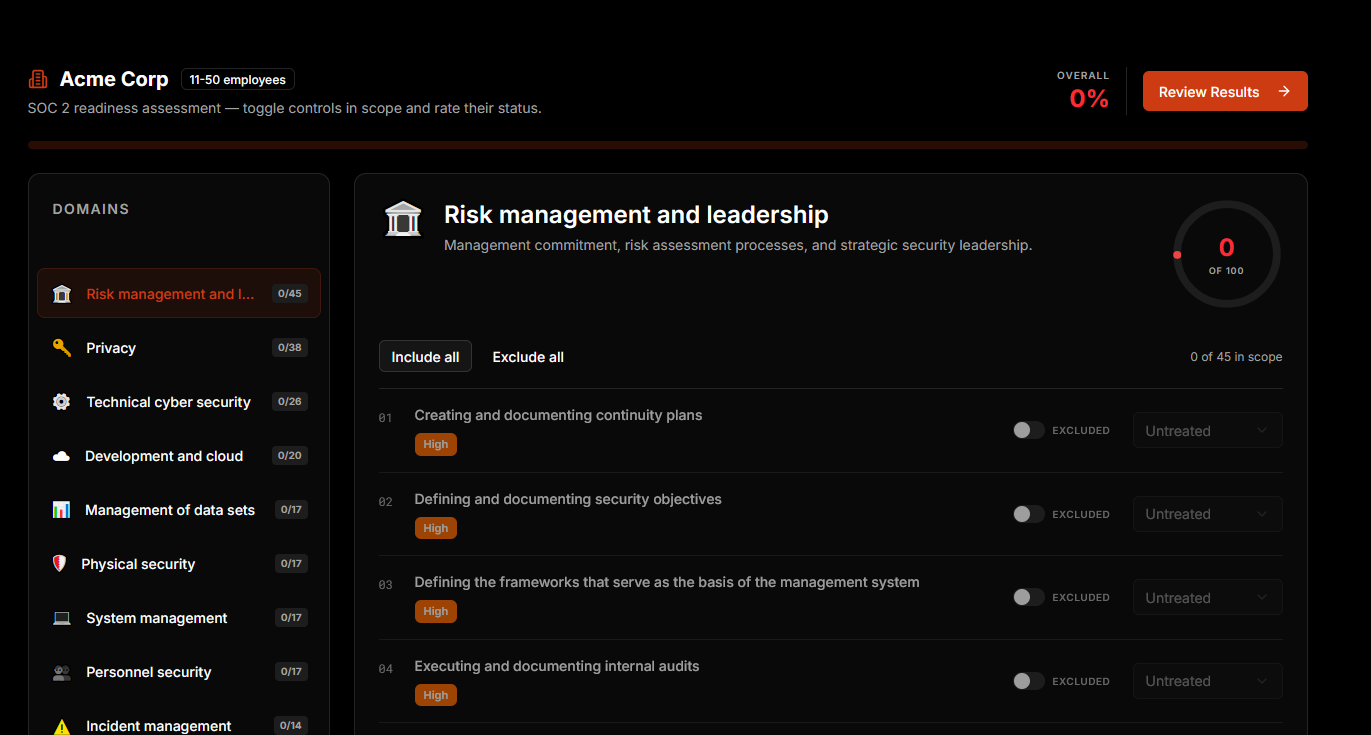
Free SOC 2 Readiness Assessment — Start Here
Before committing to either path, the free SOC 2 Readiness Assessment gives you the data to decide:
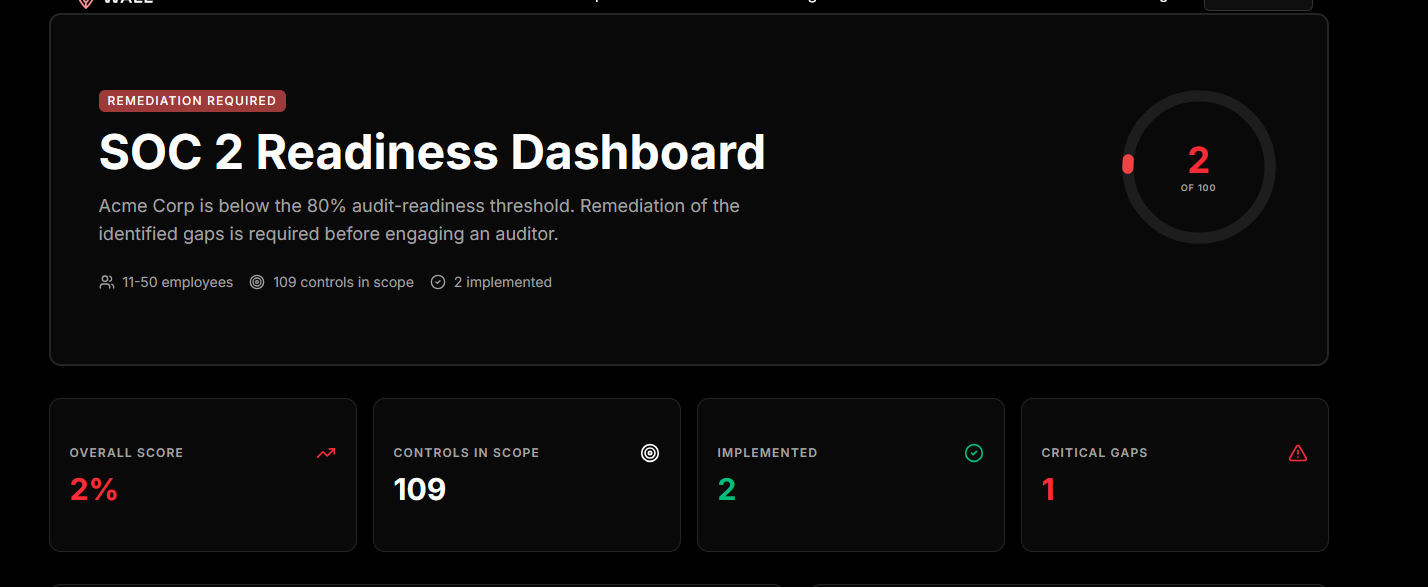
- Weighted score across 12 control domains that map to both frameworks' fundamentals
- Critical gap list with a control-by-control breakdown
- Executive summary with a remediation roadmap
- 200+ controls, 100% browser-based, no sign-up
SOC 2 Readiness and Audit Support
For companies whose market demands SOC 2 first:
- Full gap analysis scoped to your chosen Trust Services Criteria
- Remediation advisory and evidence-collection support
- Penetration testing that meets auditor expectations
- Coordination with the CPA audit firm through Type 1 or Type 2
ISO 27001 Readiness and Certification Support
For companies whose market demands ISO 27001:
- ISMS design and documentation scope, Statement of Applicability, risk assessment and treatment
- Annex A control implementation and internal audit programme
- Pre-certification readiness review ahead of Stage 1 and Stage 2
- Coordination with the accredited certification body
- See our ISO 27001 compliance services for the full pathway
Doing Both — Combined Programmes
For companies pursuing both, we build the control environment once to the union of both frameworks, map evidence across them, and sequence the two assessments so you are never doing the same work twice the most cost-efficient route to dual coverage.
Penetration Testing for Both
A single, well-scoped penetration test produces evidence accepted by SOC 2 auditors and ISO 27001 certification bodies alike. Our cross-framework penetration testing is documented and mapped so one engagement serves both. The team holds OSCP, OSWE, CREST, CISM, and CISSP credentials.
Independent of Audit Firms and Certification Bodies
SecurityWall is neither a SOC 2 auditor nor an ISO 27001 certification body — and never will be. SOC 2 reports must come from an independent CPA firm and ISO 27001 certificates from an accredited registrar. We handle readiness, remediation, penetration testing, and ongoing support, and work alongside the bodies that issue the formal result. That independence is a core principle of both frameworks.
Related reading:
- What Is SOC 2 Compliance? A Guide for SaaS Companies in 2026
- SOC 2 Type 1 vs Type 2: Which One Do You Actually Need?
- SOC 2 Readiness Assessment: Free Tool, Instant Score
- SOC 2 Gap Analysis: What It Covers and How to Prepare
- Penetration Testing for SOC 2, ISO 27001 and PCI DSS (2026)
- Best Free SOC 2 Tools in 2026: Honest Comparison
Frequently Asked Questions
Is SOC 2 the same as ISO 27001?
No. SOC 2 is an attestation report issued by a licensed CPA firm on your controls against the AICPA Trust Services Criteria. ISO 27001 is an international certification, issued by an accredited certification body, confirming your information security management system meets the ISO/IEC 27001 standard. They cover overlapping controls but differ in form, issuer, and the markets that recognise them.
Which is better, SOC 2 or ISO 27001?
Neither is objectively better they suit different markets. SOC 2 is the default expectation in US technology and SaaS procurement; ISO 27001 is the internationally recognised standard, common across the EU, UK, and Asia and in government tenders. The right choice is whichever your customers are asking for.
Is SOC 2 or ISO 27001 recognised internationally?
ISO 27001 is the internationally recognised standard and is more widely accepted outside the United States. SOC 2 is strongest in US and North American markets. Companies selling globally often pursue both.
Can one audit cover both SOC 2 and ISO 27001?
Not a single audit SOC 2 requires a CPA report and ISO 27001 requires a certificate from an accredited body, and those are separate engagements. But the underlying control work, evidence, and penetration testing largely transfer, so building once to the union of both frameworks makes the second far cheaper than the first.
How much do SOC 2 and ISO 27001 overlap?
Substantially practitioners commonly cite around 80% control overlap, covering access control, risk management, incident response, change management, and vendor oversight. The main thing ISO 27001 adds is the formal management system (the ISMS); the main thing SOC 2 adds is period-of-time effectiveness testing in a Type 2.
Should a US SaaS startup get SOC 2 or ISO 27001 first?
For most US-based SaaS companies, SOC 2 first it is what US enterprise procurement asks for and unblocks the immediate pipeline. ISO 27001 is typically added later as international expansion makes it necessary, reusing most of the SOC 2 control work.
How do I decide between them for my company?
Start by looking at where your customers are and what their security questionnaires ask for, then baseline your current controls. The free SOC 2 Readiness Assessment scores you across the controls that underpin both frameworks in 10 minutes, which makes the decision concrete rather than theoretical. From there, a 30-minute scoping conversation with SecurityWall confirms the right path and produces a scoped proposal within 24 hours.
Tags
About Hisham Mir
Hisham Mir is a cybersecurity professional with 10+ years of hands-on experience and Co-Founder & CTO of SecurityWall. He leads real-world penetration testing and vulnerability research, and is an experienced bug bounty hunter.