
API Security Assessment for Partner Integrations
Babar Khan Akhunzada
July 21, 2026
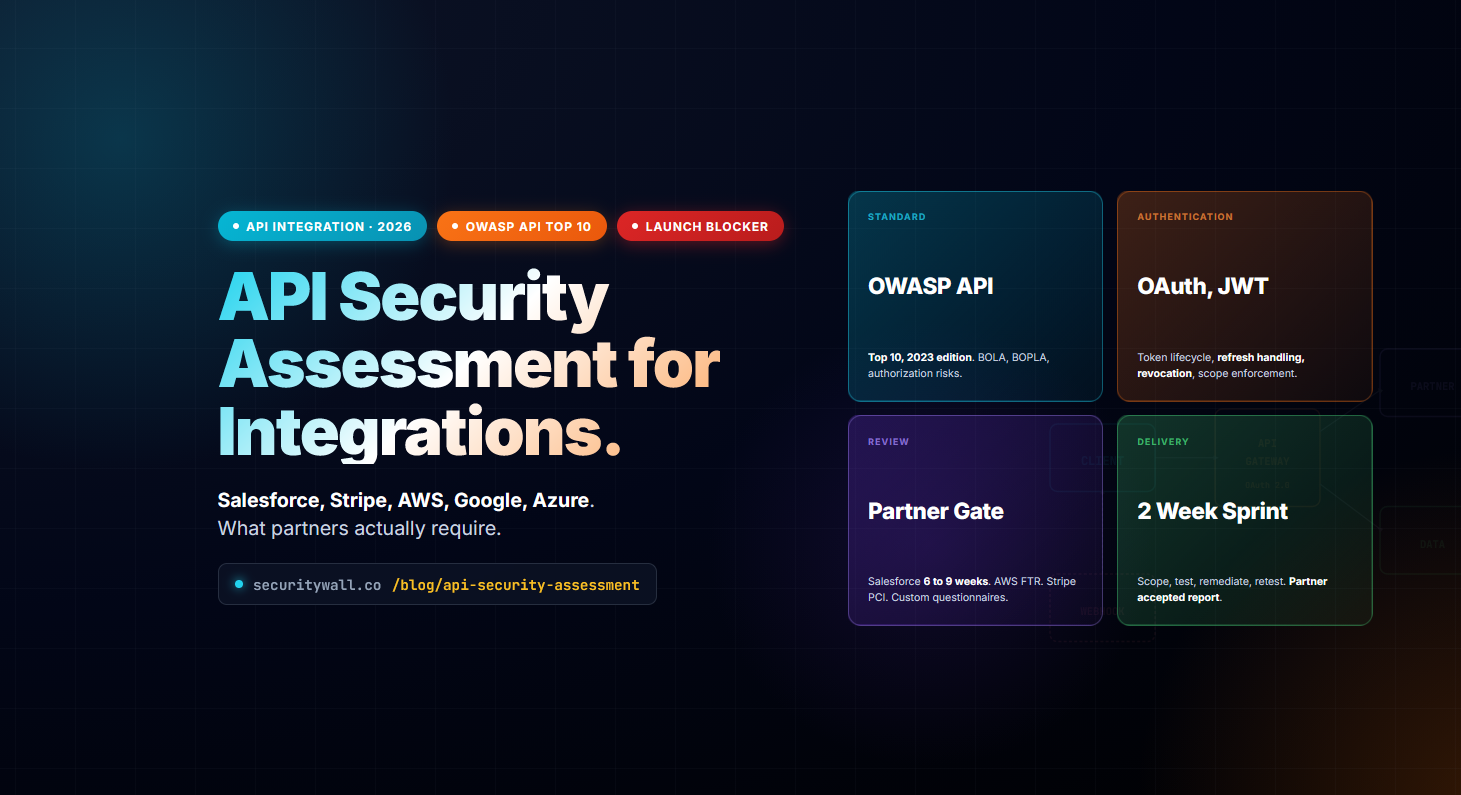

An API security assessment for a partner integration is a scoped penetration test of the specific API surface your integration exposes, mapped to OWASP API Security Top 10 (2023), the partner platform's own security requirements, and any regulatory frameworks that apply (PCI DSS, GDPR, SOC 2). It covers authentication and authorization (OAuth 2.0, API keys, JWT), rate limiting and abuse prevention, input validation and injection, error handling and information disclosure, encryption in transit and at rest, webhook security, and third party component vulnerabilities. Partner platforms including Salesforce AppExchange, Stripe, AWS Marketplace, Google Cloud Marketplace, Microsoft Azure Marketplace, Shopify, and HubSpot each require some form of security sign off before an integration goes live. Depending on the partner, the review can take 2 to 10 weeks and the format of the security evidence matters as much as the underlying testing. A well scoped, OWASP mapped, credentialed pentest report delivered in 2 weeks is often the fastest path to unblocking a stalled integration launch.
| Partner Platform | Security Requirement | Typical Review Window |
|---|---|---|
| Salesforce AppExchange | Third party pentest, Checkmarx static, OWASP ZAP or Burp or Qualys dynamic, mapped to OWASP Top 10 | 6 to 9 weeks initial |
| Stripe | PCI DSS compliant integration (SAQ level depends on card data handling) | Variable by SAQ level |
| AWS Marketplace SaaS | AWS Foundational Technical Review (FTR), SOC 2 or ISO 27001 for higher tiers | 2 to 6 weeks |
| Google Cloud Marketplace | Security review, SOC 2 or ISO 27001 for higher tier commercial offerings | 4 to 8 weeks |
| Microsoft Azure Marketplace | Security review, Microsoft 365 certification for higher tier | 4 to 10 weeks |
| Shopify App Store | App review including security checks, Built for Shopify has stricter tier | 5 to 10 business days |
| HubSpot App Marketplace | App review with data handling and OAuth security requirements | 2 to 4 weeks |
Requirements verified from partner developer documentation. Timelines observed across recent SecurityWall engagements. Partner programmes change; always confirm current requirements with the partner's developer relations team before scoping.
Every SaaS company that reaches product-market fit eventually runs into the same barrier. A large customer, or a strategic partner platform, asks for a security assessment before they will accept the integration. The request rarely arrives from procurement or legal. It arrives from a security engineer or a partner review team, and it stops the integration cold until a specific artefact lands in their inbox.
This article covers what that assessment actually is, what partner platforms are looking for, what the scope and report must contain, and how to compress the timeline from months to weeks without cutting the depth that makes the report acceptable. If you are also preparing for the broader enterprise buyer security review that follows integration launch, our companion guide on how to pass a vendor security assessment covers the questionnaire response and trust package side. For scope, methodology, and cost of API testing itself, our API penetration testing scope, methodology, and cost guide goes deeper on the technical side.
Why API Integrations Trigger Security Assessment Requirements
Partner platforms and enterprise buyers require security assessments for integrations for the same underlying reason: your integration becomes their attack surface. When Salesforce lists a managed package on AppExchange, when Stripe processes payments through your integration, when AWS Marketplace fulfils a SaaS subscription through your API, when Shopify approves an app that accesses merchant orders, the partner platform is extending its own trust to your code. If your integration has a security flaw, the partner platform's customers pay for it and, indirectly, so does the partner.
Payment platforms. Stripe operates as a PCI Level 1 Service Provider and requires businesses accepting payments to maintain their own PCI compliance calibrated to the volume and directness of card data handling. Direct card handling can trigger over 300 PCI DSS controls. Custom Connect flows and higher volume integrations often require additional attestation.
Marketplace platforms. AWS Marketplace requires the Foundational Technical Review (FTR) for SaaS listings, with SOC 2 or ISO 27001 becoming effectively mandatory at higher tiers. Google Cloud Marketplace, Microsoft Azure Marketplace, and specialised marketplaces from Snowflake, Databricks, and others operate similar programmes.
ISV programmes. Salesforce AppExchange runs one of the most rigorous programmes in the industry, combining static analysis (Checkmarx CxSAST, Salesforce Code Analyzer), dynamic testing (OWASP ZAP, Burp Suite, Qualys since the retirement of Chimera in June 2025), and manual review across eight categories defined in the ISVforce Security Review guidelines. Initial reviews typically take 6 to 9 weeks. The submission fee is $999 per attempt for paid apps.
Enterprise procurement. Enterprise buyers integrating your product into their tech stack apply the same third party risk programme they apply to any vendor. The security questionnaire (SIG Lite, SIG Core, CAIQ, VSAQ, or a custom template) trails the integration. Even when the deal is otherwise closed, security review can stall the go live.
The common thread across all of these is that the partner or buyer is looking for the same kind of evidence: a scoped, credentialed, OWASP mapped security assessment of the integration surface, delivered in a format their reviewers can consume without translation work.
What a Security Assessment for API Integration Covers
The technical scope of an integration security assessment is calibrated to the OWASP API Security Top 10 (2023), because every partner platform's own security team references the same framework. A defensible assessment covers each of the following areas.
Authentication. OAuth 2.0 flows are tested end to end: authorisation code issuance, token exchange, refresh handling, and revocation. API keys are examined for scope, storage, and rotation. JWT implementations are tested for algorithm confusion, signature verification, expiration handling, and claim validation (our free JWT analyzer tool can be used for pre-engagement self-check). API2:2023 (Broken Authentication) is one of the most consequential findings in an integration context because it maps directly to the partner platform's user trust boundary.
Authorisation. Broken Object Level Authorization (BOLA, API1:2023) is consistently the highest impact category in API testing. Every endpoint is tested to confirm that a user can only access objects they are entitled to, with tenant isolation enforced across every data path. Broken Object Property Level Authorization (BOPLA, API3:2023) is tested by attempting to read or write fields that should be filtered out for the current user role or context. Broken Function Level Authorization (API5:2023) is tested by attempting to invoke admin or privileged endpoints as a lower privileged user.
Rate limiting and resource consumption. Unrestricted Resource Consumption (API4:2023) is tested by attempting to exhaust the API through payload size, query complexity, concurrency, and expensive operations. Rate limits, quotas, and payload caps are validated at the endpoint level. This category is especially important for integrations because a resource exhaustion issue at your API is an availability issue at the partner platform.
Input validation and injection. All input surfaces are tested against injection categories: SQL, NoSQL, command, LDAP, XML external entity, template injection, and prompt injection where the API touches an LLM. Mass assignment is tested by attempting to write protected object properties through the API contract.
Business logic abuse. Unrestricted Access to Sensitive Business Flows (API6:2023) is tested by walking each business flow that has monetary or trust consequences and attempting to abuse it at scale or out of intended sequence.
Server side request forgery (SSRF). API7:2023 is tested at every endpoint that accepts URLs, hostnames, or references to internal services.
Security misconfiguration. API8:2023 is examined across TLS configuration, HTTP headers, CORS policy, error handling, verbose error messages, and any exposed administrative endpoints or debug interfaces.
Inventory and third party consumption. API9:2023 (Improper Inventory Management) is tested by looking for undocumented, deprecated, or shadow endpoints. API10:2023 (Unsafe Consumption of APIs) is tested where your integration itself consumes upstream third party APIs.
Webhook security. Webhook signing, replay protection, timing tolerance, and receiver validation are tested. Webhooks are a frequent finding source because they are often built quickly and left un-hardened.
Most integration launch delays are not caused by exotic vulnerabilities. They are caused by evidence that does not match what the partner reviewer expects to see. A general web app pentest report does not satisfy an OWASP API mapped review requirement. Discovering this after submission adds weeks to the launch.
Book a Pre Integration Scoping Call →The Integration Security Checklist Partners Actually Check
Beyond the OWASP mapping, partner reviewers apply an operational checklist of controls that reflect the specific risks of integration code. This is the layer that catches vendors who wrote a technically clean API but did not think about the integration lifecycle.
Authentication flow documentation. A written description of your OAuth 2.0 flow, token lifetime policy, refresh token rotation policy, and revocation mechanism. Reviewers verify the description matches the tested behaviour.
Least privilege scopes. OAuth scopes must be defined granularly and requested minimally. An integration that requests admin scope when it only needs read access to two objects is a failure category on most partner reviews.
Secret handling. How API secrets, client secrets, signing keys, and integration credentials are stored, rotated, and revoked. Storage in application config files or committed to source control is a fail. Our free API key exposure checker is a useful pre-engagement self-check.
Tenant isolation. For multi tenant integrations, evidence that data isolation is enforced at every data access path, not just at the API gateway. This is where BOLA and BOPLA findings often surface.
Logging and audit. What integration activity is logged, where the logs go, how long they are retained, and how they are protected. Personally identifiable information leakage into log lines is a common finding.
Error handling. No verbose error responses that leak stack traces, database schema, internal hostnames, or environmental information. Standardised error format across the API.
Rate limiting. Per client, per endpoint, and global limits with clear documentation of the limit values and the client response format when limits are hit.
Webhook verification. Signed webhooks with documented signature algorithm, timing tolerance, and replay protection.
Dependency inventory. Software bill of materials for third party components, with a documented process for tracking vulnerabilities in dependencies.
Deprecation and versioning policy. How API versions are announced, deprecated, and eventually retired. Old versions left running are a common inventory finding.
What the Security Report Must Include for Integration Approval
A pentest report that will clear a partner review has specific structural requirements. Reports that lack these elements typically fail on first read, regardless of the underlying quality of the testing.
Clear scope statement. The integration API surface actually tested, the endpoints and authentication flows exercised, and any surfaces explicitly excluded. Ambiguity here fails on submission.
OWASP API Top 10 (2023) coverage matrix. Each of the ten categories must appear in the report, including categories where no vulnerability was found. Reviewers check for coverage first and detail second. Absence of a category makes them assume it was not tested.
Named credentialed testers. OSCP, OSWE, CREST, CRT, or equivalent verifiable credentials on the testers. Anonymous or uncredentialed reports fail Salesforce AppExchange review and are treated with scepticism elsewhere.
Methodology reference. A named framework the testers followed. OWASP Web Security Testing Guide, OWASP API Security Testing methodology, PTES, or CREST aligned methodology. The methodology must be appropriate to the API target.
Findings with proof. Description, reproduction steps, evidence (request and response captures or screenshots), CVSS v3.1 severity rating, business impact statement, and remediation recommendation.
Retest confirmation. For critical and high severity findings, documented retest confirming remediation. A report with open critical findings is treated as a red flag by any partner reviewer.
Executive summary calibrated to the reviewer. A partner review team lead has 20 minutes, and the executive summary is what they read.
Partner platform mapping. For Salesforce AppExchange, the report should map findings to the AppExchange review categories. For PCI in scope integrations, findings should map to PCI DSS requirements. For SOC 2 in scope, mapping to Common Criteria. This mapping is what reduces the reviewer's workload and speeds approval.
Timeline: Getting Integration Security Sign Off in 2 Weeks
The 2 week window below assumes a standard API scope of up to 40 endpoints across one authentication flow. Larger scopes extend proportionally.
Days 1 to 2. Scoping call, statement of work, kick off. The scope document specifies the endpoints in scope, the authentication flow, test accounts, testing windows, deliverables, and retest inclusion. Written commitment to OWASP API Top 10 (2023) coverage and to the partner platform requirements you are targeting.
Days 3 to 10. Active testing. Automated tooling supports manual expert testing across authentication, authorisation, injection, business logic, and misconfiguration categories. Daily communication on critical findings so remediation can begin in parallel with continued testing.
Days 11 to 13. Draft findings delivered, remediation of critical and high findings by your engineering team, retest of remediated items, final report drafted.
Day 14. Final report delivered with the OWASP coverage matrix, partner platform mapping, and retest confirmations included.
Compressing this timeline further is possible for smaller scopes, and extending it is necessary for larger ones. What is not negotiable is the OWASP mapping, the credentialed testing team, and the retest of critical and high findings. Skipping any of these three loses more time in partner review than it saves in testing. For organisations running frequent integrations, a penetration testing as a service (PTaaS) retainer often works better than a one-off engagement.
Common Integration Security Issues SecurityWall Finds
The recurring patterns below are what SecurityWall observes across API integration engagements. Each maps to at least one OWASP API Top 10 (2023) category and each has blocked integration launches.
Tenant identifier trust. APIs that trust a tenant or organisation identifier passed in the request without server side verification against the authenticated principal. Classic BOLA. Present in a material share of engagements.
Over scoped OAuth applications. Integrations that request admin scope when they only need read access to a small object set, because the developer copied a template. Partner reviewers flag this immediately.
Refresh token misuse. Refresh tokens with excessive lifetime, no rotation, or accepted after logout. Frequently found and easily missed by generic web app testing.
JWT algorithm confusion. APIs that accept both RS256 and HS256 signed tokens and can be tricked into treating a public key as an HMAC secret. Present in older or vibe coded integrations. Our JWT security testing analyzer guide walks through the full test methodology.
Mass assignment through partial updates. PATCH or PUT endpoints that accept full object payloads and allow writing to fields the client should not be able to modify. BOPLA territory.
Webhook replay. Webhooks with signing but without timestamp verification or nonce tracking, allowing replay of past events. Common finding in payment integrations.
Verbose error messages. Stack traces, database error messages, internal hostnames, and version numbers returned in error responses. Small individually, additive to reviewer scepticism.
Undocumented staging endpoints. Staging or debug endpoints exposed on production infrastructure. Inventory finding under API9:2023.
If you cannot confidently answer yes to all six, your report is likely to trigger a follow up cycle that adds weeks to launch.
- Is the pentest report scoped to the integration API surface specifically, not a general web application scope?
- Does the report explicitly cover OWASP API Security Top 10 (2023) with every category addressed, including where no finding was found?
- Are authentication findings mapped to your OAuth 2.0 flow with token lifecycle explicitly tested?
- Does the report include rate limiting, resource consumption, and abuse prevention findings under API4:2023?
- Are named testers with OSCP, OSWE, or CREST credentials listed and verifiable?
- Does the report include retest confirmation on every critical and high finding?
Frequently Asked Questions
Do I need a pentest for an API integration? For any integration with Salesforce AppExchange, AWS Marketplace, Google Cloud Marketplace, Microsoft Azure Marketplace, or an enterprise customer applying third party risk management, yes. Salesforce AppExchange explicitly requires a third party penetration test alongside its own automated scanning. Enterprise buyers request a pentest report as part of the vendor security assessment. Payment integrations may require PCI attested testing rather than a general pentest. For smaller partner integrations, the requirement varies but the trend across 2026 is toward tighter evidence expectations.
How long does an API security assessment take? Two weeks is realistic for a standard API scope (up to about 40 endpoints and one authentication flow) when you engage a credentialed provider immediately. Larger scopes and multi flow integrations extend proportionally. Anything materially faster than 8 to 10 working days for the technical work is a signal that the depth is not there.
What is the difference between API security testing and a full pentest? An API pentest focuses on the API surface: authentication, authorisation, data flow, business logic, rate limiting, injection, and webhook security, mapped to OWASP API Security Top 10 (2023). A full application pentest additionally covers the web UI, the mobile app if applicable, and often the network or cloud infrastructure. For integration approval, the API pentest is usually the specific artefact required. For SOC 2 or vendor assessment, a broader scope is typical.
What format do integration partners accept for security reports? A structured PDF containing executive summary, scope statement, methodology reference, named credentialed testers, OWASP category coverage matrix, findings with evidence and CVSS v3.1 ratings, business impact per finding, remediation guidance, retest confirmation on critical and high findings, and mapping to relevant partner requirements. Vulnerability scanner outputs are not accepted as pentest reports by any major partner platform.
Does the assessment cover both our API and the partner's? The assessment covers your side of the integration: the API you expose, the authentication flow you implement, and the way your integration consumes the partner's API (API10:2023 Unsafe Consumption of APIs). The partner platform is out of scope for your testing. Your report demonstrates that your integration does not introduce risk to the partner's platform.
How much does API integration security testing cost? For a standard API scope, engagements typically run US$5,000 to US$15,000 including scoping, testing, retest, and partner mapping. Larger scopes with multiple authentication flows or high endpoint counts run higher. This compares against the opportunity cost of a delayed integration launch, which is usually materially larger, and against Salesforce AppExchange resubmission fees of $999 per attempt when a submission fails on security grounds.
Related reading:
Tags
About Babar Khan Akhunzada
Babar Khan Akhunzada leads security strategy, offensive operations. Babar has been featured in 25-Under-25 and has been to BlackHat, OWASP, BSides premiere conferences as a speaker.