
Penetration Testing Cost FAQ: SOC 2, ISO 27001, PCI DSS
Babar Khan Akhunzada
August 24, 2026
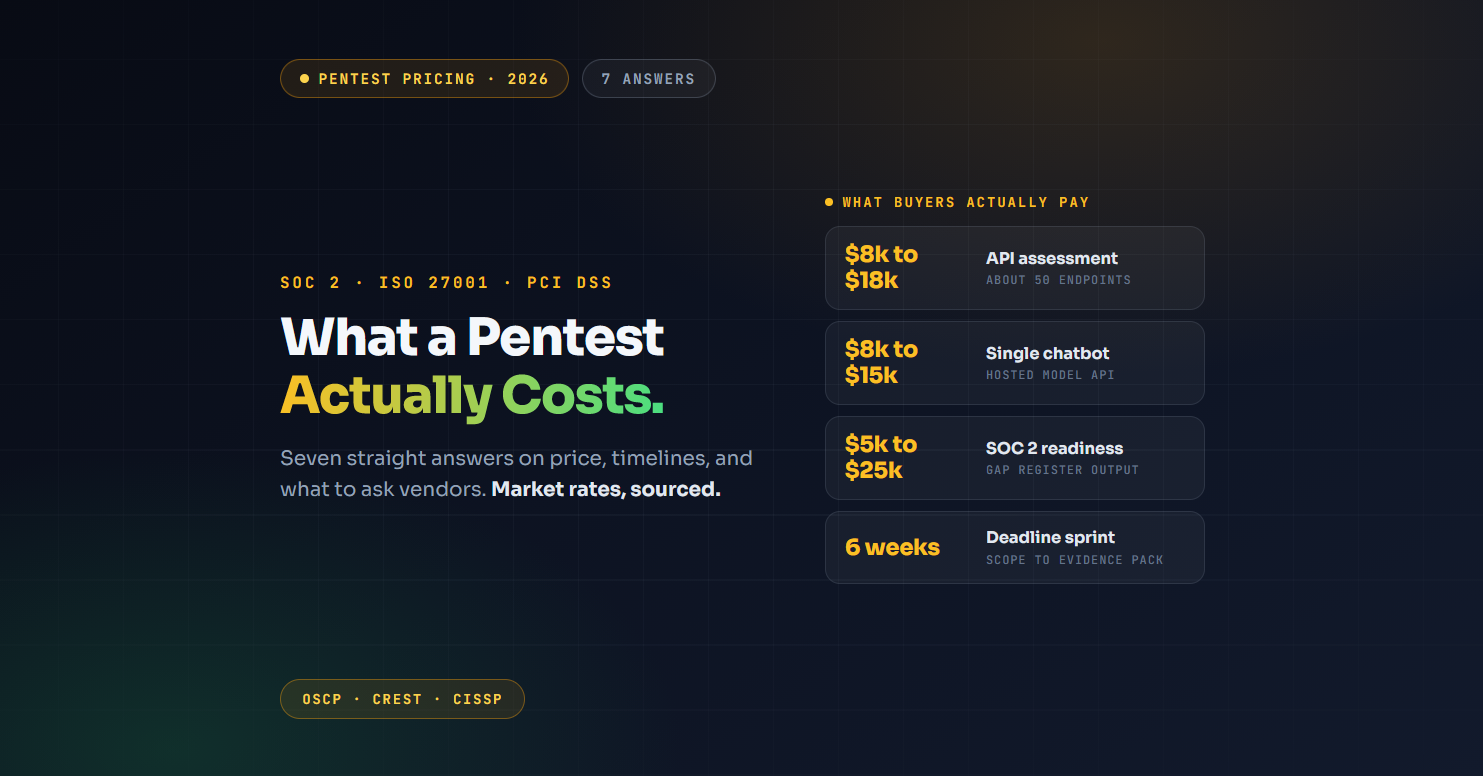
Every answer below is direct and self contained. Ranges are market rates from published sources, listed under each answer. SecurityWall quotes fixed scope in a call rather than posting a price list, so treat these as budget planning bands, not quotes.
What does a penetration test cost, generally?
Most commercial penetration tests in 2026 land between US$6,000 and US$50,000, with the majority of web and API engagements between US$10,000 and US$35,000. A frequently repeated market average of roughly US$18,000 exists, but averaging this market describes almost nobody, because the same scope on paper routinely returns quotes that differ by five times.
The reason is that price is set by delivery model far more than by scope. One human consultant days run roughly US$1,000 to US$3,000 each. Multiple scope engagement have specialists and it exceed more than one pentester. Multiply the day rate and by humans involved and realistic engagement length and you get a better estimate than any published average.
| Engagement Type | Typical 2026 Range | What Actually Drives the Price |
|---|---|---|
| Web application | $5,000 to $30,000 | User roles, tenants, payment flows, SSO, file upload paths |
| API | $8,000 to $25,000 | Authorisation complexity, not endpoint count |
| External network | $4,000 to $12,000 | Live host count and service exposure |
| Internal network | $8,000 to $30,000 | Active Directory size, segmentation, number of sites |
| Mobile application | $5,000 to $20,000 | Platform count, offline storage, certificate pinning |
| Cloud configuration review | $6,000 to $20,000 | Account count and service sprawl |
| LLM and AI systems | $8,000 to $40,000 | Tool access, retrieval, agent autonomy |
| Full red team | $30,000 to $150,000 | Objectives, duration, physical and social scope |
Bands compiled from published 2026 pricing guides including BD Emerson, Blaze Information Security, Simbian, Synack and BSG. Ranges are a starting map for budgeting, not a quote for your scope.
Two line items decide whether a cheap quote stays cheap. Retest inclusion typically adds 10 to 20 percent when bundled, or gets sold back later at a day rate. Authenticated role coverage is the other: a quote that never asks how many user roles and tenants you have is a quote for unauthenticated scanning. Anything priced near US$2,000 is almost always a vulnerability scan with a cover page, which is a different product solving a different problem.
Our penetration testing cost guide breaks the drivers down further.
Basis — Ranges aggregated from published 2026 vendor pricing guides. Day rate figures from BD Emerson and Simbian. No figure on this page is a SecurityWall price.
How much does an API security assessment cost for about 50 endpoints?
For roughly 50 endpoints, budget US$8,000 to US$18,000 for a competent grey box assessment. The upper end applies when you have several user roles, multi tenancy, or endpoints that touch payments or personal data.
The counterintuitive part: endpoint count is one of the weakest predictors of API pentest price. Fifty endpoints exposing one role and one tenant is a small job. Fifty endpoints across four roles and two tenant types is a large one, because object level and function level authorisation testing is a matrix. Each additional role multiplies the number of access combinations a tester has to check by hand, and that manual authorisation work is where the serious findings live.
What actually moves your quote, in order of weight:
- Roles and tenants. Proper multi tenant isolation testing needs at least two tenants under the tester's control.
- Authentication mechanism. OAuth flows, JWT handling, API keys and session tokens each carry their own test set.
- Documentation quality. A current OpenAPI spec or Postman collection can cut a day or more off discovery. Time spent reverse engineering your API is time not spent finding vulnerabilities, and you pay for both.
- Business logic depth. Payment, provisioning and quota endpoints need scenario testing, not signature checks.
Bring the spec, the role matrix, and a test tenant to the scoping call and the quote tightens immediately. Details on methodology are in our API penetration testing scope and cost guide and on the API penetration testing service page.
Basis — API band of $8,000 to $25,000 published by BD Emerson, 2026. The narrower 50 endpoint estimate reflects the lower half of that band for a single product with standard role complexity.
A twenty minute scoping call converts these ranges into a fixed number for your actual environment. Bring your endpoint list, role matrix, or system description.
Book a free scoping call →How much does an LLM or chatbot penetration test cost?
A single customer facing chatbot built on a third party model API costs roughly US$8,000 to US$15,000 to test properly. Published market anchors put simple chatbot audits around US$8,000 to US$15,000, focused single agent engagements at US$16,000 to US$50,000, and enterprise multi agent systems up to US$75,000 or more.
The jump in price is not about model size. It is about what the system is allowed to do.
| System Type | Typical Range | What Gets Tested |
|---|---|---|
| Chatbot on a hosted model API | $8,000 to $15,000 | Prompt injection, jailbreaks, system prompt leakage, output handling |
| RAG application | $12,000 to $30,000 | Adds retrieval poisoning, vector store exposure, untrusted context |
| Single tool using agent | $16,000 to $50,000 | Adds tool abuse, permission escalation, action chaining |
| Multi agent or MCP ecosystem | $30,000 to $75,000 | Adds cross agent trust, orchestration abuse, server boundaries |
Ranges compiled from published 2026 AI red teaming pricing from Repello AI, AI Vyuh, BD Emerson and Schellman. Schellman publishes a stated floor of $16,000 for a single AI red team engagement.
The market here is young, so scrutinise methodology harder than price. A credible quote names the standards it tests against, typically the OWASP Top 10 for LLM Applications and MITRE ATLAS, and states clearly whether tool calling, retrieval, and multi turn attacks are in scope or sold as separate modules. Ask for one worked example of a chained finding, not a list of refused prompts. Background is in our LLM penetration testing guide and LLM security audit cost breakdown.
Basis — Chatbot floor from AI Vyuh published pricing and pentesttesting.com 2026 guide. Single agent minimum from Schellman published rate card. Upper bands from Repello AI vendor pricing analysis, May 2026.
I need a PCI DSS pentest for card payments. What should I ask vendors for?
PCI DSS is the one framework on this page that does not make you read between the lines. Requirement 11.4 states plainly that you must perform internal and external penetration testing on a defined cadence, using a documented methodology, and test your segmentation controls. The v4.x future dated requirements became mandatory on 31 March 2025, so assessors are enforcing the detail now.
Incorrect scoping is the single most common reason a PCI pentest fails QSA review. Send vendors this list and reject anyone who cannot answer all seven in writing.
| Ask For | Why It Matters | Requirement |
|---|---|---|
| Named methodology document | Must cite an industry accepted approach such as NIST SP 800-115 or OWASP | 11.4.1 |
| Both internal and external testing | One layer alone is a partial engagement and a QSA finding | 11.4.2, 11.4.3 |
| Explicit CDE scope listing | Named IP ranges, hostnames and URLs. The phrase "the CDE was tested" is insufficient | 11.4.2 |
| Segmentation validation testing | Tests from every out of scope segment toward the CDE, at network and application layer | 11.4.5, 11.4.6 |
| Correct segmentation cadence | Annual for merchants, every six months for service providers | 11.4.5, 11.4.6 |
| Retest of exploitable findings | Evidence the exploit no longer works. A closed ticket is not evidence | 11.4.4 |
| Tester availability to your QSA | Assessors ask methodology questions during fieldwork | Practice |
Sub requirement numbering per PCI DSS v4.0.1, Requirement 11.4. Your tester does not need to be a QSA or ASV, but organisational independence and demonstrable methodology are expected.
One warning worth internalising: failed segmentation testing does not just produce a finding, it expands your CDE. Systems you had scoped out get pulled back in, and your assessment grows. Test segmentation early in the compliance cycle, not the week before your QSA arrives. Full detail sits in our PCI DSS penetration testing requirements guide and the PCI DSS compliance page.
Basis — PCI DSS v4.0.1 Requirement 11.4 sub requirements. Mandatory date of 31 March 2025 for future dated v4.x requirements per PCI Security Standards Council.
Bring your QSA's timeline to the call. We scope backwards from the assessment date so segmentation testing and retest both land before fieldwork opens.
Book a free scoping call →Will my ISO 27001 or SOC 2 auditor accept an automated or PTaaS pentest report?
Yes for human led PTaaS. Usually no for fully autonomous scanner output.
Auditors do not assess delivery format. They assess whether the evidence demonstrates independent evaluation of your controls. A platform delivered report that carries scope reconciliation, a named methodology, credentialed testers, control mapping and retest evidence satisfies that test just as well as a consultancy PDF, and often better, because it can show remediation across a whole observation period rather than on one day.
What fails is scanner output wearing a PTaaS label. If a provider cannot show you one finding with a working proof of exploit and a named tester attached, your auditor will classify the artifact as vulnerability scanning under CC7.1 rather than as an evaluation under CC4.1, no matter what the cover page says.
The same logic applies on the ISO side. Annex A 8.8 and A.8.29 are the controls in play, and ISO/IEC 27002:2022 implementation guidance references penetration testing directly. Missing evidence against an applicable control is a routine path to a Stage 2 nonconformity. The full clause by clause treatment is in our ISO 27001 and SOC 2 penetration testing guide, and SLASH is the human led PTaaS model referenced above.
Basis — AICPA TSP Section 100 criteria CC4.1 and CC7.1. ISO/IEC 27001:2022 Annex A 8.8 and 8.29 with ISO/IEC 27002:2022 implementation guidance.
What is a SOC 2 readiness assessment, and do I need one before the audit?
A SOC 2 readiness assessment is a structured review of your existing controls against the Trust Services Criteria your auditor will test, run before you engage that auditor. It is not required. It is also the single cheapest insurance available on a SOC 2 programme.
The output that matters is a gap register: every missing or deficient control mapped to a named owner and a remediation deadline. That register drives the following ten to twelve weeks. Without it, teams fix the loudest problems and miss the structural ones.
Market pricing for a readiness or gap engagement sits around US$5,000 to US$25,000 depending on scope, and it is normally billed separately from the audit even when a firm bundles both into one contract. Skipping it rarely saves money, because gaps found during fieldwork are remediated on the auditor's clock rather than yours.
Timing rule: start readiness three to six months before you want the observation period to open, not after you have signed an engagement letter. Companies that walk into fieldwork with a completed gap register close audits faster and with fewer exceptions. See our SOC 2 readiness assessment guide and SOC 2 gap analysis for the control by control version.
Basis — Readiness and gap assessment band of $5,000 to $25,000 published by Drata and soc2auditors.org, 2026. Timing guidance from published auditor side commentary, May 2026.
My SOC 2 deadline is in 6 weeks. Can a pentest be booked and delivered in time?
Yes, for a scoped single application or API engagement, with two conditions: you start scoping this week, and you accept that remediation of anything critical happens in parallel rather than after.
Six weeks is tight but workable. It is not workable if you also need a readiness assessment, or if your scope covers multiple applications plus an internal network. Here is the honest calendar.
Three things make or break the schedule. Credentials on day one, because a tester waiting for a test account burns billable days. Live critical reporting, so remediation starts in week two rather than week four. A retest that is already in the contract, because negotiating one at week five is how deadlines get missed.
One timing rule specific to SOC 2 Type II: the test should fall inside your observation window. A report dated before the window opens is a fine security exercise and a weak audit artifact. If your window has not opened yet, that changes the sequencing, and it is worth ten minutes on a call to get right.
Basis — Turnaround reflects a scoped single application or API engagement. Type II observation window guidance derives from the period based nature of a Type II opinion under AICPA attestation standards.
Turn a range into a number
Bring your audit date, your scope, and your endpoint or asset list. You leave the call with a fixed price, a delivery date, and a clear answer on whether your timeline is realistic.
Book a free scoping call →How to read any pentest quote
Across all seven questions above, the same four line items separate a quote you can trust from one you cannot. Ask every vendor to state each one explicitly in writing:
- Is retest included, and for how long after delivery?
- How many authenticated roles and tenants are in scope, and who provides the accounts?
- Which methodology standard is named in the report?
- Will findings be mapped to my framework's control numbers, or will my team do that mapping?
A vendor who answers all four in the proposal is quoting an engagement. A vendor who answers none is quoting a scan. SecurityWall offers fulfilled engagement with complementary add-ons included.

Twenty minutes with your scope and audit date gives you a fixed price and a delivery window.
Book a scoping call →Tags
About Babar Khan Akhunzada
Babar Khan Akhunzada leads security strategy, offensive operations. Babar has been featured in 25-Under-25 and has been to BlackHat, OWASP, BSides premiere conferences as a speaker.