
SOC 2 Readiness Assessment: Free Tool, Instant Score
Hisham Mir
May 23, 2026
You are about to spend $20,000 to $80,000 on a SOC 2 audit. Before you sign the engagement letter, the cheapest insurance you can buy is finding out, in advance, whether you are actually ready for it. SOC 2 audits do not refund failed attempts. Auditors do not pause their billing because your controls were not where you said they were. And the gap between "we are pursuing SOC 2" and "we are audit-ready" is, in our experience, a 4-to-6-month remediation programme not the two-week sprint most founders assume.
A SOC 2 readiness assessment is the diagnostic that closes that gap. It scores your current controls against the AICPA Trust Services Criteria, surfaces the specific gaps between where you are and where the auditor will expect you to be, and gives you a defensible remediation roadmap before any audit fees come due.
This guide explains what a readiness assessment is (and is not), how to choose between a free self-assessment and a consultant-led gap analysis, what the score actually means at each range, and what to do once you have it. It is written for the founder, CTO, or compliance lead about to commit to a SOC 2 programme who wants to walk into the first auditor conversation with data, not guesses.
If you are still working out the basics of SOC 2 itself, start with our plain-English guide to SOC 2 compliance and come back to this when you are ready to find out where you stand.
- What a SOC 2 Readiness Assessment Is — and What It Isn't
- Self-Assessment vs Consultant-Led Gap Analysis — Which First?
- What SecurityWall's Free Readiness Assessment Covers
- How to Take the Assessment
- How to Interpret Your Score — What Each Range Actually Means
- What to Do After Your Assessment — The Three Paths
- How This Compares to Vanta, Drata, and Cyberday
What a SOC 2 Readiness Assessment Is and What It Isn't
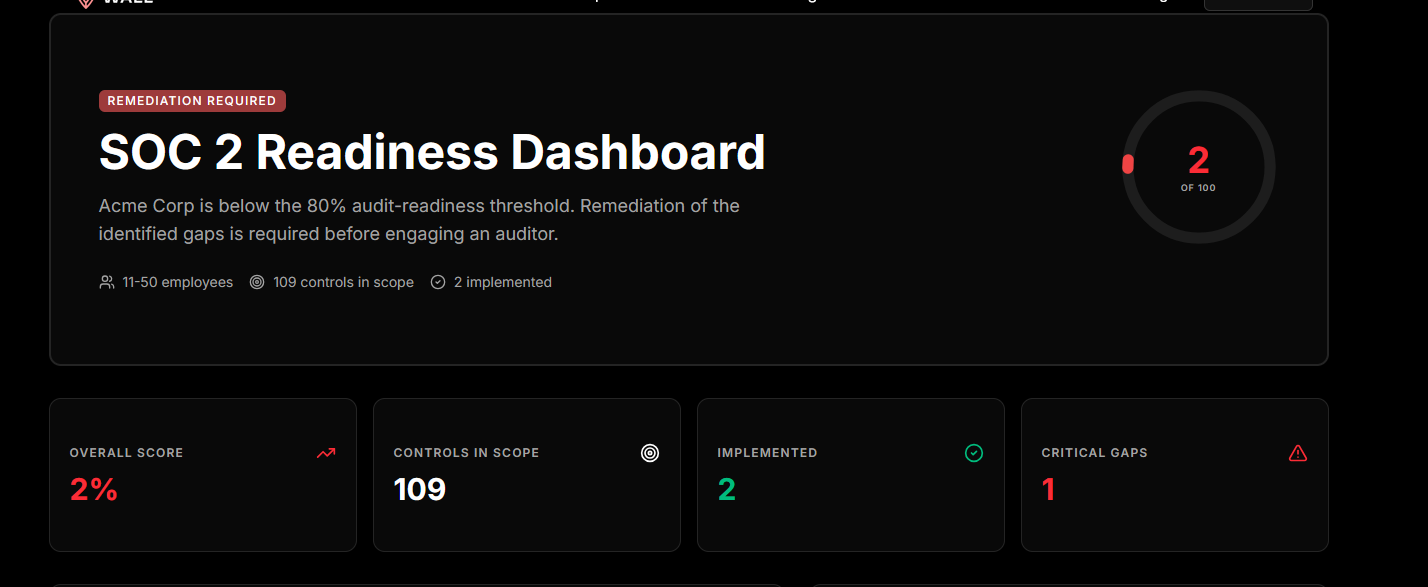
A SOC 2 readiness assessment is a structured comparison of your current controls against the AICPA Trust Services Criteria, conducted before you engage an auditor. It produces three outputs: where you stand today (weighted score), what is missing (critical gap list), and how far from audit-ready you are (remediation roadmap).
It is the step that prevents wasting $20,000 to $80,000 on a SOC 2 audit you are not ready to pass.
What It Is
- A diagnostic — designed to surface gaps, not certify their absence
- Scored against the same Trust Services Criteria the eventual auditor will use
- Granular — control-by-control rather than domain-level only
- Pre-engagement — completed before the auditor signs an engagement letter
- Actionable — produces a roadmap the engineering team can execute against
What It Is Not
- Not a SOC 2 audit. It does not produce an opinion letter, an AoC, or anything you can hand to a customer
- Not a substitute for a QSA or CPA firm. Formal SOC 2 validation requires an independent licensed audit firm
- Not a one-time fix. Even a clean readiness score requires remediation execution to maintain
- Not the same as a vendor security questionnaire response. Those are customer-facing; this is internal preparation
Why Skipping It Costs You
SOC 2 audits are not refundable. The auditor's clock starts the day they begin fieldwork, and finding out mid-audit that your access reviews have not been documented, your change management process has gaps, or your monitoring lacks formal alerting does not stop the billing. It just produces a qualified opinion or a failed audit that you then need to remediate and re-test.
Companies that engage auditors before a structured readiness assessment routinely run 50–100% over budget on their first SOC 2. The cost of finding out you are not ready during the audit is meaningfully greater than the cost of finding out before.
Self-Assessment vs Consultant-Led Gap Analysis — Which First?
There are two distinct ways to assess readiness, and they answer different questions. Most companies should do them in sequence, not in parallel.
A self-assessment like SecurityWall's free SOC 2 Readiness Assessment is a 10-minute browser-based exercise that gives you a directional score across the 12 control domains. It surfaces obvious gaps, anchors your starting position, and produces an executive summary suitable for sharing with a board or investor.
A consultant-led SOC 2 gap analysis is a 1-to-3-week engagement involving structured interviews, evidence sampling, configuration review, and a formal written report. It produces specific, evidenced findings and a prioritised remediation roadmap.
The two are not interchangeable. They do different work at different scales.
When to Self-Assess First
Self-assessment is the right starting point in three situations:
- You have no baseline — you are not sure where to even begin
- You need board or investor evidence that compliance preparation is underway
- You are deciding whether a formal gap analysis is worth commissioning and need a directional score to make that call
If your self-assessment score lands below 60%, you have substantial work ahead of you and a formal gap analysis is the next step. If it lands above 75%, you may be close enough to audit-ready that a pre-audit review is more useful than a gap analysis. The score itself tells you which path to take.
When to Skip Straight to Gap Analysis
Skipping the self-assessment makes sense when:
- You have already done one recently and the findings are still actionable
- You have an audit engagement letter signed with a date within 8 weeks, and need detailed findings fast
- Your board or investors require a third-party assessment specifically self-attestation is not sufficient
For most other situations, the right sequence is: free self-assessment first, gap analysis if the score warrants it, audit engagement when remediation is complete.
What SecurityWall's Free Readiness Assessment Covers
The free SOC 2 Readiness Assessment scores your organisation against 200+ controls organised into 12 domains mapped to the AICPA Trust Services Criteria.
The 12 Domains
The assessment covers the full breadth of SOC 2 Common Criteria, including:
- Control Environment and Governance
- Risk Assessment and Management
- Information and Communication
- Monitoring of Controls
- Logical and Physical Access Controls
- System Operations
- Change Management
- Vendor and Third-Party Management
- Incident Response and Recovery
- Data Classification and Protection
- Privacy and Confidentiality
- Availability and Resilience
How the Scoring Works
The scoring is weighted, not flat controls under Common Criteria 6 (logical access) and Common Criteria 7 (system monitoring and detection) carry more weight than controls under areas that auditors typically scrutinise less aggressively. The output reflects how auditors actually assess maturity, not just how many boxes are ticked.
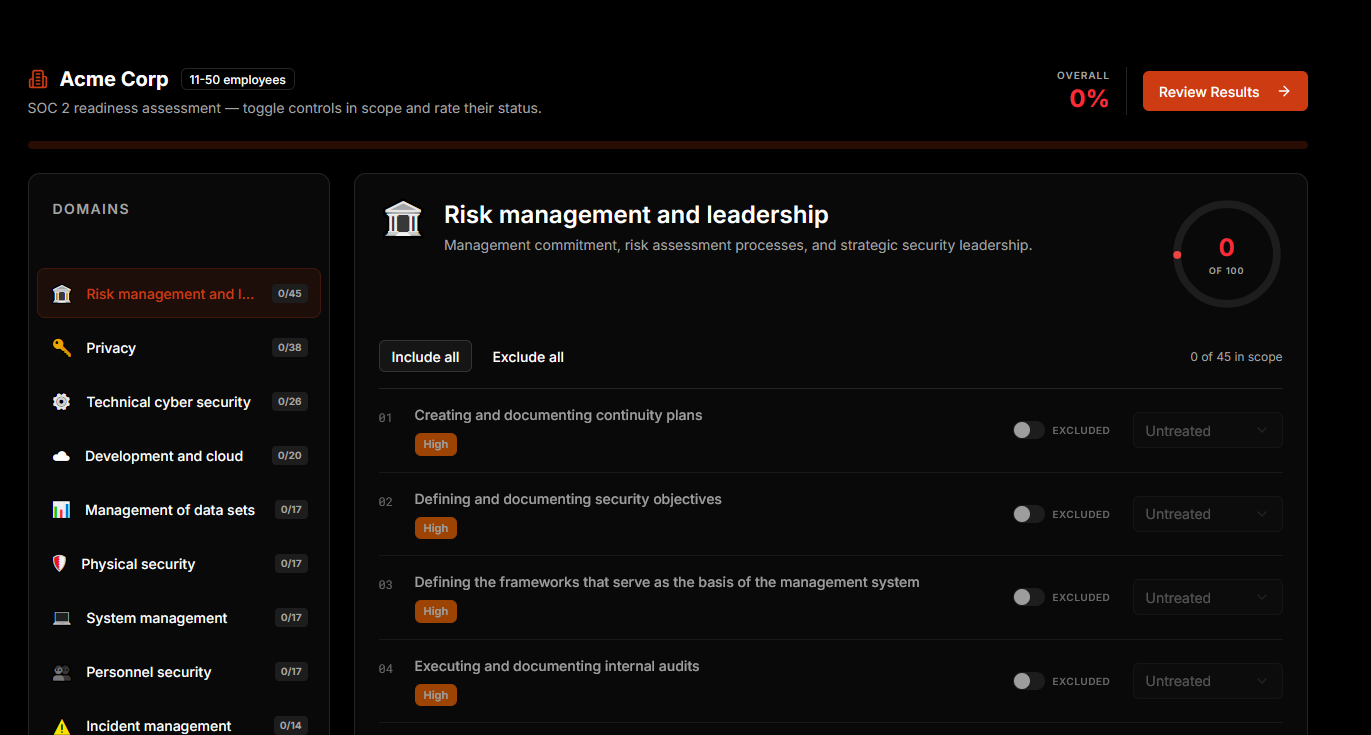
For each control, you indicate:
- Yes the control is implemented and you have evidence
- Partial the control is partially implemented or evidence is incomplete
- No the control is not in place
- Not applicable with the requirement to justify the exclusion
What You Receive
On completion, the tool produces three artefacts:
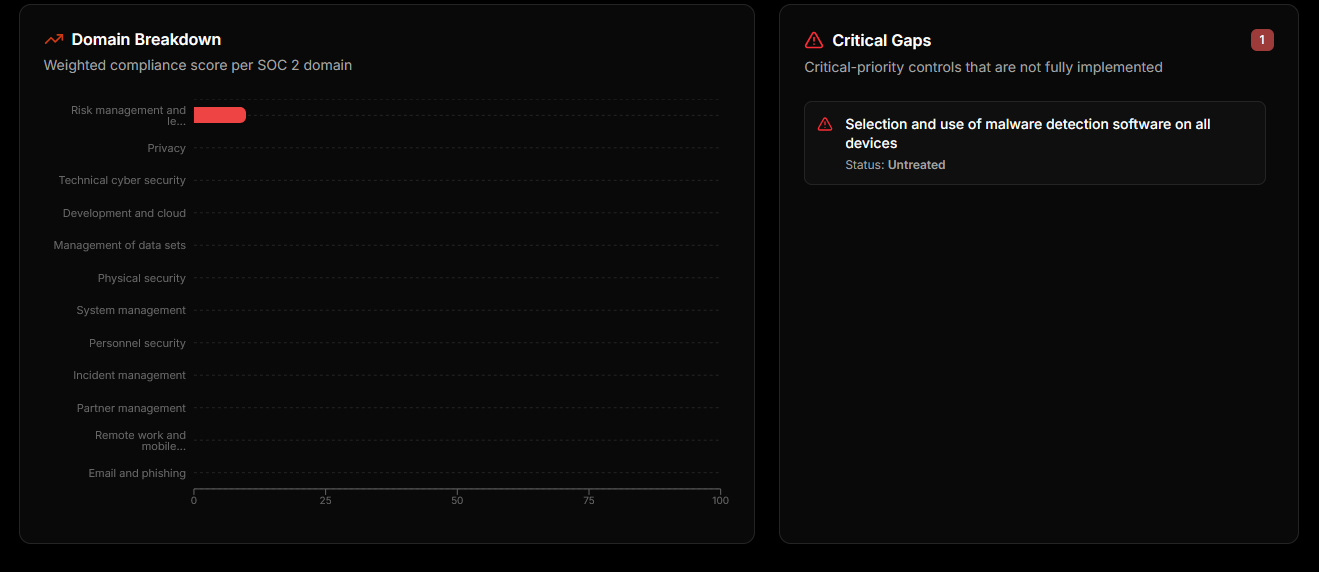
- A weighted compliance score broken down by domain so you can see exactly which areas need the most work
- A critical gap list showing the specific controls flagged as gaps
- An executive auditor summary with a remediation roadmap, formatted for sharing with executives, the board, or investors
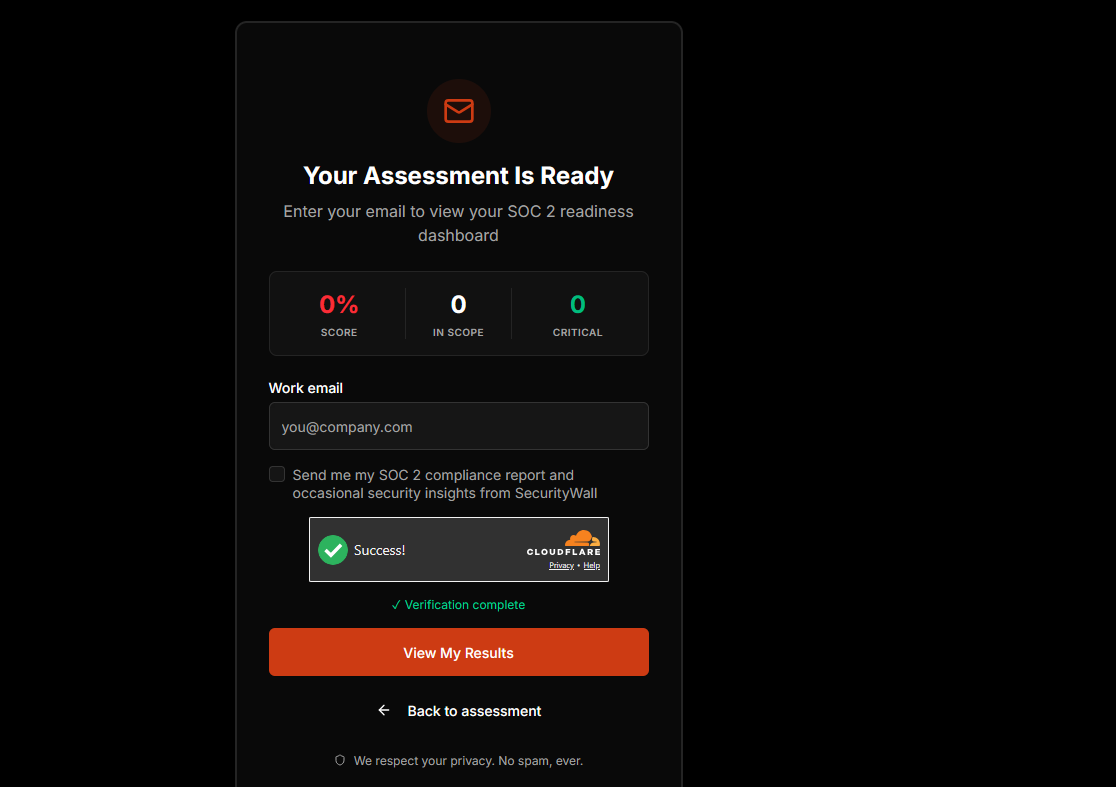
Everything runs in your browser. No sign-up. No email harvested. No data leaves your device. The tool is designed for compliance leads who need a defensible baseline before they commit to spending not for software vendors looking to capture leads in exchange for a score.
Ready to find out where your controls stand? Take the free SOC 2 Readiness Assessment — 200+ controls, instant scoring, executive summary you can share with your board. No sign-up required.
How to Take the Assessment
The assessment is designed for one person to complete in about 10 minutes typically the CISO, head of engineering, or compliance lead. Two practical notes before you start.
Have These Tabs Open
The assessment moves faster if you have direct access to:
- Your identity provider admin console (Okta, Google Workspace admin, Azure AD)
- Your cloud provider console (AWS, Azure, GCP) for IAM and logging visibility
- Your HR or onboarding tool (Rippling, BambooHR, etc.) for access provisioning workflow
- Your existing security policy documentation if you have one for governance answers
You will not need to upload anything. The questions are answerable by someone who has working knowledge of how each of these systems is configured.
Answer Honestly — Especially on Partial Implementations
The most useful score is the most accurate one. The temptation to mark a control as fully implemented when it is "mostly implemented" produces a flattering score and a useless roadmap. The Partial option exists precisely for the controls that are functioning but lack evidence, documentation, or consistency.
A SOC 2 auditor will mark those same controls as exceptions during fieldwork. Calibrating your self-assessment to the auditor's standard not to your most optimistic interpretation is the difference between a useful diagnostic and a vanity score.
What Happens at the End
When you finish, the tool produces your score and analysis immediately, in-browser. You can save the executive summary as a PDF, share it with internal stakeholders, or use it as the basis for an internal kickoff meeting on your SOC 2 programme. Nothing is sent to SecurityWall unless you explicitly request follow-up.
How to Interpret Your Score — What Each Range Actually Means
The score is a directional indicator not a pass/fail grade. What matters is which band you land in, because each band implies a different next step.
0–40% — Pre-Implementation
Your control environment is largely informal or absent. This is the most common starting position for pre-Series-A SaaS companies and any organisation that has not previously tackled a security framework. Specifically:
- You likely lack formal policies, documented procedures, or consistent execution across security controls
- Access management is probably ad-hoc rather than provisioned through a documented process
- Logging exists but is not centralised or alerted on
- Change management may be tracked in pull requests but lacks formal approval gates
Do not engage an auditor yet. Engaging an audit firm at this stage wastes their time and your money. The path forward is a 4–6 month minimum control implementation programme usually with consultant support before readiness work can meaningfully begin.
40–65% — Foundation in Place, Significant Gaps
You have implemented foundational controls but have meaningful gaps that will surface during an audit. Common pattern:
- Policies exist but are not consistently followed in practice
- Access reviews happen but are not formally documented
- Logging is in place but alerting is incomplete
- Change management exists for production but not consistently for adjacent systems
Focus remediation on CC6 (logical access) and CC7 (monitoring and detection) first these are the criteria where SOC 2 auditors find the most consequential gaps, and the criteria most weighted in the readiness score. A formal gap analysis is the right next step.
65–80% — Most Controls Exist, Evidence Is Incomplete
You are closer to audit-ready than you think. The controls largely exist; the issue is that the evidence of their consistent operation is incomplete. Auditors classify this as a "documentation problem" rather than a "control problem" substantially easier to remediate.
Focus on policy documentation, formal evidence collection, and consistency across the audit period. If you are pursuing SOC 2 Type 1 first, you may be 6–10 weeks from audit-ready. For Type 2, you still need the observation period.
80%+ — Near Audit-Ready
You have a defensible control environment and the primary remaining gaps are evidence gaps specific controls where consistency or formal documentation is incomplete. Engage an auditor within 1–3 months. Use the remaining time to close evidence gaps, formalise documentation, and ensure consistency across the systems your auditor will sample.
What to Do After Your Assessment — The Three Paths
Your assessment score determines which of three paths is realistic for your organisation.
Path A — Score Below 50%: Formal Gap Analysis First
A self-assessment below 50% indicates substantial control work ahead. The right next step is a formal SOC 2 gap analysis 1-to-3-week consultant-led engagement that produces specific, evidenced findings and a prioritised remediation roadmap. From there:
- Remediation programme 3 to 6 months of control implementation
- Penetration testing once controls are in place
- Auditor engagement once readiness is confirmed
Total timeline: 6 to 12 months from gap analysis to first Type 1 report.
Path B — Score Between 50–80%: Prioritised Remediation
A mid-range score means the foundational work is done but specific gaps need targeted remediation. The right next step is a focused remediation programme typically scoped to the lowest-scoring 2–3 domains from your assessment followed by a pre-audit penetration test and auditor engagement. From there:
- Targeted remediation from 6 to 16 weeks depending on which domains
- SOC 2 penetration testing aligned to auditor expectations
- Auditor engagement once remediation is complete
Total timeline: 3 to 6 months from assessment to first Type 1 report.
Path C — Score Above 80%: Pre-Audit Review and Engagement
A high score means you are close to audit-ready. The right next step is a pre-audit readiness review usually 2–3 weeks to close evidence gaps, formalise final documentation, and ensure consistency. Then engage an auditor directly. From there:
- Pre-audit review and evidence formalisation 2 to 4 weeks
- Penetration testing if not already conducted in the past 12 months
- Auditor engagement begins
Total timeline: 4 to 8 weeks from assessment to auditor engagement. See our SOC 2 services page for end-to-end audit readiness support.
The score is the navigation tool. The three paths exist because the right next investment is fundamentally different depending on where you start.
How This Compares to Vanta, Drata, and Cyberday
The free SOC 2 Readiness Assessment is one option in a growing market of SOC 2-related tools. Buyers regularly ask how it compares to compliance automation platforms like Vanta and Drata, or to GRC platforms like Cyberday. The short answer: they solve different problems at different stages of the journey.
Versus Compliance Automation Platforms (Vanta, Drata)
Vanta, Drata, and similar platforms are continuous compliance automation systems typically priced from $10,000 to $30,000+ per year that integrate with your cloud accounts, identity provider, HR systems, and code repositories to continuously collect evidence for your audit. They are designed for the audit period itself and for ongoing compliance maintenance. They are excellent at what they do.
They are not designed to give you an instant baseline before you have committed to the programme. They are post-decision tooling you subscribe once you have decided to pursue SOC 2 and want automation to manage the work.
SecurityWall's tool is the diagnostic that comes before the platform decision. It helps you decide whether you need a compliance platform at all, and if so, what specifically the platform needs to manage.
Versus GRC Platforms
GRC platforms handle the ongoing management of multiple compliance frameworks SOC 2 plus ISO 27001 plus HIPAA, for example with workflow tooling, evidence management, and audit coordination. They are typically subscription products aimed at organisations running several frameworks in parallel.
Like the compliance automation platforms, GRC platforms are post-decision tooling. They are valuable once you have decided to pursue multiple frameworks and need infrastructure to manage them. They are not the right answer to "should I pursue SOC 2 yet, and how far am I from being able to."
Versus Consultant-Led Gap Analyses
Consultant-led gap analyses including our own SOC 2 gap analysis service are 1-to-3-week engagements with structured interviews, evidence sampling, and a formal report. They are the natural step after a self-assessment confirms you have meaningful gaps and need detailed findings to act on.
The right sequence for most companies is straightforward: self-assessment first (10 minutes, free), gap analysis second (1–3 weeks, paid) if the score warrants it, compliance platform third if continuous automation makes sense for your team. Each layer answers a different question. Skipping straight to the platform layer without a baseline is how companies end up paying $20,000/year for tooling that automates evidence collection for controls they have not actually implemented.
Related reading:
- What Is SOC 2 Compliance? A Plain-English Guide for SaaS Companies in 2026
- SOC 2 Type 1 vs Type 2: Which One Do You Actually Need?
- SOC 2 Gap Analysis: What It Covers and How to Prepare
- SOC 2 Penetration Testing Requirements: What Auditors Expect
- SOC 2 Penetration Testing Cost: What to Budget
- Best Free SOC 2 Tools in 2026
Frequently Asked Questions
What is a SOC 2 readiness assessment?
A structured comparison of your current controls against the AICPA Trust Services Criteria, completed before you engage an auditor. It produces a weighted score, a gap list, and a remediation roadmap. It is not an audit it is the diagnostic that tells you whether commissioning an audit is worth the spend yet.
How is a readiness assessment different from a SOC 2 audit?
A readiness assessment is internal preparation; an audit is formal validation by an independent licensed CPA firm. The readiness assessment helps you find and close gaps. The audit produces the report you share with customers, investors, and partners. You complete the readiness assessment to prepare; you complete the audit to validate.
Is SecurityWall's SOC 2 readiness assessment really free?
Yes. No sign-up, no email required, no data collected. Your assessment runs entirely in your browser. The executive summary is yours to download, share, or ignore as you choose. SecurityWall makes money from gap analysis, penetration testing, and audit readiness consulting not from the free assessment.
How accurate is a 10-minute self-assessment?
Directionally accurate, not audit-grade. The assessment is calibrated to surface meaningful gaps and produce a reliable band (pre-implementation, foundation, near-ready, audit-ready). It is not a substitute for the rigorous evidence sampling a formal gap analysis or auditor performs. Treat the score as a navigation aid it tells you which next step is realistic, not whether you will pass a specific audit on a specific date.
After the assessment, do I have to use SecurityWall's services?
No. The assessment is genuinely free and independent. The output is yours to use however you like including engaging a different consultant or going it alone. We provide gap analysis, penetration testing, and audit readiness consulting because that is the natural next step for many companies, but there is no commitment.
Can the assessment tool replace Vanta or Drata?
No and it is not trying to. Vanta and Drata are compliance automation platforms for ongoing evidence collection during your audit period. Our tool is a one-time diagnostic before you have committed to any compliance platform. Both can have a role: assess yourself first to baseline, then decide whether continuous automation tooling makes sense for your team.
What is the next step after taking the assessment?
It depends on your score. Below 50%: commission a formal gap analysis. Between 50–80%: targeted remediation followed by penetration testing and auditor engagement. Above 80%: pre-audit review and direct auditor engagement. The article above walks through each path in detail. If you want SecurityWall to help with any of these stages, a 30-minute scoping conversation produces a scoped engagement proposal within 24 hours.
Tags
About Hisham Mir
Hisham Mir is a cybersecurity professional with 10+ years of hands-on experience and Co-Founder & CTO of SecurityWall. He leads real-world penetration testing and vulnerability research, and is an experienced bug bounty hunter.