
Buying a Nessus Licence vs Scan Service: Cost Comparison
Muhammad Khizer Javed
July 22, 2026
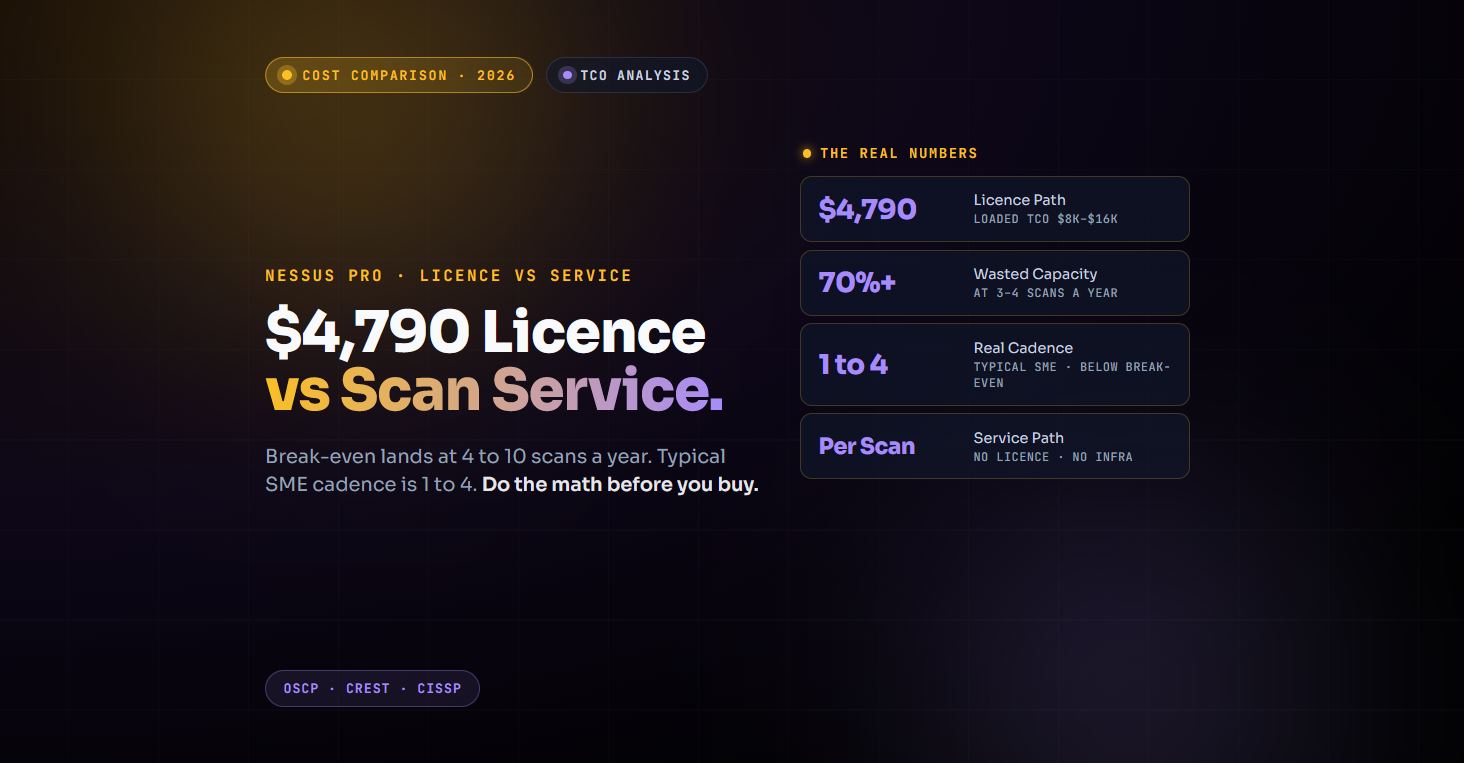

Tenable Nessus Professional costs $4,790 per year for a single scanner with unlimited target IPs (Tenable published pricing, verified July 2026). Real total cost of ownership including scanner infrastructure, analyst time to interpret findings, compliance framework mapping, and reporting typically runs $8,000 to $15,000 in year one for an SME. A per-engagement scan service quote from a credentialed provider typically sits materially below the licence break-even for organisations running 4 or fewer scans per year, which is the operating pattern most SMEs actually run. The break-even math is honest: if you scan monthly, the licence pays for itself. If you scan quarterly, annually, or on compliance triggers, the service model wins. This article breaks down both cost structures with transparent assumptions, the break-even calculation, the non-financial factors that shift the decision, and how SecurityWall's per-engagement scan service is structured.
Scanning 4 Times a Year or Less? Skip the $4,790 Licence.
Per-engagement vulnerability assessment with CIS Benchmarks, PCI DSS, SOC 2, and ISO 27001 mapping included. No annual commitment, no infrastructure to run, no analyst time to hire. Concrete quote given in the 30 minute scoping call.
This article uses transparent cost inputs so buyers can adjust the math for their own scale. We distinguish clearly between verified published figures and reasonable market estimates:
Verified: Nessus Professional annual price of $4,790 (Tenable official pricing, July 2026). Nessus Essentials free tier with 16 IP limit and no compliance auditing. Nessus Vulnerability Management as enterprise contact-only pricing.
Estimated with disclosure: scanner infrastructure hosting cost ($300 to $800 annually for a small VM), analyst interpretation time (5 to 15 hours per scan cycle at market SME rates), compliance framework mapping effort (10 to 25 hours annually), report writing (2 to 8 hours per scan). Ranges reflect variance across SME contexts.
Not published here: SecurityWall's specific per-engagement pricing. Concrete quotes are given in the scoping meeting because they depend on scope, framework coverage, and turnaround. What we can say: for SME scopes running fewer than 4 scans a year, the service model reliably comes out under the loaded TCO of a Nessus Pro licence.
Buying decisions around vulnerability scanning are almost always framed as licence-versus-nothing. The founder Googles "Nessus cost", sees $4,790, does a rough gut check on whether the compliance requirement or enterprise procurement pressure justifies it, and either buys or delays. What almost nobody in that decision path considers is that there is a third option, and for the operating cadence most SMEs actually run, that third option is materially cheaper.
This article compares two cost structures honestly. Nessus Professional licence with all the loaded costs of running it. And per-engagement scan service where you pay for the report you need, when you need it, without the annual commitment. The math is transparent, the assumptions are disclosed, and the decision framework at the end is meant to help buyers pick correctly for their own scale rather than default to the tool everyone tells them to buy.
The Two Cost Structures Compared
Nessus Professional is sold as an annual subscription. Once purchased, you pay a fixed cost regardless of how many scans you actually run. The economic unit is calendar time, not scans. Whether you run one scan or fifty, the licence cost is the same.
Scan service is sold per engagement. Each scan is scoped, priced, and delivered as a discrete unit. The economic unit is scans, not calendar time. If you run one scan you pay for one. If you run five, you pay for five.
The implication is straightforward. If you run enough scans in a year, the fixed cost of the licence divided across scans becomes lower than the per-engagement price. If you do not, the fixed cost is being amortised across too few scans and each one is expensive on a per-report basis.
The break-even point sits at whatever number of scans makes the two costs equal. Below that number, service model wins. Above it, licence wins. The rest of this article is about finding that break-even for your context.
Nessus Pro Total Cost of Ownership in Year One
The advertised price is not the operating cost. Nessus Professional at $4,790 per year is the licence line item. Actually running Nessus in production requires several other cost inputs that buyers routinely underestimate at procurement time.
Licence. $4,790 per year for a single scanner with unlimited target IPs. Verified from Tenable's published pricing page in July 2026. This is the visible cost.
Scanner infrastructure. Nessus needs to run somewhere. A dedicated VM in AWS, Azure, or GCP sized appropriately for scanning workloads runs $300 to $800 annually depending on cloud, region, and usage pattern. On-premises deployment substitutes hardware capex and internal ops cost for cloud opex, roughly equivalent over a three-year window.
Analyst interpretation time. A raw Nessus report from a typical SME environment produces 200 to 800 findings before triage. Turning that into a defensible remediation plan requires a security engineer or knowledgeable IT lead to work through the findings, dismiss false positives, contextualise real ones, and prioritise remediation. Market rate for this work in the SME segment is 5 to 15 hours per scan cycle. At $100 to $200 per hour loaded rate, that is $500 to $3,000 per scan cycle in analyst time.
Compliance framework mapping. If the scan needs to produce evidence for SOC 2, ISO 27001, PCI DSS, or another framework, someone has to map findings to control identifiers, write the compliance mapping narrative, and package the report in an auditor-acceptable format. 10 to 25 hours annually is typical.
Reporting time. Nessus produces a technical report. Executives, auditors, and boards need a summary they can actually read. Producing that summary from raw Nessus output takes 2 to 8 hours per scan.
Year one total for a typical SME: $4,790 licence + $500 infrastructure + $2,000 to $6,000 analyst time (across 3 to 4 scan cycles) + $1,500 to $4,000 compliance mapping + $500 to $2,000 reporting. Loaded TCO lands in the $8,000 to $15,000 range for organisations actually using the tool the way procurement teams expect.
| Organisation Profile | Scans Per Year | Trigger | Model Fit |
|---|---|---|---|
| Seed stage startup | 1 or 2 | SOC 2, VC diligence | Service |
| SaaS SME (pre Series A) | 2 or 3 | SOC 2 Type II cycle | Service |
| PCI Level 4 merchant | 4 | PCI DSS quarterly requirement | Break even |
| Mid market SaaS | 6 to 8 | Continuous cycle plus change | Break even |
| Enterprise regulated | 12+ | Monthly plus event triggered | Licence |
| MSP or consultancy | 50+ across clients | Recurring per engagement | Licence |
Cadence patterns observed across SecurityWall SME engagements. Individual context varies; use as a starting point, not an absolute rule.
Scan Service Cost Structure Per Engagement
Per-engagement scan service uses a different economic structure. Each scan is a scoped, priced, delivered unit. There is no annual commitment, no infrastructure to run, no capacity to underuse. What you pay for is the specific report you need for the specific scope you have.
A typical scan-service engagement includes several components bundled into the fixed fee.
Scoping meeting. A 30-minute call to agree scope, framework coverage, timeline, and deliverable format. This is the moment the price gets quoted, before any work starts.
Scan execution. External or internal vulnerability scanning against the agreed scope, using industry-standard tooling and methodology, with configuration calibrated to the compliance requirement (SOC 2, PCI DSS, HIPAA, ISO 27001, or others).
Findings triage and validation. Automated scanner output is triaged by a senior engineer to remove false positives, contextualise findings, and prioritise for remediation. The buyer receives a triaged report, not a raw scanner dump.
Framework mapping. Findings mapped to the relevant control identifiers in the compliance framework the buyer needs evidence for. This is what makes the report auditor-acceptable.
Report delivery and walkthrough. Written report plus a 30-minute walkthrough call to explain findings, prioritisation, and remediation guidance.
Retest. Once critical and high findings are remediated by the buyer, retest of those specific findings to confirm closure, included in the same engagement fee.
The specific SecurityWall price for a given engagement depends on scope, framework coverage, and turnaround urgency. What we can say publicly: for SME scopes in typical scan configurations, the per-engagement price sits materially below the annualised loaded TCO of a Nessus Pro deployment at 3 to 4 scans per year utilisation.
Most SMEs commit to a $4,790 annual licence expecting monthly scans, then run 3 or 4 in the first year and never renew. The unused capacity is wasted budget. Check your actual cadence before committing.
Schedule a Cost Comparison Call →The Break Even Calculation
The break-even math is straightforward once cost inputs are clear. Break-even sits at the number of scans where licence loaded TCO equals the total of per-engagement scan service prices for the same number of scans.
Working with round numbers for illustration. If the Nessus Pro loaded TCO for the year is approximately $10,000 (mid-point of the $8,000 to $15,000 range), and a scan service engagement is priced at approximately $1,500 for an SME scope, then break-even sits at approximately 7 scans per year.
Adjusting the inputs: at loaded TCO of $8,000 and service price of $800 (small scope), break-even is 10 scans. At loaded TCO of $15,000 and service price of $2,000 (larger scope with extra framework mapping), break-even is 7 or 8 scans. Across the plausible ranges of SME context, break-even consistently sits somewhere between 4 and 10 scans per year. Real observed SME cadence is 1 to 4 scans per year. The service model wins for the vast majority of SME contexts by design.
The math tells you what the market has been slow to acknowledge. The Nessus licence model is built for organisations running scans on a continuous or near-monthly cadence. It is being sold to buyers who scan quarterly or less. The pricing pressure this creates on SME budgets is not an accident. It is a mispriced fit.
Do the math for your context. Take your realistic scan cadence for the coming twelve months. Multiply by an estimated per-engagement service price (or request a quote in a scoping meeting for accurate figures). Compare to the loaded TCO of a Nessus Pro deployment. If your cadence is below break-even, service model is the correct commercial choice.
The Non Financial Factors
Cost is not the only variable. There are meaningful non-financial factors that should shape the decision in either direction.
Time to first report. Buying Nessus, provisioning infrastructure, and getting the first meaningful report through triage typically takes 4 to 8 weeks from procurement start. Scan service delivers a first report in 5 to 10 business days from scoping meeting. If you need a report in the next 30 days, the licence path does not close that timeline.
Analyst expertise access. Nessus produces findings. Turning findings into a defensible action plan requires expertise. Buying the licence does not buy the expertise. Scan service bundles expert triage into the engagement price. For teams without dedicated security engineering, this is the primary value delivered.
Framework mapping quality. Auditor acceptance depends on framework-mapped output. Raw Nessus reports are not framework mapped by default. Doing this internally takes hours per scan cycle. Scan service typically delivers framework mapping as standard.
Compliance evidence continuity. For SOC 2 Type II, evidence needs to span the review period. Whether that evidence comes from a licence-owned scanner or from a series of scan service engagements matters less than whether the evidence exists and is auditor-formatted.
Institutional knowledge retention. Running Nessus internally builds team capability. Buying scan service does not. For organisations planning to eventually staff a security engineering function, the licence path builds relevant muscle memory. For organisations that have decided security is not core, the service path is more efficient.
Change flexibility. Locking into an annual licence assumes your compliance requirements and scan scope will not change materially in the coming twelve months. In fast-moving companies, this assumption often breaks. Service model absorbs scope changes without penalty.
When Each Model Wins
Clean decision framework for buyers running the numbers on their own context.
Licence model wins when: your realistic scan cadence exceeds break-even (typically 5+ scans per year); you have in-house security engineering capacity to interpret findings and produce framework-mapped output; you need the same scanner configuration across many scans for consistency; you have an existing Nessus deployment and are considering renewal (sunk cost matters when integrations are built); you are an MSP or consultancy running scans as a service offering yourself.
Service model wins when: your realistic scan cadence is 4 or fewer scans per year; you need a report faster than a licence procurement timeline supports; you do not have in-house security engineering to triage findings; you need framework-mapped output for compliance and do not want to build the mapping capability internally; your compliance requirement is uncertain or evolving; you are running a one-off scope (SOC 2 audit, VC diligence, insurance renewal).
Both are wrong when: you need continuous asset discovery and real-time posture management. That is a different product category (Qualys VMDR, Rapid7 InsightVM, cloud-native scanners) that neither Nessus Pro nor per-engagement scan service directly solves. Do not use either as a substitute for continuous scanning at scale.
Answer honestly. If two or more answers point to service model, the licence commitment is very likely overpricing your actual usage.
- How many vulnerability scans did your organisation actually run in the last 12 months (not planned to run, actually ran)?
- Who on your team triages Nessus findings today, and how many hours per scan cycle does it take them?
- Does the report you produce today include framework mapping to SOC 2, PCI DSS, or ISO 27001 control identifiers?
- If you needed a compliance-ready scan report in 10 business days, could you produce one from your current setup?
- Is scanning something your team wants to own strategically, or is it a compliance line item you want handled?
- Have you compared the loaded TCO of your Nessus deployment to per-engagement service pricing at your actual scan cadence?
SecurityWall's Approach to Scan Service
SecurityWall's vulnerability assessment service is structured specifically for the SME operating pattern that the licence model does not fit. Fixed-fee per-engagement pricing. No annual commitment. No infrastructure to provision. Framework mapping to SOC 2, PCI DSS, ISO 27001, HIPAA, and other applicable frameworks included in the base engagement fee.
Concrete pricing is quoted in the 30-minute scoping meeting because it depends on scope size, framework coverage, and turnaround requirement. What is standard across every engagement: triaged findings (not raw scanner dumps), framework-mapped output, executive summary suitable for auditor or investor review, retest of critical and high findings once remediated.
For organisations running enterprise scanning at high cadence, we will honestly recommend buying the licence and running it internally. For SMEs, startups, and mid-market operators running realistic 1 to 4 scan cycles per year, the service model consistently comes out under the loaded TCO of a Nessus Pro deployment with less time investment and more direct compliance output.
Frequently Asked Questions
How do I calculate my break even? Take the loaded TCO of a Nessus Pro deployment for your context (baseline $4,790 plus 30 to 100% for infrastructure, analyst time, framework mapping, and reporting). Divide by the typical per-engagement service price for your scope (request a quote in a scoping meeting for accurate figures). The result is the number of scans per year where the two costs equal. Below that number, service wins. Above it, licence wins. For most SMEs, break-even sits between 4 and 10 scans annually, and real cadence is 1 to 4.
What if I scan monthly? At 12 scans per year, the licence model almost always wins. Loaded TCO of $10,000 to $15,000 divided by 12 scans is a per-scan cost of $800 to $1,250, which is typically at or below per-engagement service pricing. SecurityWall offer monthly scans with economical cost lower than the typical cost.
Do you offer subscription pricing for scan service? For organisations that want the convenience of pre-committed scanning without an annual licence, we do offer multi-engagement bundle pricing that mimics subscription economics without locking to a single tool. This is not our default sales motion but is available for buyers who prefer it. Discussed in scoping.
What about internal and external scanning? Both are supported. External scans run from our infrastructure against your public-facing scope. Internal scans require either agent-based tooling deployed by your team, VPN access, or an on-site scanner temporarily deployed. Scoping meeting confirms which model fits your environment.
Is scan service output accepted by auditors? Yes. SOC 2 auditors, PCI QSAs, and ISO 27001 assessors accept scan reports from credentialed third parties as evidence for the relevant vulnerability management controls. Framework mapping in the report is what makes it acceptable, not the specific scanning tool used.
Can I switch models later? Yes. Many buyers start with service model to bridge a specific compliance requirement or diligence event, then buy the licence when cadence grows. Others do the reverse when they realise they are not running enough scans to justify the licence. There is no lock-in either direction.
Related reading:
- Nipper Firewall Audit Cost 2026
- Free Nessus Report Visualizer: Understand Your Nessus Scans Instantly
- How to Read a Nessus Report: Results, Severity, Plugins Explained
- Nessus Report Remediation Steps
- Penetration Testing Cost Guide 2026
- Penetration Testing for SOC 2, ISO 27001 and PCI DSS 2026
- Vulnerability Assessment Services
Tags
About Muhammad Khizer Javed
Muhammad Khizer Javed is a member of the SecurityWall team, contributing expert insights on cybersecurity and penetration testing.