
Nipper Firewall Audit Cost 2026: What You Actually Pay
Hamza Razzaq
July 21, 2026
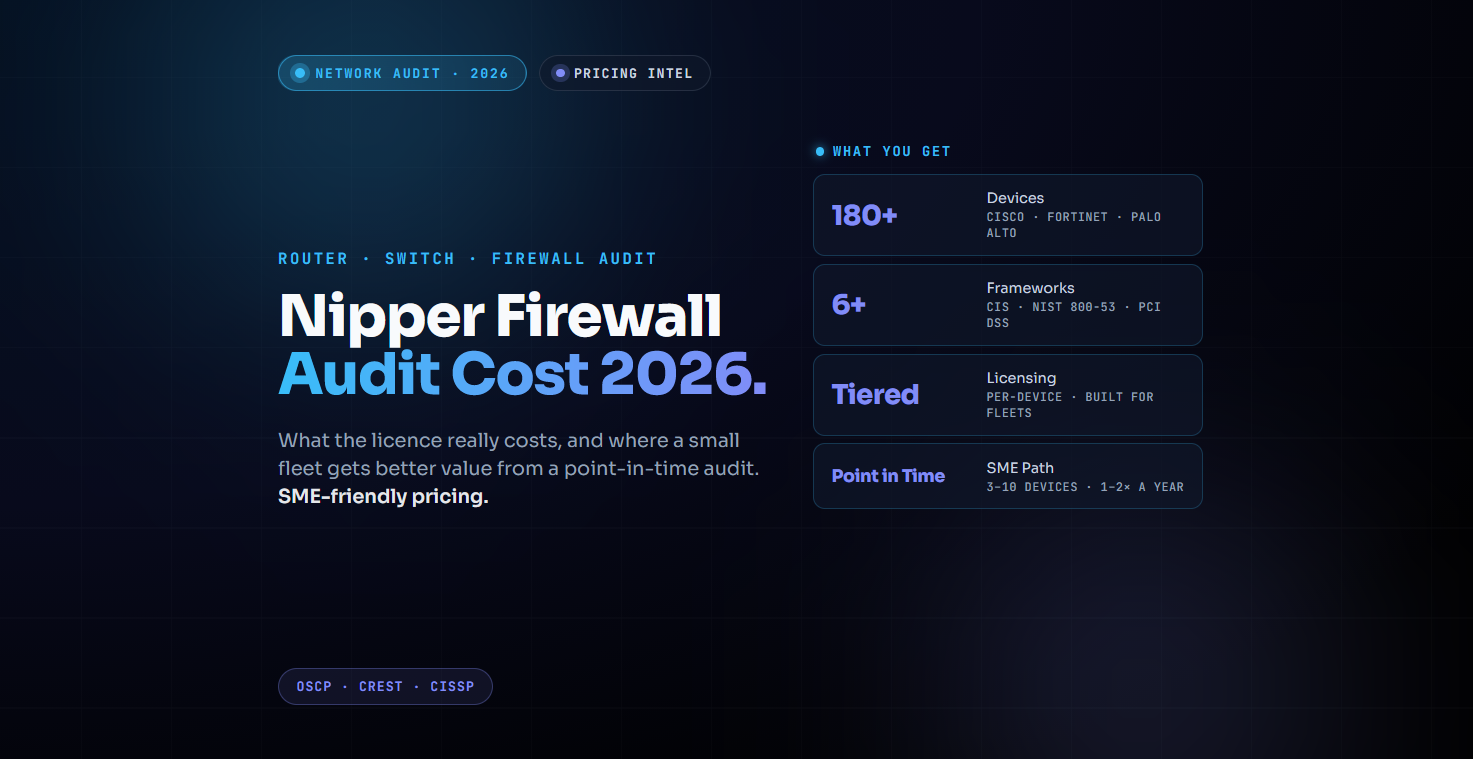

Titania Nipper is a network configuration audit tool used by 30+ US federal agencies and 800+ organisations globally to assess firewalls, routers, and switches against CIS Benchmarks, NIST 800-53, PCI DSS, CMMC, STIGs, and other frameworks. Titania does not publish official pricing. Market intelligence from Gartner Peer Insights, TrustRadius, and historical SC Media reviews indicates a tiered per-device model with volume discounts, structured around annual host counts commonly starting from meaningful fleet sizes. The licensing structure fits organisations auditing tens or hundreds of devices on a recurring cycle. Smaller organisations, SMEs, and startups with 3 to 10 core network devices, or one-off audit needs, frequently find Nipper's minimum licensing above their actual requirement. This is the gap SecurityWall's network configuration audit service addresses: router, switch, and firewall configuration review with CIS, NIST 800-53, and PCI DSS mapping, scoped to your actual device count and priced for SME budgets.
Nipper Costing Too Much? Get a Router, Switch, and Firewall Audit for Less.
CIS Benchmarks, NIST 800-53, PCI DSS mapping. Scoped to your actual devices, not to an annual license capacity you will not use. Concrete quote given in the 30 minute scoping call.
Titania Nipper does not publish official pricing. Every "Nipper cost" figure circulating online either comes from a direct sales conversation with Titania or from a legacy publication no longer maintained. To keep this article accurate, we distinguish clearly:
Cited market intelligence: SC Media's product test historically listed Nipper Studio at $40 per device down to $8.50 per device based on volume. TrustRadius reviewers report a tiered per-device annual model with fixed host counts. Gartner Peer Insights confirms tiered licensing based on device count or audit volume, with annual or perpetual license options.
What we do not claim: current specific price points, minimum device counts, or region-specific pricing. Titania's Sales team gives current quotes calibrated to buyer profile. Anything else is speculation.
Every emerging startup and firm network security buyer has run the same script. Looking for "Nipper pricing" land on Titania's product page. Read impressive features. Click "Request Quote". Fill in a lead form. Wait for a sales call. Compare the quote against a mental budget that has no market benchmark to check against. The pricing opacity is not accidental. It is a deliberate commercial design that works well for Titania and works less well for buyers with small or one-off requirements.
This article covers what Nipper actually is and what its licensing typically fits, what a Nipper-style network configuration audit report contains, when Nipper is the right tool and when it is overkill, and how organisations with smaller device fleets can get equivalent configuration audit coverage without a multi-year enterprise license. The commercial framing at the end is honest: SecurityWall's network configuration audit service exists specifically to serve organisations that Titania's licensing model does not naturally serve.
What Nipper Does and Why It Costs What It Does
Nipper is a network device configuration audit tool. It ingests configuration files from firewalls, routers, and switches (Cisco, Fortinet, Palo Alto, Juniper, SonicWall, and 180+ other vendors and models), analyses them against a curated ruleset, and produces a report of misconfigurations and security weaknesses. What makes Nipper distinctive is that it does this without touching the live device. Configuration files are exported by the operator and processed by Nipper offline, which makes it suitable for air-gapped environments and for use by external auditors who do not have network access to the devices being audited.
The commercial value Nipper sells is time. Titania's own marketing claims Nipper reduces audit times by up to 80% compared to manual review. For an internal audit team that runs 40 firewall configurations through the same review cycle every quarter, that time saving is material. For a Managed Security Service Provider running audits across dozens of clients, it is a competitive advantage. For a compliance consultancy tracking control effectiveness across a portfolio of engagements, it is a productivity multiplier.
The licensing model reflects this value proposition. Tiered per-device or per-audit annual subscriptions with volume discounts, and perpetual license options for buyers who prefer capex over opex. Titania's Nipper InfraSight product, launched to modernise the platform, uses a similar structure with additional capabilities around continuous monitoring and orchestration.
For organisations that fit the profile Titania designed for, Nipper's pricing is genuinely competitive versus manual audit hours or against alternatives like AlgoSec and Tufin. For organisations that do not fit that profile, Nipper's minimum licensing tier often exceeds the operational need.
Real Nipper Pricing: What Buyers Report Paying
The published third-party data on Nipper pricing is limited but consistent. SC Media's product test of Nipper Studio historically listed a range from $40 per device at low volume down to $8.50 per device at high volume. TrustRadius reviewers repeatedly note that licensing is calculated against an annual host count that does not flex easily when devices being audited change between years. Gartner Peer Insights confirms the tiered per-device model with annual and perpetual options.
Extrapolating from this published intelligence and combining it with more recent buyer conversations we have observed:
Small deployments with a handful of devices commonly find that Nipper's entry licensing tier includes more device capacity than they will realistically use in a year, resulting in effective per-device cost above the published unit ranges.
Mid-market deployments with recurring quarterly or continuous audit needs typically find Nipper's pricing efficient once device counts reach a critical mass and the audit cycle uses the full licensed capacity.
Enterprise and public sector deployments benefit from volume discounts, air-gapped deployment options, and integration with existing GRC and SIEM tooling. These buyers see the strongest ROI on Nipper licensing.
None of this constitutes a public price list. It reflects the pattern that emerges when you compare what Titania publishes officially (nothing), what third-party sources have historically reported (SC Media, TrustRadius, Gartner), and what buyers report anecdotally through reviews and community forums.
| Organisation Profile | Typical Device Fleet | Audit Cadence | Nipper Fit |
|---|---|---|---|
| Startup or seed stage SaaS | 1 to 3 firewalls, cloud native | Once yearly for compliance | Overkill |
| SME with hybrid infrastructure | 3 to 10 core devices | Annual or biennial | Overkill |
| Mid-market on-prem heavy | 15 to 40 core devices | Quarterly | Consider |
| Enterprise regulated industry | 50+ devices, multi-site | Continuous or monthly | Strong fit |
| MSSP or consultancy | 100+ across client base | Recurring per engagement | Strong fit |
| Public sector or critical infrastructure | Highly variable, air-gapped | Continuous with audit trail | Strong fit |
Fit assessment based on observed licensing structure and buyer feedback. Confirm current requirements with Titania Sales for your specific case.
What a Nipper Audit Report Actually Contains
A Nipper-generated report and, more broadly, a competent network configuration audit report of any kind, contains a specific set of artefacts that make it useful for security and compliance work.
Device inventory with configuration snapshots. Every audited device with model, firmware version, and the configuration date captured. This becomes the baseline for future audits and change tracking.
Finding-by-finding analysis. Each configuration weakness is listed with a description of what the configuration does, why it is a weakness, the specific configuration line or setting that creates the exposure, and the vendor-specific remediation. This is device-aware guidance, not generic advice.
Risk-based prioritisation. Findings are grouped and ranked so operators focus on high-impact remediation first. This addresses the classic problem of an audit report that lists 400 findings and leaves the operator unable to decide where to start.
Compliance framework mapping. Each finding is mapped to the control identifiers in the frameworks relevant to the buyer: CIS Benchmarks for the specific device type, NIST 800-53 controls, PCI DSS requirements, CMMC practices, DISA STIGs, and often industry-specific overlays.
Executive summary suitable for non-technical leadership. A CISO or a compliance lead needs to understand posture at a glance without reading 200 pages. The executive summary carries the risk verdict.
Suppression of low-value findings. A well-generated network audit report suppresses findings that are true positives on paper but not operationally relevant for the specific deployment. This is where mature tooling separates from raw scanners.
The key insight for a buyer evaluating audit deliverables is that these elements are what makes an audit report acceptable to a PCI QSA, an ISO 27001 assessor, an NCA reviewer, or an insurance underwriter. The tool that produces the report matters less than whether the report contains these elements.
Most SME network configurations are written by the same engineer who runs them. Independent review typically only happens when a compliance requirement forces it or an incident exposes it. Both are worse triggers than a planned audit cycle.
Schedule a Scoping Meeting →When Nipper Is Overkill (and What to Buy Instead)
The straightforward test is whether the total cost of a Nipper license divided by the number of audits you will actually run in the license period gives a per-audit cost lower than a point-in-time engagement with an external firm. For organisations that audit rarely, the calculation almost always favours the external engagement. For organisations that audit continuously, the calculation almost always favours the license.
Sub-5-device environments. A small SaaS with one edge firewall and one internal router does not need a per-device annual license. A single audit engagement covers everything, once a year or once at compliance renewal.
Cloud-native environments. Organisations running everything on AWS, Azure, or GCP with no on-premises network devices to audit are not the target market for a device configuration tool. Their equivalent audit is cloud configuration review against CIS Benchmarks for the specific cloud, which is a different discipline.
One-off compliance need. SOC 2 or ISO 27001 typically requires evidence of network configuration review. If you need this once for the audit and again in twelve months, a point-in-time engagement is materially cheaper than a two-year license.
Startup pragmatic path. Founders preparing for Series A due diligence need evidence of network hygiene without a capital expenditure they cannot justify. An external audit produces the artefact for the diligence room.
Consultants running one engagement. External consultants scoping a single client engagement do not need to buy a Nipper license for a one-time audit. Subcontracting the audit to a firm that already has the tooling and the reporting cadence is more efficient.
For each of these profiles, the operational need is a network configuration audit report against recognised frameworks, delivered on a project basis. That is the exact gap SecurityWall's service fills.
Network Configuration Audit for Small and Mid Fleet Operators
SecurityWall's network configuration audit service is calibrated for the profiles that Nipper's licensing model does not naturally serve. Router, switch, and firewall configurations are reviewed against CIS Benchmarks for the specific device type, NIST 800-53 relevant controls, PCI DSS requirements, and other frameworks applicable to the buyer's compliance context.
The engagement structure is deliberately simple. A 30-minute scoping call to agree scope, framework coverage, and delivery timeline. Configuration files supplied by the operator (or exported by SecurityWall with authorised access). Analysis and finding validation by senior network security engineers. Report delivery with executive summary, device-by-device findings, framework mapping, and risk-based remediation guidance. A follow-up call to walk through findings and prioritisation.
Pricing is calibrated for the SME profile. Titania's model is built for buyers with recurring high-volume audit needs, which is why the minimum licensing tier makes sense there. Our model is built for buyers with 3 to 10 devices and one or two audit cycles per year, which means our pricing model differs materially from an enterprise license amortised across a year. Concrete pricing is quoted in the scoping meeting because it depends on device count, framework coverage, and turnaround, and we prefer to give a specific number rather than a range that misleads.
What we do not claim. We do not resell Titania's licensing. We do not brand our reports as Nipper reports. We do not misrepresent the methodology behind our audit. We publish this article specifically because the pricing opacity in the network audit market is unhelpful for SME buyers, and being transparent about the market intelligence available while being equally transparent about what our own service does and does not include is the honest positioning.
Nipper vs AlgoSec vs Tufin vs FireMon (Quick Comparison)
Nipper's most commonly compared alternatives are AlgoSec, Tufin, and FireMon. Each solves a slightly different problem, and the pricing model differs accordingly.
AlgoSec. Enterprise-focused firewall policy management platform with change automation, policy optimisation, and business application connectivity mapping. Pricing is enterprise-tier subscription. Fits organisations that want continuous policy management and change automation, not just periodic audit.
Tufin. Similar enterprise focus with strong policy orchestration and network segmentation compliance. Cloud-native extensions for hybrid environments. Pricing is enterprise-tier subscription. Overlaps significantly with AlgoSec on target market.
FireMon. Continuous security posture management for firewalls and cloud environments. Real-time visibility and change intelligence. Enterprise subscription. Comparable to AlgoSec and Tufin in target market and pricing tier.
Nipper. Configuration audit rather than policy management or orchestration. Suits scheduled audit workflows and compliance evidence generation. Fits a distinctly different buyer than the three above.
Point-in-time external audit. No license commitment, delivered as a project. Suits buyers who need the audit output but not the ongoing platform.
The choice between them is not a features comparison. It is a workflow question. Do you need continuous policy management, or periodic audit evidence, or one-off compliance documentation? Each answer points to a different tool or service.
If you cannot confidently answer yes to all six, the audit you commissioned is either producing evidence that does not satisfy your compliance requirement or you are paying for capacity you do not use.
- Does the report map findings to the specific compliance framework you need evidence for (CIS, NIST 800-53, PCI DSS, or your regional equivalent)?
- Does each finding include the specific configuration line or setting that creates the exposure, not just a generic advisory?
- Are findings suppressed where they are true positives but not operationally relevant to your deployment context?
- Is the auditor independent from the engineer who wrote the configuration being reviewed?
- Does the audit cadence match your actual change frequency, rather than being locked to a licensing calendar?
- Is your total spend on network configuration audit tooling and services proportional to your fleet size and audit frequency?
Frequently Asked Questions
What is Titania Nipper used for? Titania Nipper is a network device configuration audit tool. It ingests configuration files from firewalls, routers, and switches and analyses them offline against a curated ruleset that maps to compliance frameworks including CIS Benchmarks, NIST 800-53, PCI DSS, CMMC, and DISA STIGs. It is used by internal audit teams, external assessors, MSSPs, and consultants who need to produce risk-prioritised findings and remediation guidance for network device configurations.
Is Nipper a vulnerability scanner? No. Nipper is a configuration audit tool, not a vulnerability scanner in the traditional sense. It does not send probes to devices or check for known CVEs the way Nessus does. It reviews device configurations for security weaknesses, compliance violations, and misconfigurations. The two categories are complementary: a vulnerability scanner tells you which software has known vulnerabilities, and a configuration audit tool tells you whether the way the device is configured creates exposure.
Can Nipper analyse Cisco, Fortinet, Palo Alto, and Juniper configurations? Yes. Nipper supports over 180 device types across major network vendors including Cisco (ASA, IOS, IOS-XE, Nexus), Fortinet (FortiGate), Palo Alto Networks (PAN-OS), Juniper (Junos), SonicWall, Check Point, and others. Vendor and model support changes over time. Confirm coverage for your specific device inventory with Titania Sales before commissioning a Nipper engagement or use SecurityWall's network configuration audit service which covers equivalent vendor scope.
Does Nipper require live network access to my devices? No. Nipper analyses configuration files exported by the operator, which makes it suitable for air-gapped environments, sovereign cloud deployments, and external audits where the auditor does not have live network access. This is one of Nipper's operational advantages over scanners that require in-line network presence.
How often should I run a network configuration audit? The mature answer depends on your compliance context. PCI DSS expects at least annual review with additional review after significant changes. ISO 27001 expects periodic review under Annex A.8 technological controls. Saudi NCA ECC and OTCC apply similar expectations. Practically, annually for stable environments, quarterly for change-heavy environments, and after any material configuration change is a defensible cadence.
Can I get a Nipper-quality network audit without buying a Nipper license? Yes. SecurityWall's network configuration audit service delivers router, switch, and firewall configuration review with CIS Benchmarks, NIST 800-53, PCI DSS, and other framework mapping, on a project basis without any tooling license commitment. This is calibrated for SME, startup, and mid-market buyers whose device fleet or audit cadence does not justify an annual enterprise license. Pricing is quoted per engagement in a 30-minute scoping call because it depends on device count, framework coverage, and turnaround.
Related reading:
- Network Penetration Testing: Internal and External Guide
- Free Nessus Report Visualizer: Understand Your Nessus Scans Instantly
- PCI DSS Penetration Testing Requirements in 2026
- ISO 27001 Penetration Testing Requirement
- NCA Penetration Testing Requirements in Saudi Arabia
- Cloud Penetration Testing (AWS, Azure, GCP) Guide 2026
- Vulnerability Assessment Services
Tags
About Hamza Razzaq
Hamza Razzaq is a cybersecurity professional with 10 years of SOC operations experience, specializing in threat monitoring, incident response, and SIEM-based detection across enterprise environments.