
SLASH vs PlexTrac: Pentest Management Compared
Muhammad Khizer Javed
October 1, 2026
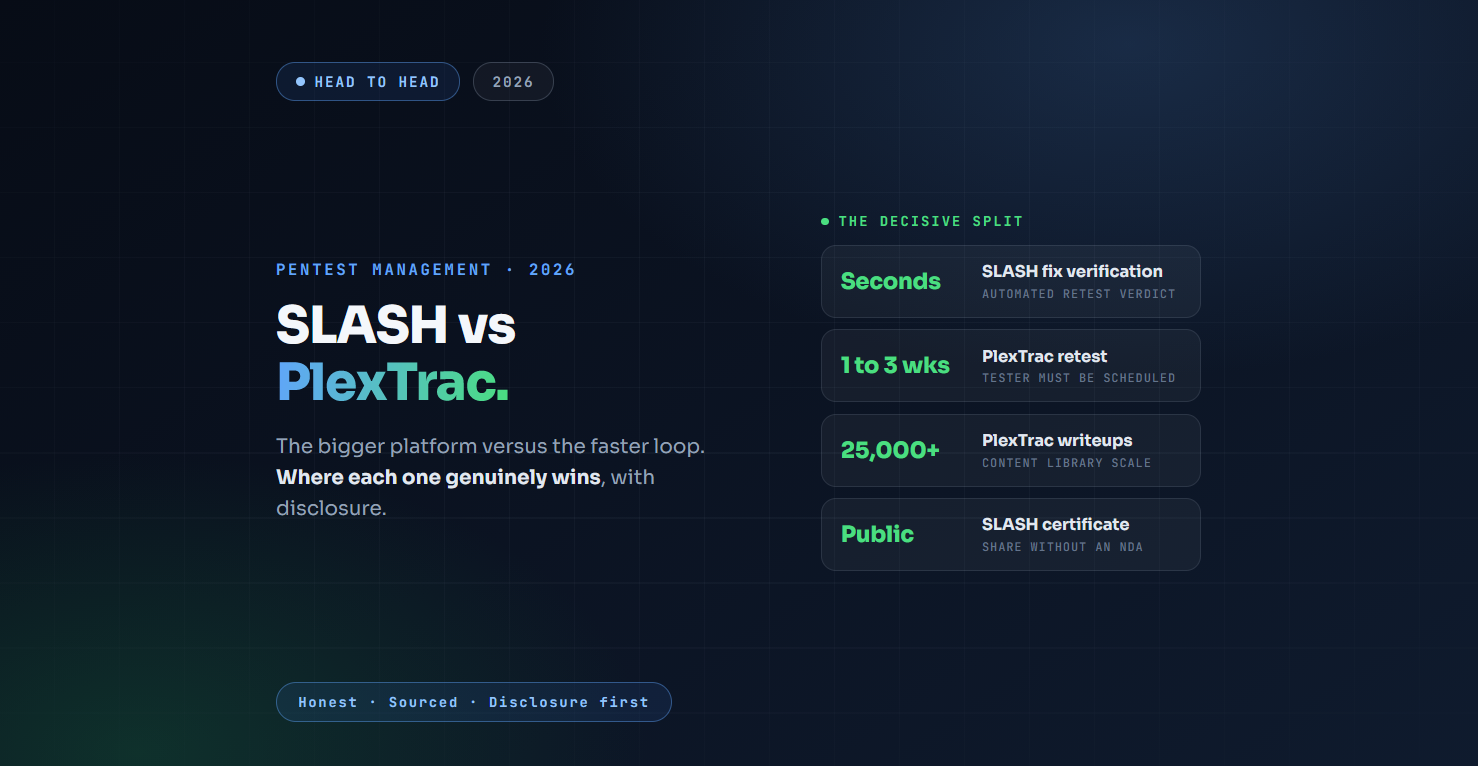
SecurityWall builds SLASH. This page compares our product to a competitor, so read it with that in mind. We have put "Where PlexTrac wins" before "Where SLASH wins", named seven specific areas where PlexTrac is the better choice, and told you plainly which team should buy which. If you want a neutral starting point instead, our roundup of PlexTrac alternatives covers six platforms including both of these.
PlexTrac is the incumbent. SLASH is the hybrid one. That is the whole comparison in one line, and almost every decision follows from it. That is the whole comparison in one line, and almost every decision follows from it.
PlexTrac runs a programme. Seven modules covering clients, assessments, reports, priorities, a content library, analytics and purple team runbooks, with a 25,000-plus writeup library and 42 catalogued integrations. If your problem is coordinating a broad offensive security function across many data sources, that breadth is the product.
SLASH covers the same breadth , run differently. It manages the full offensive security function across many data sources, and it is the only platform here that is genuinely hybrid: human testers and automated testing in one engagement, rather than the all-automated or all-manual delivery the rest of the category makes you choose between. On top of that sits a platform people can actually operate, with security built in rather than sold as an upgrade, automated retest that returns a verdict in seconds instead of scheduling a tester, and a publicly shareable certificate no other platform here issues.
Choose PlexTrac if you need its specific modules. Choose SLASH if you want human and automated testing in one engagement with proof you can publish. Both are legitimate answers to different questions.
What each platform actually is
These are not the same shape of product, and most comparisons miss that because both output a report.
PlexTrac was founded in Boise in 2016, raised a $70 million Series B led by Insight Partners in 2022, and was acquired by Brinqa on 19 August 2026. It is the enterprise standard in pentest reporting and has grown into a broad offensive security management platform. Its documentation lists seven modules beside the dashboard: Clients, Assessments, Reports, Priorities, Content Library, Analytics and Runbooks. The Content Library alone contains NarrativesDB, WriteupsDB and RunbooksDB.
SLASH is Hybrid Offensive Security Platform by SecurityWall's as pentest management platform. It go beyond pentest and covers red teaming and compliance operations and covers scoping, tester assignment, vulnerability tracking with CVSS scoring, automated retesting, bidirectional Jira sync and audit-ready reporting. It does not attempt to be a purple team execution platform or an exposure management hub. The design bet is that most teams do not fail at documenting findings; they fail at closing them and proving it.
Basis — PlexTrac module list from docs.plextrac.com product documentation. Funding and acquisition detail from Futurum Group analysis, 24 August 2026, and Brinqa's press release of 19 August 2026. SLASH capabilities from SecurityWall product documentation.
Where PlexTrac wins
Seven areas where PlexTrac is the better product. If two or more of these describe your situation, stop reading and buy PlexTrac.
| Advantage | Detail | Who This Matters To |
|---|---|---|
| Integration breadth | 42 catalogued integrations across scanners and vulnerability management tools | Programmes consolidating many automated data sources |
| Assessments module | Framework questionnaire templates plus custom assessment building | Teams running control assessments alongside testing |
| Analytics depth | Findings, asset and runbook metrics, trend analysis and SLA dashboards | Programme managers reporting upward on a portfolio |
| On-prem tier | Available under enterprise contract, separately licensed | Organisations with data residency or air-gap mandates |
| Procurement maturity | Gartner Magic Quadrant recognition, large Fortune 500 install base, established security review packet | Anyone whose vendor review process takes months |
Integration count from PlexTrac's integration catalogue as reported August 2026. Writeup library figure from PlexTrac's platform overview. On-prem availability confirmed by PlexTrac documentation; feature parity with the SaaS tier should be verified directly before contracting.
The last row deserves emphasis because buyers underweight it. If your organisation requires a completed vendor security questionnaire, a SOC 2 report, a DPA and a procurement review before any tool is approved, PlexTrac has been through that process thousands of times and has the packet ready. A younger platform will slow you down regardless of how good the product is.
One caveat on PlexTrac's integrations, raised in Gartner Peer Insights reviews: practitioners report that third-party integrations are not updated as frequently as the core platform, and that some features available in the main product are not supported inside the integrations. If a specific integration is central to your workflow, test it rather than trusting the catalogue entry.
Where SLASH wins
Four areas. They are narrower than PlexTrac's list, and they are all aimed at the same thing: closing a finding and proving it closed.
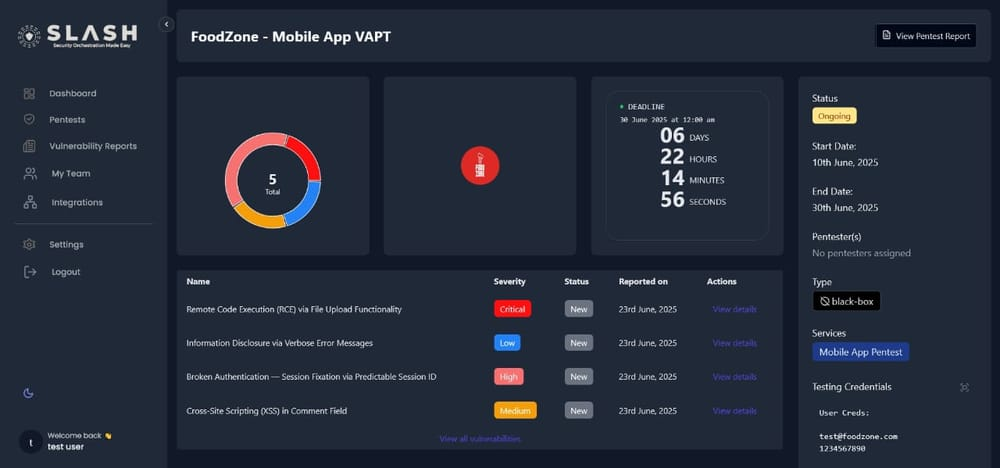
| Advantage | Detail | Why It Changes the Economics |
|---|---|---|
| Automated retest | Hit retest when engineering ships. Verdict in seconds: fixed, still vulnerable, or could not verify | Removes the tester-week from every verification cycle |
| Verifiable certificate | Publicly shareable attestation of scope, dates and remediation status, cryptographically anchored | Answers a prospect's security question without an NDA round |
| Dual report views | One engagement produces an executive view in business language and an engineering view with reproduction detail | No rewriting a technical report for the board |
| Modern auth without an enterprise tier | WebAuthn passkeys across USB, NFC, BLE and internal transports, TOTP 2FA, and step-up re-authentication before report publication or credential access | Security controls usually gated behind an upgrade |
PlexTrac includes SAML SSO across its paid tiers, so single sign-on itself is not the differentiator. The difference is passkey support and step-up authentication on sensitive actions.
Two of those are conveniences. Two change what the engagement is worth, and both get their own section below.
Side by side
| Capability | SLASH | PlexTrac |
|---|---|---|
| Findings tracking with CVSS | Yes | Yes |
| Reusable content library | Yes | Yes |
| Automated fix verification | Yes, verdict in seconds | Retest workflow, tester scheduled |
| Jira sync | Bidirectional | Jira and ServiceNow |
| Scanner integrations | Limited | 42 catalogued |
| Purple team runbooks | No | Yes, dedicated module |
| Framework assessments | No | Yes, questionnaire templates |
| Analytics and SLA dashboards | Retest and remediation metrics | Findings, assets, runbooks, trends |
| Executive and engineering report views | Both from one engagement | Customisable templates |
| Publicly shareable certificate | Yes, independently verifiable | No |
| Retest audit trail for auditors | Timestamped and archived | Available via reporting |
| SSO | Yes | SAML across paid tiers |
| Passkeys and step-up auth | Yes | Not documented |
| Self-hosted or on-prem | No, cloud only | Enterprise on-prem tier |
| Published pricing | No | No |
Verified September 2026 against vendor documentation. Both products ship frequently; confirm current capability before contracting. Where a capability is undocumented rather than absent, the cell says so.
The retest difference in practice
Both platforms support retesting. They mean different things by it, and the difference is measured in weeks.
The compliance consequence is the part buyers underestimate. Across every framework we have written about, the retest report is the most commonly missing artifact in an evidence pack. A report listing open critical findings with no verification attached is read as a documented, unremediated risk, which is a worse position than not having tested. Our guide to ISO 27001 and SOC 2 penetration testing sets out exactly what auditors expect to see.
If your findings close quickly today and verification is not your bottleneck, this advantage is worth little and PlexTrac's breadth matters more. If criticals sit open for a month waiting on tester availability, this is the whole argument.
Thirty minutes on a live sample engagement, then a trial run on your environment. Scoping, automated retest, Jira sync, report and certificate, end to end.
Book a SLASH walkthrough →Shareable proof: the certificate
This is the one capability with no PlexTrac equivalent, and it solves a problem neither platform's feature list usually mentions.
A pentest report cannot be published. It carries exploitation detail, architecture information and sometimes unresolved findings, so it moves under NDA, one prospect at a time, through a legal review that adds days to every deal. Yet the question a prospect is actually asking is simple: has this company been tested, by whom, when, and were the findings closed?
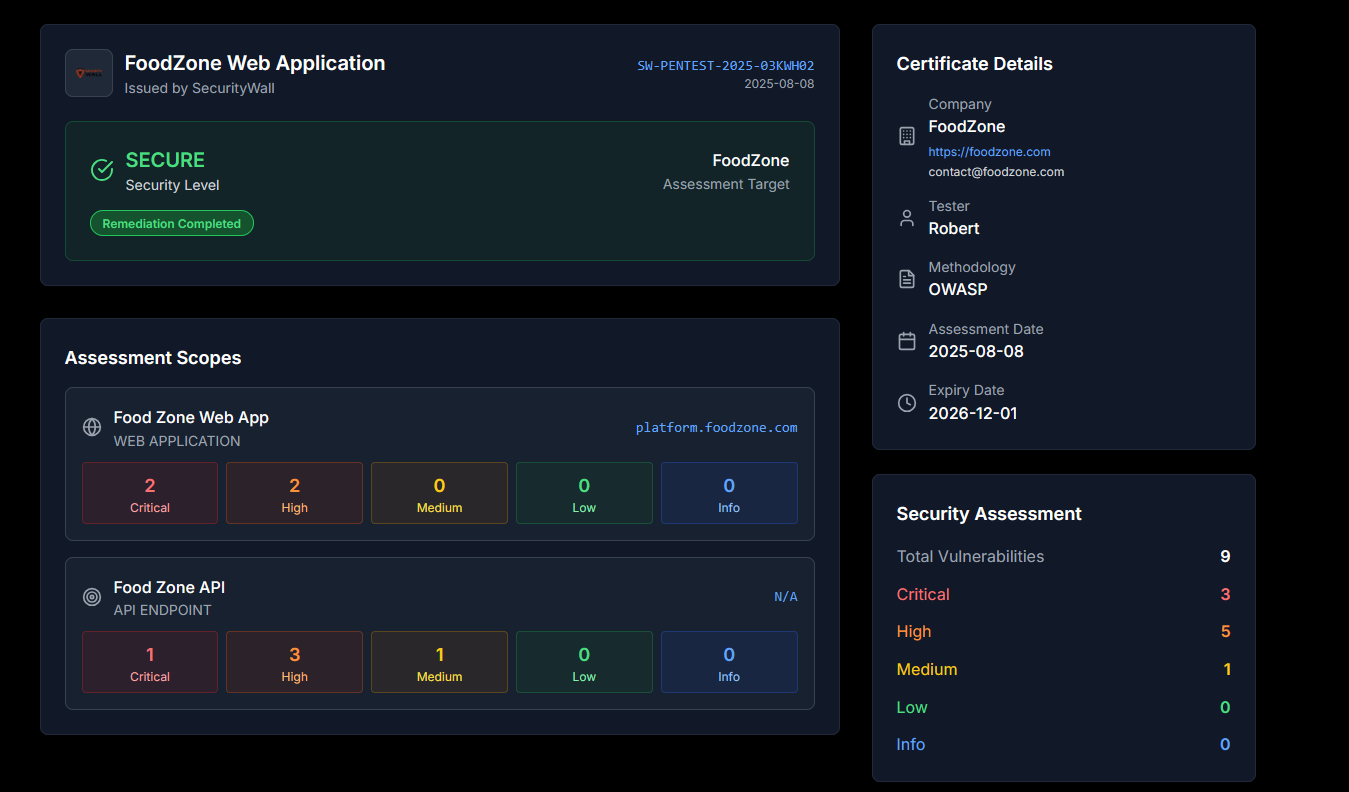
That question does not need the report. It needs an attestation. The usual answer is a PDF letter on headed paper, which anyone can fabricate in a word processor and no recipient can verify.
SLASH issues a certificate designed to be shared in the open. It confirms the engagement, scope, dates and remediation status without exposing findings, and it is cryptographically anchored so the recipient can confirm it is genuine and unaltered without contacting SecurityWall. It goes on a trust page, into an RFP response, or to a prospect's security team on day one instead of week three.
| Artifact | Shareable Publicly | Verifiable by Recipient | Friction |
|---|---|---|---|
| Full pentest report | No, NDA required | Yes, if they read it | Days of legal review |
| Attestation letter PDF | Yes | No, trivially forgeable | Low, but low trust |
| Platform status page | Yes | Only inside that vendor | Low, limited credibility |
| SLASH certificate | Yes | Yes, cryptographically anchored | One link, no NDA |
At the time of writing no other platform in this category issues a publicly shareable, independently verifiable engagement certificate. This is a capability competitors can copy, so verify current vendor documentation.
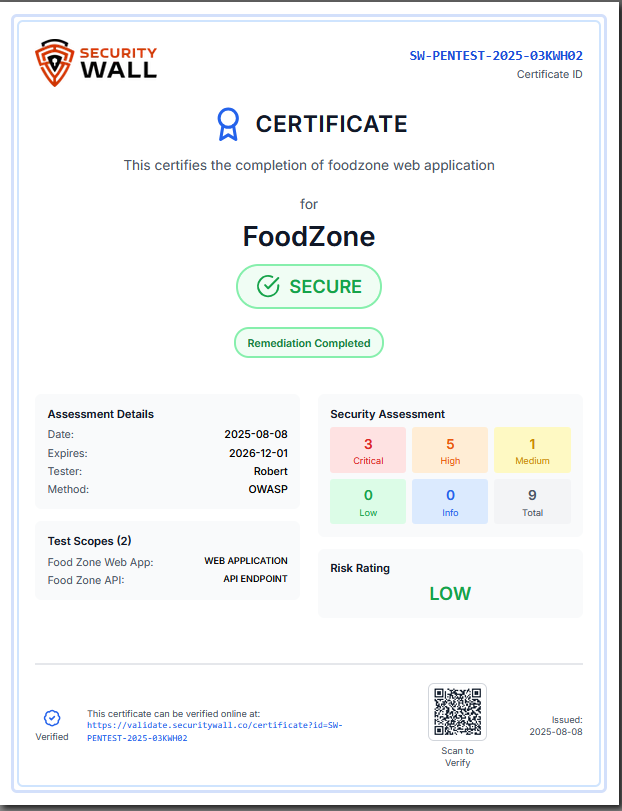
For companies whose penetration test exists mainly to unblock enterprise deals, this changes what the engagement buys. The report satisfies the auditor; the certificate satisfies the buyer, immediately. Our guide on passing a vendor security assessment covers how much of a sales cycle that one step consumes.
Pricing and deployment
Neither platform publishes pricing, and that is a fair criticism of both.
PlexTrac sells on enterprise quote with package tiers bundling features for pentest reporting, vulnerability management and CTEM. Third-party comparison sites report figures around $450 to $500 or more per month, but those are not vendor-confirmed and real cost depends on seats, modules and term. The on-prem tier is separately licensed under enterprise contract with a different update cadence, and feature parity with the SaaS product is worth confirming in writing before you sign.
SLASH is also quote based. The only mitigation we can honestly offer is that you get a scoped number inside one call rather than a procurement cycle, which is a smaller difference than publishing a price would be.
On deployment, PlexTrac wins outright. SLASH is cloud only. If your policy or your clients require self-hosting, air-gapped operation or data residency in a specific jurisdiction, SLASH is disqualified and PlexTrac's on-prem tier, AttackForge or Dradis are the realistic shortlist. Our PlexTrac alternatives roundup covers those options with sourced pricing.
Basis — PlexTrac packaging from plextrac.com platform overview. On-prem licensing detail from PlexTrac documentation as reported August 2026. Third-party price estimates from comparison sites, not vendor-confirmed.
Which should you choose
The honest summary: PlexTrac has more modules. SLASH has the delivery model. Runbooks, assessments and scanner breadth are real reasons to choose PlexTrac. Hybrid testing, verified closure and a certificate you can publish are real reasons to choose SLASH.
Frequently asked questions
Is SLASH a direct PlexTrac replacement? For pentest reporting, findings tracking, remediation routing and retesting, yes. For purple team runbooks, framework assessments and wide scanner consolidation, no. SLASH does not have modules equivalent to PlexTrac's Runbooks or Assessments, and teams relying on those should stay on PlexTrac.
What is the main difference between SLASH and PlexTrac? Retest. PlexTrac provides a retest workflow that still requires scheduling a human tester, typically adding one to three weeks. SLASH re-verifies a finding automatically on demand and returns a verdict in seconds, with a timestamped archive for audit evidence.
Does PlexTrac have a certificate like SLASH? No. PlexTrac produces reports and attestation documents, but not a publicly shareable, independently verifiable engagement certificate. At the time of writing SLASH is the only platform in this category issuing one.
Can SLASH be self-hosted? No. SLASH is cloud only. PlexTrac offers an on-prem tier under enterprise contract, separately licensed with a different update cadence. If self-hosting is mandatory, PlexTrac on-prem, AttackForge or Dradis are the realistic options.
Which is cheaper, SLASH or PlexTrac? SLASH is relatively low when it comes to cost. Third-party sites estimate PlexTrac at roughly $450 to $500 or more per month, unverified by the vendor. SLASH is quote based and scoped on a single call.
Does the Brinqa acquisition change the comparison? Not directly. Brinqa states PlexTrac continues as a standalone offering and retained its founder, who now leads the combined offensive security practice. The question worth raising at renewal is whether consultancy delivery remains a roadmap priority inside an enterprise CTEM strategy.
Run SLASH against your own scope
Thirty minutes on a sample engagement, then a trial on your environment. If you need runbooks, framework assessments or on-prem deployment, we will tell you PlexTrac is the better fit and why.
Book a walkthrough →
Twenty minutes, a scoped price, and an honest answer on whether SLASH fits your workflow.
Book a walkthrough →About Muhammad Khizer Javed
Muhammad Khizer Javed is a member of the SecurityWall team, contributing expert insights on cybersecurity and penetration testing.