
SAQ A vs SAQ A-EP vs SAQ D: Which One Applies to You
Muhammad Khizer Javed
October 9, 2026
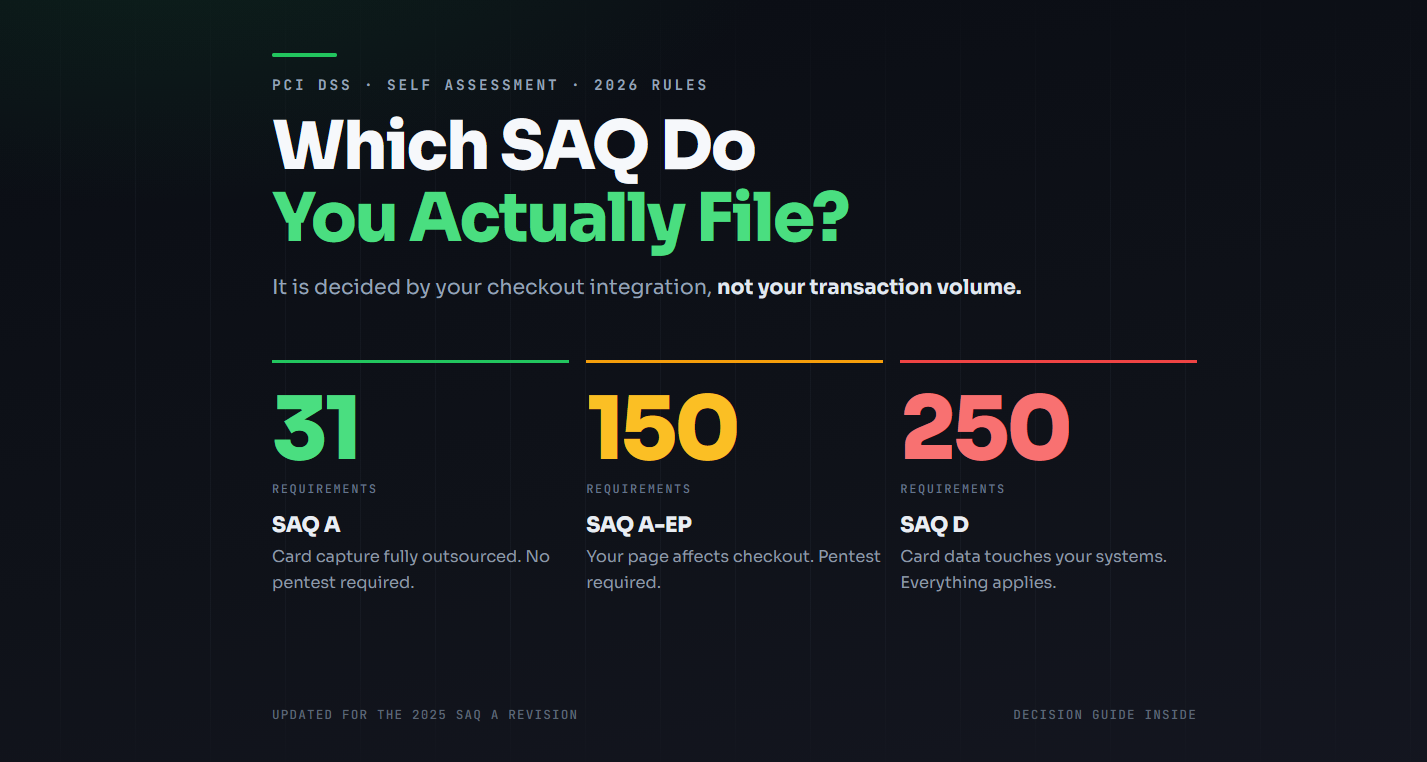
SAQ A is for merchants who have fully outsourced card capture. Every element of the payment page comes directly from your provider, and card data never reaches a system you control. Around 31 requirements.
SAQ A-EP is for e-commerce merchants whose own website affects the payment page but never receives card data. Your page loads the provider's script, redirects, or controls the form. Around 150 requirements, roughly five times the work.
SAQ D is the catch-all. If card data touches your servers, or you take payments by phone, mail or in person outside the narrow SAQ B and C cases, you are here. Around 250 requirements.
The dividing question is not how much you process. It is whether your own code can influence what happens on the payment page. If it can, SAQ A is off the table however small you are.
What changed for SAQ A in 2025, and why most guides have it wrong
If you are reading an article written before 2025, it is describing a form that no longer exists. The PCI Security Standards Council revised SAQ A on 30 January 2025, effective 31 March 2025, and the change ran in two directions at once.
| Change | Detail | Effect on you |
|---|---|---|
| Requirement 6.4.3 removed | Payment page script management no longer on the SAQ A form | Fewer controls to evidence |
| Requirement 11.6.1 removed | Payment page tamper detection no longer on the SAQ A form | Fewer controls to evidence |
| Requirement 12.3.1 removed | The targeted risk analysis supporting 11.6.1 went with it | Fewer controls to evidence |
| New eligibility criterion 1 | All payment page elements must originate only and directly from a compliant TPSP or payment processor | Many merchants no longer qualify |
| New eligibility criterion 2 | You must confirm your site is not susceptible to script attacks affecting your e-commerce systems | You attest to this, by signature |
| Requirement 11.3.2 kept | Quarterly ASV external scanning, added to SAQ A back in v4.0 | Still required. v3.2.1 had no scan on SAQ A |
PCI SSC announcement 30 January 2025, effective 31 March 2025 when the October 2024 SAQ A version retired. Requirements 6.4.3, 11.6.1 and 12.3.1 were removed from the SAQ A form only. They remain in force under PCI DSS v4.0.1 for everyone else.
Read those two halves together, because the combination is what trips people up. The Council took three technical controls off the form and replaced them with an eligibility bar and a signature. You no longer evidence script integrity control by control. Instead you sign a statement that your site is not susceptible to script attacks, and if that statement is wrong, the exposure sits with you rather than with a missing checkbox.
The practical result: SAQ A got shorter, and the pool of merchants entitled to use it got smaller. If you cannot honestly make both attestations, your form is SAQ A-EP.
Basis — PCI Security Standards Council SAQ A revision announced 30 January 2025, effective 31 March 2025. Change detail per SecurityMetrics and Jscrambler assessor commentary, 2025. Requirement 11.3.2 addition to SAQ A dates from PCI DSS v4.0.
Which SAQ applies to you
Four questions, in order. Stop at the first one that sends you somewhere.
That is the most expensive uncertainty in PCI, and it is usually settled in twenty minutes by looking at how your checkout loads. Bring a URL and we will tell you which form applies.
Book a free scoping call →The three forms compared
| SAQ A | SAQ A-EP | SAQ D | |
|---|---|---|---|
| Who it is for | Fully outsourced card capture | Site affects the page, never sees card data | Everyone else |
| Approximate requirements | 31 | 150 | 250 |
| Card data touches your systems | Never | Never | Yes |
| Quarterly ASV scan | Yes, since v4 | Yes | Yes |
| Internal vulnerability scanning | No | Yes | Yes |
| Penetration testing, Req 11.4 | No | Yes | Yes |
| Script integrity controls on the form | Removed Jan 2025 | Yes, 6.4.3 and 11.6.1 | Yes |
| Typical annual all-in cost | $0 to $500 | $2,000 to $10,000 | $15,000 to $60,000 |
| Staff time for the form itself | 8 to 15 hours a year | Days | Weeks, plus ongoing |
Requirement counts are approximate and vary by version; treat them as orders of magnitude, not exact figures. Cost bands from paymentgatewaycost.com 2026 and Paytia, 29 May 2026. Full breakdown in our PCI DSS compliance cost guide.
The row that costs real money is penetration testing. SAQ A does not trigger Requirement 11.4. SAQ A-EP does. That single step from A to A-EP adds an annual penetration test, internal scanning, and the script integrity controls that SAQ A merchants no longer evidence. Our PCI DSS penetration testing guide covers what the test has to include, and the cost guide prices every line.
What pushes you from SAQ A to SAQ A-EP
This is where most merchants are wrong about their own status. The trigger is not receiving card data. It is being able to influence the page that collects it.
| How your checkout works | Card data reaches you? | Your form |
|---|---|---|
| Full redirect to the provider's hosted page | No | SAQ A |
| Provider-hosted iframe, no custom fields | No | SAQ A |
| Provider's JS library rendering fields into your page | No | SAQ A-EP |
| Your own form, posting directly to the provider | No | SAQ A-EP |
| Your server receives the PAN and forwards it by API | Yes | SAQ D |
Rows three and four are the common surprise. In both, card data never lands on your infrastructure, yet both are SAQ A-EP, because your page controls how the capture happens and a compromise of your site could alter it.
Rows three and four are where the Magecart risk actually lives. An attacker who injects a script into your page can skim card details before the provider ever sees them, which is precisely why those integrations carry the heavier form. It is also why the 2025 SAQ A revision tightened eligibility rather than loosening it: the Council narrowed SAQ A to the cases where your site genuinely cannot interfere.
Worth checking rather than assuming. Teams routinely file SAQ A on the basis that "we use Stripe" or "we use Adyen", without knowing which integration their developers chose. The provider name tells you nothing. The integration pattern tells you everything.
What pushes you all the way to SAQ D
SAQ D is the default when nothing narrower fits, and merchants land there through routes that have nothing to do with their website:
- A contact centre that takes card details by phone. The single most common cause outside e-commerce, and it drags the whole centre, its agents, its recordings and its network into scope.
- Card numbers in call recordings that nobody realised were being retained.
- PANs in application logs, support tickets or CRM free-text fields. Usually accidental, always in scope.
- Storing card data for recurring billing rather than tokenising it with the provider.
- Being a service provider. Most service providers file SAQ D regardless of how clean the architecture is.
- Mixed channels. E-commerce on SAQ A plus phone orders means the phone channel drags you to SAQ D.
That last one surprises people. Your SAQ is determined by the whole of your card acceptance, not the cleanest part of it. A merchant with an immaculate iframe checkout and one phone line taking orders files SAQ D.
How to move down a tier
The A-EP to A move is the one most teams underestimate the value of. A few days of engineering removes an annual penetration test, internal scanning, and roughly 120 requirements from your form, every year, permanently.
What happens if you file the wrong one
Filing SAQ A when you should have filed A-EP is not a paperwork error. The AoC is a signed attestation by a senior officer that the stated requirements are met. If the eligibility criteria were never satisfied, the attestation was not accurate when signed.
The consequences show up in three places. Your acquirer can reclassify you and demand revalidation. An enterprise customer doing vendor due diligence can reject your AoC once they see the integration does not match the form. And after a breach, a forensic investigator establishes which SAQ applied, and an AoC for the wrong form offers no protection.
The fix is cheap if you do it before any of those: confirm your integration pattern, file the correct form, and if the correct form is more expensive, treat that as the trigger for a descoping project rather than a reason to keep filing the wrong one. Our guide to the PCI DSS Attestation of Compliance covers what the signed document actually commits you to.
SecurityWall is partnered-QSA. For Level 1 and most service provider engagements a QSA conducts the ROC and signs the AoC, and we coordinate with independent QSA partners for those.
What we do is confirm which SAQ genuinely applies, run the gap assessment, handle the Requirement 11.4 penetration test where A-EP or D applies, and scope the descoping work that moves you down a tier.
See the PCI DSS service →Frequently asked questions
What is the difference between SAQ A and SAQ A-EP? SAQ A is for merchants who have fully outsourced card capture, where every payment page element comes directly from the provider. SAQ A-EP is for e-commerce merchants whose own website affects the payment page but never receives card data, such as a JavaScript integration or a form posting directly to the provider. SAQ A has around 31 requirements; SAQ A-EP has around 150 and triggers penetration testing.
Do I need SAQ D if I use Stripe or Adyen? Not necessarily, and the provider name is irrelevant. What matters is the integration. A full redirect or provider-hosted iframe is SAQ A. Their JavaScript library rendering fields into your page is SAQ A-EP. Your server receiving the card number and forwarding it is SAQ D.
What changed for SAQ A in 2025? On 30 January 2025, effective 31 March 2025, the PCI SSC removed Requirements 6.4.3, 11.6.1 and 12.3.1 from the SAQ A form and added two eligibility criteria: all payment page elements must originate only and directly from a compliant provider, and the merchant must confirm its site is not susceptible to script attacks. The form became shorter but harder to qualify for.
Does SAQ A require a penetration test? No. Requirement 11.4 penetration testing does not apply to SAQ A. It does apply to SAQ A-EP and SAQ D. This is the largest cost difference between the forms and the main financial reason to move from A-EP to A.
Does SAQ A require quarterly ASV scans? Yes, under PCI DSS v4. Requirement 11.3.2 was added to SAQ A, which version 3.2.1 did not include. Quarterly external scanning by an Approved Scanning Vendor is required at least every 90 days and after significant changes to internet-facing infrastructure.
Can I file SAQ A for my website and ignore phone orders? No. Your SAQ is determined by all of your card acceptance channels, not the cleanest one. A merchant with a compliant iframe checkout who also takes card details by phone files SAQ D unless the phone channel is descoped, typically with DTMF masking.
Confirm which SAQ actually applies
Bring your checkout URL and your payment channels. You leave the call knowing your correct form, what it requires, and whether a few days of engineering could move you down a tier.
Book a free scoping call →Sources
| Claim | Source |
|---|---|
| SAQ A revision: 6.4.3, 11.6.1 and 12.3.1 removed; two eligibility criteria added | PCI SSC announcement 30 January 2025, effective 31 March 2025 |
| Exact wording of the new eligibility criteria | SecurityMetrics and Jscrambler assessor commentary on the January 2025 SAQ A, 2025 |
| Requirement 11.3.2 added to SAQ A in v4.0 | PCI DSS v4.0.1 SAQ A; absent from the v3.2.1 form |
| Requirement 11.4 penetration testing obligation | PCI DSS v4.0.1, Requirement 11.4 |
| Annual cost bands and DTMF masking figures | paymentgatewaycost.com 2026; Paytia, 29 May 2026 |
Requirement counts are approximate and differ slightly between versions and sources. Eligibility is determined by the current SAQ document and your acquirer, not by any article. Confirm against the PCI SSC Document Library before filing. Last reviewed October 2026.

Twenty minutes, a scoped price, and an honest answer on whether SLASH fits your workflow.
Book a walkthrough →Tags
About Muhammad Khizer Javed
Muhammad Khizer Javed is a member of the SecurityWall team, contributing expert insights on cybersecurity and penetration testing.