
PCI DSS Compliance Cost in 2027: Real Price Breakdown
Muhammad Khizer Javed
October 9, 2026
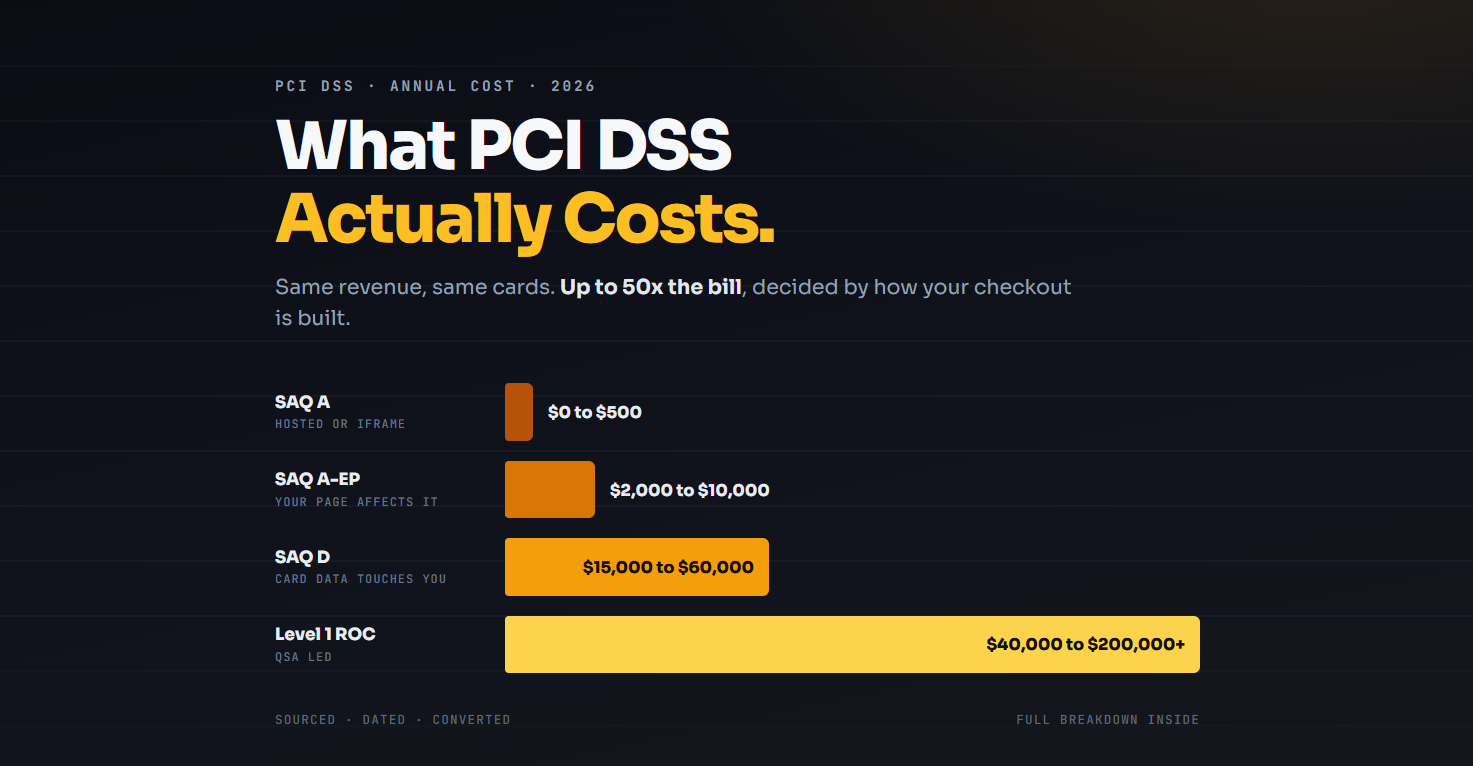
PCI DSS compliance costs between about $500 and $200,000 a year, and the single biggest factor is not your company size. It is how your checkout is built.
A merchant whose payment page is a hosted iframe from Stripe or Adyen files SAQ A and pays a few hundred dollars a year. The same business processing the same volume through a server-side API integration files SAQ D and pays tens of thousands. Same revenue, same cards, roughly 50 times the compliance bill, decided by an architecture choice made years earlier.
So the useful question is not "what does PCI cost", it is "which validation path am I on, and can I get off it". This page prices every line item, shows what drives each one, and sets out the descoping move that removes most of the cost.
What PCI DSS compliance costs by merchant level
These are annual all-in bands, covering assessment, required scanning and testing, tooling and internal time. They are directional figures widely quoted by QSAs and merchant advisory firms, not a single published dataset, because the PCI Security Standards Council does not publish pricing.
Bands cross-checked against 2026 breakdown. Bar widths are proportional to the top of each band. The Level 1 bar is capped; large multi-site programmes run well past $200,000. SecurityWall offer market competitive pricing.
Note what the ladder actually tracks. Merchant level is set by annual card transaction volume, but the cost tracks the SAQ type, and SAQ type is set by integration architecture. A Level 4 merchant with a bad integration can file SAQ D and pay more than a Level 2 merchant with a clean one.
Basis — Level bands PCI Compliance Cost guide, 2026. Cross-checked against Paytia, Cost of PCI Compliance, updated 29 May 2026. Neither is a PCI SSC figure; the Council does not publish pricing.
The line items, priced
A quote is only comparable if you know what is inside it. These are the components, with what each costs on its own.
| Line item | Typical annual cost | Who needs it |
|---|---|---|
| QSA engagement (ROC) | $40,000 to $190,000 | Level 1, and most service providers |
| ASV quarterly scanning | $1,900 to $19,000 | Everyone, including SAQ A since v4 |
| Penetration test, external only | $7,500 to $15,000 | Small, well segmented environments |
| Penetration test, internal and external | $31,000 to $75,000 | Level 1 and segmented CDEs |
| Internal vulnerability scanning tooling | $3,800 to $10,000 year one | SAQ D and above |
| File integrity monitoring | $10,000 to $38,000 | Level 1 environments |
| Log management and SIEM | $25,000 to $125,000+ | Level 1 environments |
| Security awareness training | $10 to $31 per user | Everyone with CDE access |
| GRC platform | $19,000 to $100,000 | Larger multi-framework programmes |
| Internal staff time | $25,000 to $50,000 | SAQ D and Level 1. Rarely budgeted |
SecurityWall pricing is always market competitive. Schedule a call for the discounted pricing.
Two rows deserve attention because they are the ones missing from most budgets around. SecurityWall have always focused on the compliance focused delivery with lower costing for startups especially.
Internal staff time. Someone has to gather evidence, chase vendors for their AoCs, answer assessor questions and maintain documentation. For an SAQ D programme that is routinely 40 to 80 hours a year on vendor management alone. It never appears on a quote because nobody invoices you for it.
ASV scanning for SAQ A merchants. Under PCI DSS v3.2.1 the SAQ A form carried no external scanning requirement. Under v4 it does: Requirement 11.3.2 was added, and SAQ A grew from roughly two dozen requirements to around 31. If your last SAQ A was filed before 2024 and you have not budgeted quarterly ASV scans, that is a new line.
Twenty minutes with your integration type, transaction volume and current SAQ tells you which path you are on and what it should cost. If your architecture lets you drop a tier, we will say so on the call.
Book a free scoping call →What a QSA actually charges
If you are Level 1, the QSA engagement is the largest single line, and it is priced as day rate multiplied by days. Both halves are negotiable in ways most buyers never test.
| Firm tier | Day rate | When it is worth it |
|---|---|---|
| Big Four | $2,250 to $3,125 | Board or regulator wants the name on the report |
| Large US firms | $2,000 to $3,500 | Multi-national scope, multiple frameworks at once |
| Mid-tier specialists | $1,500 to $2,250 | The default choice for most Level 1 merchants |
| Boutique QSAs | $1,125 to $1,625 | Single-site, well-scoped, repeat engagements |
GBP day rates from Paytia, May 2026, converted at approximately 1.25. Typical engagement length is 25 to 35 assessor days for a clean, well-segmented environment and 60 to 100 days for a complex one. The AoC is identical whichever tier signs it.
The leverage is in the days, not the rate. A clean environment is 25 to 35 days; a messy one is 60 to 100. At a mid-tier rate that difference is roughly $50,000 to $145,000 for the same certificate, and the variable you control is how well scoped and documented the environment is when the QSA walks in.
This is why a gap assessment before the ROC usually pays for itself. Every hour the QSA spends discovering that your segmentation is undocumented is an hour billed at assessor rates.
Why two identical companies pay 10x apart
| Driver | Effect on cost | Can you change it? |
|---|---|---|
| Integration architecture | Up to 50x | Yes. The biggest lever by far |
| Whether a contact centre takes card details | 80 to 95 percent of audit scope | Yes, via DTMF masking or pause and resume |
| Network segmentation quality | 2x to 3x on QSA days | Yes, with engineering effort |
| Number of physical sites | Adds assessor travel days | Partly |
| Documentation maturity | 10 to 30 assessor days | Yes. Cheapest thing to fix |
| Transaction volume, your merchant level | Sets the floor, not the ceiling | No |
Note the last row. Transaction volume is the one driver you cannot influence, and it is the one most buyers assume determines their cost. The five above it matter more and are all addressable.
The descoping lever
Descoping means changing your architecture so cardholder data never touches systems you control. If the data is not in your environment, your environment is not in scope, and most of the cost above disappears.
The common moves:
- Swap a server-side payment API for a hosted payment page or an iframe. This is the SAQ D to SAQ A move, and it is the single largest saving available to an e-commerce merchant.
- Add DTMF masking to a contact centre so agents never hear or see card numbers. Published figures put a masking platform at roughly $250 to $1,000 a month at low volume, against an audit scope reduction of 80 to 95 percent.
- Tokenise stored card data so your database holds tokens rather than PANs.
- Segment the CDE properly and prove the segmentation with testing, so the rest of your network falls out of scope.
Published worked examples give a sense of the size. A mid-size insurance broker on SAQ D at roughly $78,000 a year moved to SAQ A at about $28,000 including a $17,500 masking platform, a net annual saving near $50,000. The typical SAQ D to SAQ A saving is quoted at $25,000 to $75,000 a year.
Our PCI DSS gap assessment guide covers how to find which of these applies to you, and the SAQ comparison explains exactly what disqualifies you from the cheaper forms.
The three year number nobody budgets for
Almost every PCI cost article prices year one. PCI is an annual obligation, so year one is the least useful number in the conversation. Descoping costs money up front and saves it every year after, which only becomes visible over three.
| Scenario | Year 1 | Year 2 | Year 3 | Three year total |
|---|---|---|---|---|
| Stay on SAQ D | $225,000 | $175,000 | $169,000 | $569,000 |
| Descope to SAQ A | $56,000 | $22,500 | $22,500 | $101,000 |
| Difference | $169,000 | $152,500 | $146,500 | $468,000 saved |
Converted from Paytia's published GBP worked example, May 2026, at approximately 1.25. This is one vendor's modelled scenario for a specific contact centre, not an average. Your numbers will differ, but the shape of the curve, high year one then a much lower plateau, holds for any descoping project.
The year-one figures are close enough that a CFO looking only at next year's budget may see no reason to act. The case lives in years two and three.
Hidden costs and fees
| Charge | Amount | What to do |
|---|---|---|
| Processor flat PCI fee | $10 to $30 per month | Negotiable and often waivable. Ask |
| Non-compliance fee | $20 to $30 per month US, up to $625 UK | Charged for a missed annual SAQ. Diarise it |
| Re-assessment after a failed scan | Assessor day rate | Remediate before the scan, not after |
| Scope creep during the ROC | 10 to 30 extra assessor days | Gap assessment first |
| Card scheme fines after a breach | Publicly reported in the high five and six figures per incident | Check your acquirer agreement for the real schedule |
Fee figures from 2026. Breach fines are not published on a public schedule; the amounts that reach the press are not a reliable guide to what your acquirer agreement specifies.
SecurityWall For Level 1 and most service provider engagements a QSA must conduct the ROC and sign the AoC, and we coordinate with independent QSA partners for those. That separation keeps the attestation independent of the firm doing the remediation.
What we do is the work that decides your bill: gap assessment, scope reduction, the Requirement 11.4 penetration test, remediation, SAQ completion and AoC drafting. Those are the line items that turn a 90 day QSA engagement into a 30 day one.
See the PCI DSS service →Frequently asked questions
How much does PCI DSS compliance cost per year? Roughly $500 to $200,000 depending on validation path. SAQ A merchants with a hosted checkout pay a few hundred dollars. SAQ A-EP runs $2,000 to $10,000, SAQ D $15,000 to $60,000, and a Level 1 QSA-led ROC $40,000 to $200,000 or more. Integration architecture drives the number far more than company size.
How much does a QSA audit cost? The QSA engagement alone is typically $40,000 to $190,000. It is priced as day rate times days: $1,125 to $3,500 per assessor day, over 25 to 35 days for a clean environment or 60 to 100 for a complex one. Reducing days is where the saving is, not haggling the rate.
Is PCI DSS compliance a one-time cost? No. It is annual. SAQs are refiled yearly, ASV scans run quarterly, and penetration testing is at least annual under Requirement 11.4. Treat it as recurring operating cost, and budget on a three year view because descoping pays back in years two and three.
What is the cheapest way to be PCI compliant? Make cardholder data never touch systems you control. A hosted payment page or iframe from a compliant provider puts most e-commerce merchants on SAQ A, the cheapest path. For contact centres, DTMF masking removes 80 to 95 percent of audit scope for roughly $250 to $1,000 a month.
Do SAQ A merchants need an ASV scan? Yes, under PCI DSS v4. Requirement 11.3.2 was added to SAQ A, which v3.2.1 did not include. Quarterly external scanning by an Approved Scanning Vendor is now required, at roughly $1,900 to $19,000 a year depending on IP count. Many merchants who last filed under v3.2.1 have not budgeted for this.
Does a penetration test count toward PCI cost? Yes, and it is mandatory. Requirement 11.4 requires internal and external penetration testing plus segmentation validation. Budget $7,500 to $15,000 for a small external-only scope, and $31,000 to $75,000 for a Level 1 internal and external programme. Our PCI DSS penetration testing guide covers what the test must include.
Find out what your PCI programme should cost
Bring your integration type, transaction volume and last SAQ. You leave the call knowing which path you are on, what it should cost, and whether you can drop a tier.
Book a free scoping call →Sources
| Figures | Source |
|---|---|
| Annual bands by merchant level, processor and non-compliance fees | paymentgatewaycost.com, PCI Compliance Cost, 2026 |
| QSA day rates, engagement length, component pricing, descoping examples, three year model | Paytia, Cost of PCI Compliance, updated 29 May 2026 |
| SAQ A gaining Requirement 11.3.2 under v4 | PCI DSS v4.0.1 SAQ A; SecurityMetrics commentary, 2025 |
| Requirement 11.4 penetration testing obligation | PCI DSS v4.0.1, Requirement 11.4 |
No figure on this page is SecurityWall pricing. GBP sources converted at approximately 1.25 USD to GBP and rounded; exchange rates move, so treat converted figures as indicative. The PCI Security Standards Council does not publish compliance pricing, so all bands are vendor and advisory estimates. Last reviewed October 2026.

Twenty minutes, a scoped price, and an honest answer on whether SLASH fits your workflow.
Book a walkthrough →Tags
About Muhammad Khizer Javed
Muhammad Khizer Javed is a member of the SecurityWall team, contributing expert insights on cybersecurity and penetration testing.