
PlexTrac Alternatives: 6 Platforms Compared
Babar Khan Akhunzada
October 1, 2026
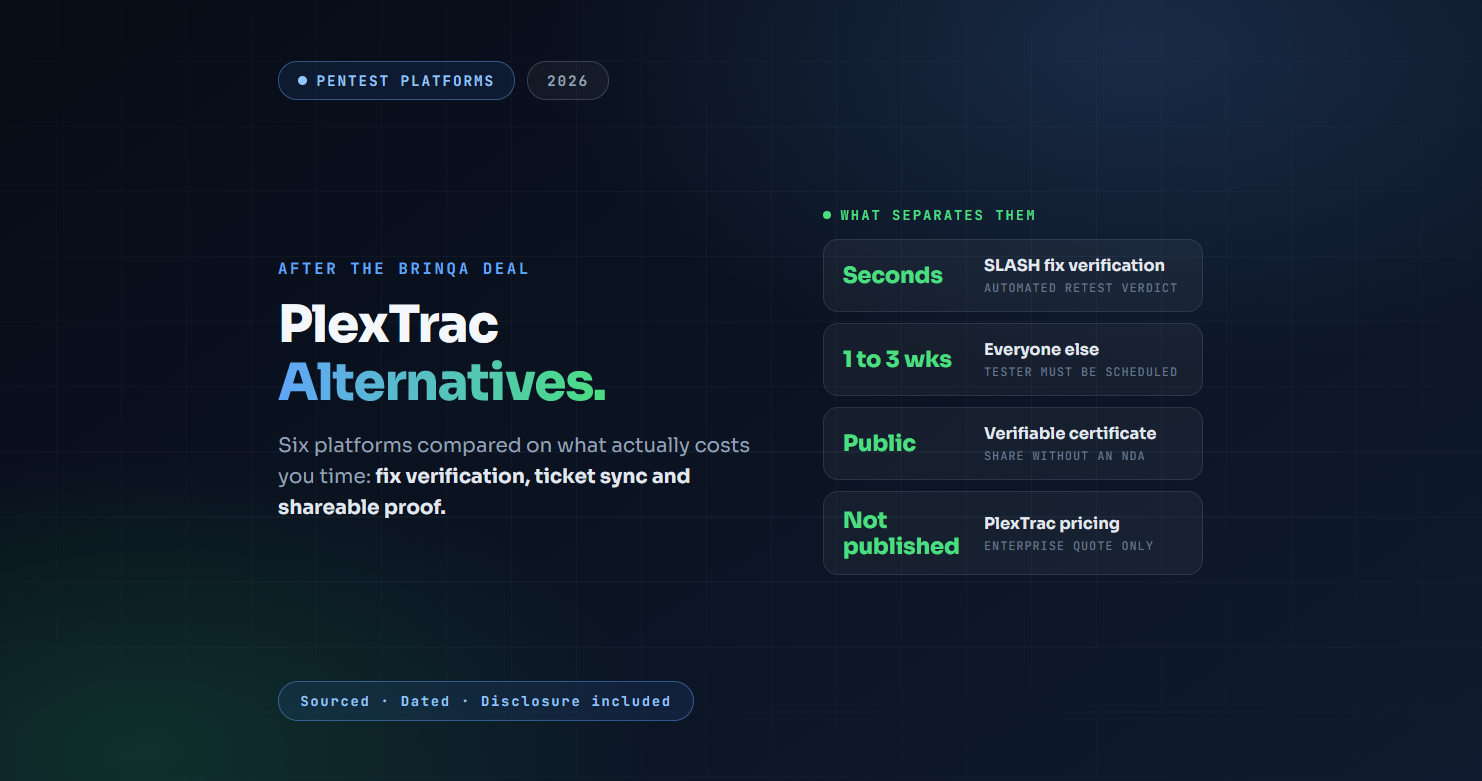
SecurityWall builds SLASH, one of the platforms below. We have reviewed it on the same criteria as everything else and named the three situations where you should buy something other than SLASH. Every price is sourced and dated, including the gaps.
Most lists of PlexTrac alternatives compare products that are not alternatives. Ghostwriter and SysReptor are report generators. They turn notes into a PDF. They do not track remediation, do not sync tickets, do not verify fixes and do not deliver to clients. Putting them beside PlexTrac because both produce documents is like comparing a word processor to a project management system.
The real PlexTrac alternatives are five platforms: AttackForge, PentestPad, Cyver Core, Dradis Pro and SLASH. Those are the products that manage an engagement rather than just document one.
And as of 19 August 2026, PlexTrac is owned by Brinqa, which repositions it inside an enterprise exposure management strategy. That is not a reason to panic, but it is a reason to ask roadmap questions at renewal.
What the Brinqa acquisition changes for buyers
On 19 August 2026, Brinqa announced it had acquired PlexTrac for undisclosed terms. Here is what was announced, separated from the speculation that followed.
| Announced | Detail | Practical Implication |
|---|---|---|
| Date and terms | 19 August 2026, terms undisclosed | Recent enough that integration effects are not visible yet |
| Combined scale | 3,000+ customers, 57 countries, over 25 percent of the Fortune 500 | Enterprise focus intensifies. Smaller accounts may feel less prioritised |
| Strategic rationale | Closing the CTEM loop: test before remediation, retest after | PlexTrac becomes a validation layer inside exposure management |
| Leadership | Founder Dan DeCloss joins Brinqa's executive team and board | Founder retention is a genuine positive signal |
| Product continuity | Brinqa states PlexTrac continues as a standalone offering | No forced migration announced. Stated intent, not a contractual guarantee |
Sourced from Brinqa's press release of 19 August 2026, Help Net Security coverage of the same date, and Futurum Group analyst commentary published 24 August 2026.
The honest read: this is a sensible strategic fit, not a distress sale. The risk is about priorities, not survival. A consultancy delivering client-facing reports is a different customer from a Fortune 500 team running CTEM. When one product serves both and one owns the roadmap, the smaller use case waits.
Basis — Brinqa press release, 19 August 2026. Help Net Security, 19 August 2026. Futurum Group analysis by Fernando Montenegro, 24 August 2026.
The two categories people keep confusing
Almost every "PlexTrac alternatives" list on the internet makes the same mistake: it puts free report generators in the same table as management platforms, because both produce a PDF at the end.
They solve different problems.
| Capability | Report Generators Ghostwriter, SysReptor, Pwndoc | Management Platforms PlexTrac, AttackForge, PentestPad, Cyver, Dradis Pro, SLASH |
|---|---|---|
| Turn findings into a document | Yes | Yes |
| Track remediation state per finding | No | Yes |
| Sync findings to Jira or ServiceNow | No | Yes |
| Verify a fix actually worked | No | Varies, see below |
| Deliver to a client without email | No | Yes |
| Produce audit-acceptable retest evidence | No | Varies, see below |
| Who maintains the deployment | You do | Vendor, unless self-hosted by choice |
This is not a criticism of Ghostwriter or SysReptor. Both are good at the job they were built for. They were not built to manage a penetration testing programme, and choosing one expecting that is the most common mistake in this evaluation.
If you are a solo tester writing three reports a quarter, a free generator is genuinely the right answer and nothing below will change that. If you are running engagements where someone else has to fix what you found, you need the second column, and the first column is not a cheaper version of it. It is a different product.
The rest of this comparison covers the second column.
The platforms compared
Buyers usually compare on licence price and feature count. Both are poor predictors of what a platform actually costs you, because the expensive parts are tester hours and delay. These are the criteria that move those two numbers.
| Platform | Fix Verification | Ticket Sync | Client Delivery | Shareable Proof | Hosting |
|---|---|---|---|---|---|
| SLASH | Automated retest on demand, verdict in seconds | Bidirectional Jira | Executive and engineering views | Publicly verifiable certificate | Cloud |
| PlexTrac | Retest workflow, tester scheduled | Jira, ServiceNow | Yes | Report only | Cloud, on-prem tier |
| AttackForge | Retest workflow, tester scheduled | Jira, ServiceNow | Yes | Report only | Cloud and self-hosted |
| PentestPad | Client requested, tester scheduled | Jira | White labelled portal | Report only | EU cloud and self-hosted |
| Cyver Core | Recurring and scheduled | Findings as tickets | White labelled portal | Report only | Cloud |
| Dradis Pro | Not a core feature | Jira | Limited | Report only | Self-hosted and cloud |
Compiled from vendor documentation and public listings, verified September 2026. Capabilities change quickly in this category; verify against current vendor docs before shortlisting.
Two columns in that table separate the field, and both are worth their own section.
The retest gap
Every platform here says it supports retesting. Almost all of them mean the same thing: a status field that marks a finding ready for retest, after which a human tester has to be scheduled.
That is the bottleneck, not the status field. The sequence in most organisations runs like this. Engineering ships the fix. Someone marks the finding ready for retest. The testing firm needs a scope call. A tester has availability in a week or two. The verdict arrives roughly three weeks after the fix went live.
In that window the finding sits open in your register, your auditor has no closure evidence, and nobody can honestly answer whether the fix worked.
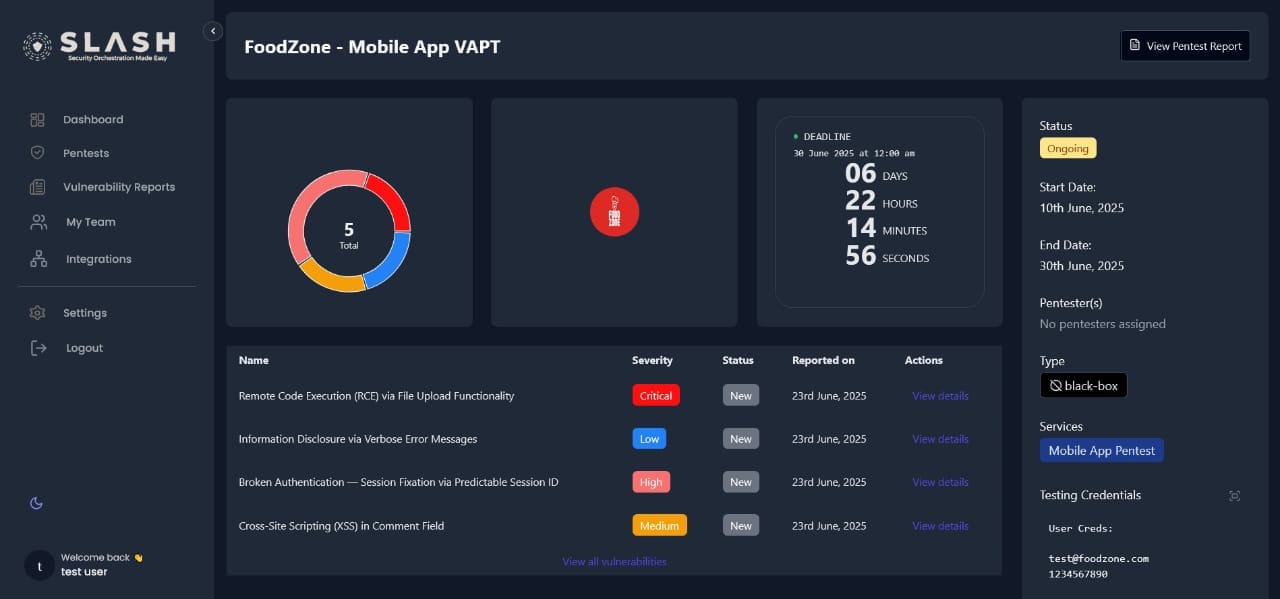
SLASH closes that gap differently. When engineering marks a fix deployed, you hit retest and the platform re-verifies the finding automatically, returning one of three verdicts in seconds: fixed, still vulnerable, or could not verify. No scope call, no tester week. A retest that consumed a tester-day closes the same afternoon the engineer ships. Every retest is timestamped and archived, so when an auditor asks you to prove a critical was fixed and re-verified, it is one click rather than an email thread.
This matters beyond convenience. Across every compliance framework we have written about, the retest report is the single most commonly missing artifact in an evidence pack. Our ISO 27001 and SOC 2 guide covers why auditors treat a report with open criticals and no retest as weaker than no report at all. A platform that makes retest evidence automatic is solving an audit problem, not a workflow preference.
Dradis is the honest outlier here. It is excellent at reporting and carries one of the widest scanner importer sets in the category, but fix verification is not what it was built for. If your bottleneck is remediation rather than report production, that is a decisive difference.
Shareable proof: the certificate problem
Here is a problem every platform in this category shares except one.
A penetration test report cannot be shared publicly. It contains exploitation detail, architecture information and unresolved findings. So it moves under NDA, one prospect at a time, through a legal review that adds days to a sales cycle. Meanwhile the thing your customer actually wants to know is simple: has this company been tested, by whom, when, and were the findings closed?
That question does not require the report. It requires an attestation. And the normal answer, a PDF letter on headed paper, is trivially forgeable and impossible for the recipient to verify independently.
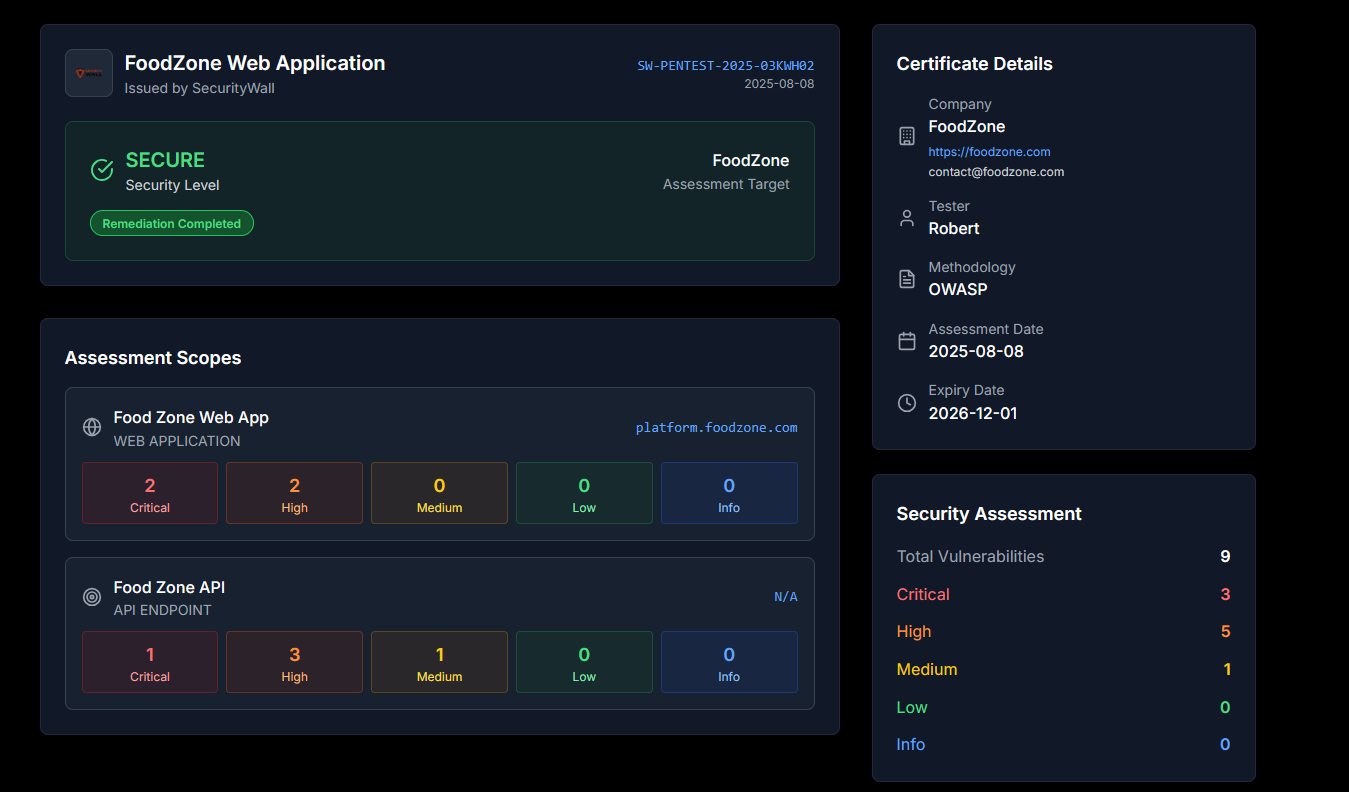
SLASH issues a certificate that can be shared in the open. It confirms the engagement, the scope, the dates and the remediation status without exposing findings, and it is cryptographically anchored so anyone receiving it can verify it is genuine and unaltered without contacting SecurityWall. You can put it on a trust page, attach it to an RFP response, or hand it to a prospect's security team on day one instead of week three. Certificate proves authenticity of the test performed and the scope and statistics of finding and verification of the restesting.
| Artifact | Shareable Publicly | Independently Verifiable | Friction for the Recipient |
|---|---|---|---|
| Full pentest report | No, NDA required | Yes, if they read it | Days of legal review |
| Attestation letter PDF | Yes | No, forgeable | Low, but low trust |
| Platform status badge | Yes | Only within that vendor | Low, limited credibility |
| SLASH certificate | Yes | Yes, cryptographically anchored with no sensitive details within certificate | One link, no NDA |
No other platform in this comparison issues a publicly shareable, independently verifiable certificate at the time of writing.
For a SaaS company whose pentest exists mainly to unblock enterprise deals, this changes what the engagement is worth. The report satisfies the auditor. The certificate satisfies the buyer, immediately, without a legal round. Our guide on passing a vendor security assessment covers how much of a sales cycle that single step consumes.
Thirty minutes against a live sample engagement, then a trial run against your own scope. Scoping, automated retest, Jira sync, report and certificate, end to end.
Book a SLASH walkthrough →What each one actually costs
| Platform | Published Price | Model | Source and Date |
|---|---|---|---|
| PentestPad | From €49 per user per month | Business tier €129 | Capterra and GetApp listings, 2026 |
| AttackForge | From $50 per user per month | Pro plan | Published vendor pricing, April 2026 |
| Cyver Core | From €99 per month | Usage based | Capterra and Software Advice, 2026 |
| Dradis Pro | From $100 per user per month | Assess plan | Dradis pricing page, August 2026 |
| PlexTrac | Not published | Enterprise quote | Third parties report $450 to $500+ per month, unverified by vendor |
| SLASH | Unlimited Users | Quote based, scoped on one call | Our own product. The same criticism applies |
Third-party figures for PlexTrac come from comparison sites, not from PlexTrac, and are indicative only. Prices verified September 2026 and will drift; check vendor pages before budgeting.
That last row stays in. If opaque pricing is a fair complaint against PlexTrac it is a fair complaint against us, and the only honest mitigation we can offer is that you get a scoped number inside one call rather than a procurement cycle.
One warning about the free end of the market, since it is where most of these comparisons end. A free licence is not a free platform. Self-hosting means someone owns the server, the upgrades, the backups and the access control. Template configuration is days of work before the first report ships. Neither cost appears on a pricing page, and both are usually larger than the licence you avoided. Free is the right choice when your coordination overhead is genuinely near zero, and the wrong one the moment a second person needs to act on a finding.
Basis — Dradis pricing page (Aug 2026), AttackForge published pricing (Apr 2026), PentestPad listings on Capterra, GetApp and Software Advice (2026), Cyver Core listings on Capterra and Software Advice (2026).
Which one fits which team
What to check before you migrate
| Check | Why It Decides the Outcome |
|---|---|
| Data export format from your current platform | Findings, evidence and attachments. If export is PDF only, your history does not move |
| Template portability | Years of report templating is the real switching cost. Ask whether the new vendor rebuilds your template for you |
| Historical findings import | Without history you lose recurrence tracking, the metric that proves remediation is working |
| Finding library or writeups database | A reusable library is what makes reporting fast. Rebuilding it is weeks nobody budgets for |
| Client-facing URLs already shared | If clients bookmarked portal links, migration breaks them. Plan the comms before cutover |
A vendor that cannot answer all five in writing before the contract is signed will not answer them better afterwards.
One piece of advice that costs vendors money and saves buyers more: do not migrate mid-engagement. Switch between client engagements, run both platforms in parallel for one cycle, and keep the old subscription for thirty days past cutover. The overlap fee is always cheaper than the recovery.
Frequently asked questions
Who acquired PlexTrac and when? Brinqa, an exposure management vendor, announced the acquisition on 19 August 2026 for undisclosed terms. The combined company reports more than 3,000 customers across 57 countries. Founder Dan DeCloss joined Brinqa's executive team and board to lead the combined offensive security practice.
Should I leave PlexTrac because of the acquisition? Not automatically. Brinqa states PlexTrac continues as a standalone offering and retained its founder. Raise roadmap and pricing questions at renewal. Move only if your workflow is consultancy delivery and enterprise CTEM priorities start crowding it out.
Are Ghostwriter and SysReptor real PlexTrac alternatives? Only if all you need is a report. Both are report generators: no remediation tracking, no ticket sync, no fix verification, no client delivery. For a solo tester they are excellent and free. As a replacement for a management platform they are a category mismatch.
Which PlexTrac alternative verifies that fixes actually worked? SLASH is the only platform in this comparison that re-verifies a finding automatically on demand and returns a verdict in seconds, with a timestamped archive for auditors. The others provide a retest workflow that still requires scheduling a human tester, typically adding one to three weeks.
Can I share a pentest result publicly without sharing the report? With most platforms, no. A report moves under NDA and an attestation letter is forgeable. SLASH issues a cryptographically anchored certificate confirming scope, dates and remediation status that can be published openly and verified by the recipient independently.
Which PlexTrac alternatives can be self-hosted? AttackForge, Dradis Pro, PentestPad and SysReptor Professional offer self-hosted deployment. Ghostwriter and SysReptor Community are self-hosted only. SLASH is cloud, so teams with a hard data residency or air-gap requirement should look at AttackForge or Dradis.
How much does PlexTrac cost? PlexTrac does not publish pricing and sells on enterprise quote. Third-party comparison sites report roughly $450 to $500 or more per month, but these are not vendor-confirmed and real cost depends on seats, modules and contract term.
See the retest and the certificate live
Thirty minutes against a sample engagement, then a trial run on your own scope. If self-hosting is mandatory or you are a team of one, we will point you at AttackForge, Dradis or Ghostwriter instead.
Book a walkthrough →
Twenty minutes, a scoped price, and an honest answer on whether SLASH fits your workflow.
Book a walkthrough →Tags
About Babar Khan Akhunzada
Babar Khan Akhunzada leads security strategy, offensive operations. Babar has been featured in 25-Under-25 and has been to BlackHat, OWASP, BSides premiere conferences as a speaker.