
Why Nessus Reports Are Not Client-Ready (With Examples)
Babar Khan Akhunzada
January 2, 2026
Nessus is an excellent vulnerability scanning engine. It is fast, comprehensive, and widely trusted for identifying security issues across networks and cloud environments.
However, Nessus reports are not designed to be shared directly with clients.

Security consultants, penetration testers, and internal security teams quickly discover that raw Nessus reports create confusion, not clarity. Clients struggle to understand severity, prioritize remediation, or connect findings to real business risk.
If you’ve already seen how raw scan output is structured, this problem becomes obvious when you start trying to interpret results in practice, as explained in How to Read a Nessus Report: Results, Severity & Plugins Explained.
Here focuses on why that same structure completely fails in client-facing scenarios, with real examples and clear fixes.
Nessus Was Built for Detection, Not Communication
Nessus focuses on finding vulnerabilities, not explaining them.
A standard Nessus report is optimized for:
- Scanner accuracy
- Technical completeness
- Plugin-based detection logic
It is not optimized for:
- Executive understanding
- Risk prioritization
- Client decision-making
- Compliance evidence
- Remediation planning
This mismatch is the root cause of most reporting problems.
Problem #1: Severity Levels Without Business Context
Example
A Nessus report shows:
- 4 Critical vulnerabilities
- 27 High vulnerabilities
- 113 Medium vulnerabilities
To a client, this immediately raises alarm.
But Nessus severity is based primarily on CVSS scores, not:
- Asset criticality
- Exposure level
- Business impact
- Compensating controls
As explained in How to Read a Nessus Report: Results, Severity & Plugins Explained, severity in Nessus does not equal priority.
A Critical vulnerability on an internal, non-production host may pose less risk than a Medium issue on a public-facing application. Nessus does not explain this distinction.

Clients often ask:
“Why is this Critical issue lower priority than that Medium one?”
Raw Nessus reports cannot answer that question.
Problem #2: Plugin Noise Overwhelms Real Risk
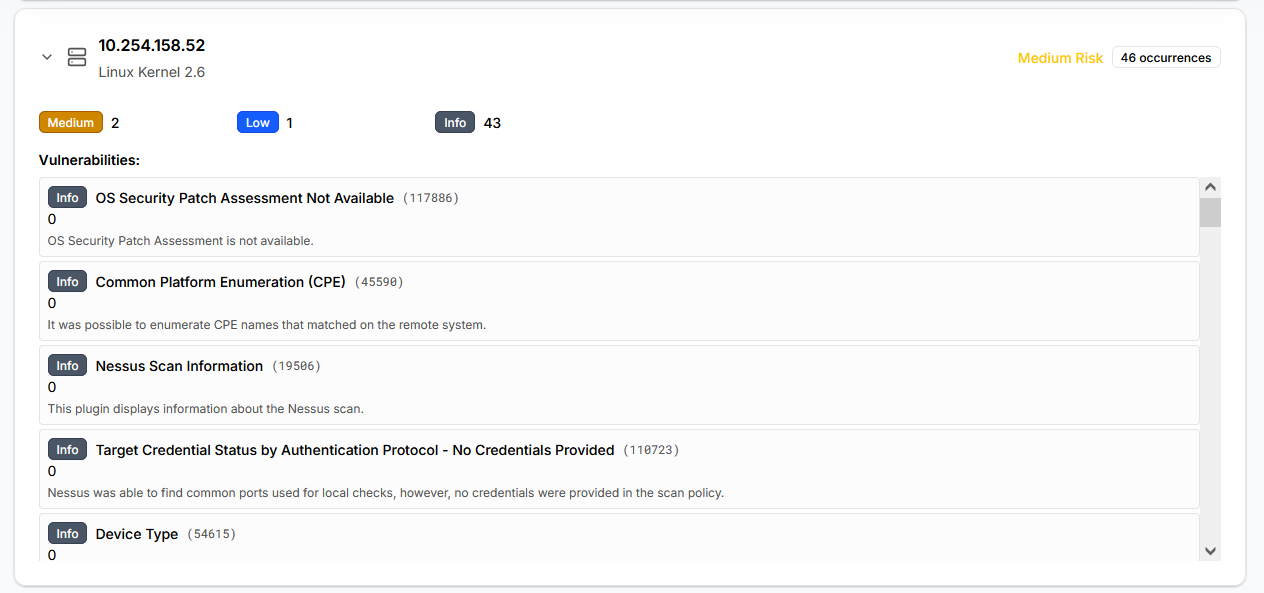
Nessus reports are plugin-driven. Each plugin generates one or more findings, which leads to:
- The same plugin repeated across dozens of hosts
- Hundreds of informational findings
- Discovery data mixed with real vulnerabilities
Example
A client receives a 120 page Nessus report where:
- 60% of findings are informational
- Scan metadata appears alongside vulnerabilities
- Low-risk plugins obscure real issues
This problem is especially obvious once you understand how plugin IDs work, but clients never see that explanation.
They do not know:
- Which plugins matter
- Which findings require action
- Which items can be ignored
This creates alert fatigue and damages trust in the report.
Problem #3: Flat CSV and XML Reports Are Not Human-Friendly
Most Nessus reports are delivered as CSV or XML files.
These formats are:
- Flat
- Repetitive
- Unprioritized
- Difficult to interpret without tooling
Example
A Nessus CSV contains:
- Thousands of rows
- Repeated plugin IDs
- Missing hostnames in cloud scans
- No grouping by asset or service
Clients ask:
“Which system is the most vulnerable?”
“What should we fix first?”
As outlined in How to Read a Nessus Report: Results, Severity & Plugins Explained, raw exports were never meant to answer these questions. A raw CSV cannot answer either.
Problem #4: Nessus Reports Lack an Executive Summary
Clients rarely want raw vulnerability data first. They want:
- Overall security posture
- Key risks that matter to the business
- Clear remediation priorities
Nessus reports do not include:
- Executive summaries
- Risk narratives
- Business-level explanations
Example
A CISO receives a Nessus report and asks:
“Are we safe right now?”
The report responds with plugin output, not answers.
Problem #5: Nessus Does Not Validate Exploitability
Nessus identifies potential vulnerabilities, not confirmed exploits.
It does not:
- Exploit vulnerabilities
- Confirm impact
- Validate chaining risks
This leads to:
- False positives
- Overestimated risk
- Misaligned remediation efforts
This is why Nessus output alone is insufficient for client reporting and why professional penetration testing reports remain essential.
Why Clients Struggle With Raw Nessus Reports
From a client’s perspective, Nessus reports often feel:
- Overly technical
- Alarmist
- Unclear
- Hard to act on
Clients are not interested in plugin IDs or scan metadata. They want:
- What is wrong
- Why it matters
- What to fix first
- How to reduce risk
Raw Nessus reports fail at all four.
How to Make Nessus Findings Client-Ready
To make Nessus results usable for clients, security teams need to transform, not just deliver, scan output.
This usually involves:
1. Visualizing Nessus Results
Instead of sharing CSV or XML files, teams visualize findings to:
- Group vulnerabilities by host and service
- Highlight high-risk assets
- Reduce informational noise
You can do this using the Nessus report visualizer, which converts raw Nessus data into structured, readable insights.
For a practical walkthrough, see Free Nessus Report Visualizer: Instantly Understand Your Nessus Scans.
2. Adding Risk Context Through Assessment
Nessus findings become meaningful when combined with structured vulnerability assessment findings that consider exposure, asset value, and business impact.
3. Validating With Penetration Testing
Confirmed exploitability and impact should come from penetration testing reports,
not scanner output alone.
4. Tracking Risk Over Time
Clients also want to know whether risk is improving platforms like
SLASH help track vulnerabilities, remediation progress, and recurring issues across scans.
Nessus is an excellent scanner, but it was never meant to be a client-facing reporting tool.
Raw Nessus reports:
- Lack context
- Create confusion
- Overwhelm clients
- Undermine trust
Client-ready reporting requires visualization, prioritization, and explanation not just scan output.
If you deliver Nessus results to clients, transforming them is not optional. It is the difference between a report that informs and one that frustrates.
Make Nessus reports client-ready
Try the Free Nessus report visualizer.
About Babar Khan Akhunzada
Babar Khan Akhunzada leads security strategy, offensive operations. Babar has been featured in 25-Under-25 and has been to BlackHat, OWASP, BSides premiere conferences as a speaker.