
Vibe Coding Security Checklist: 44 Checks Before Ship
Hisham Mir
June 12, 2026
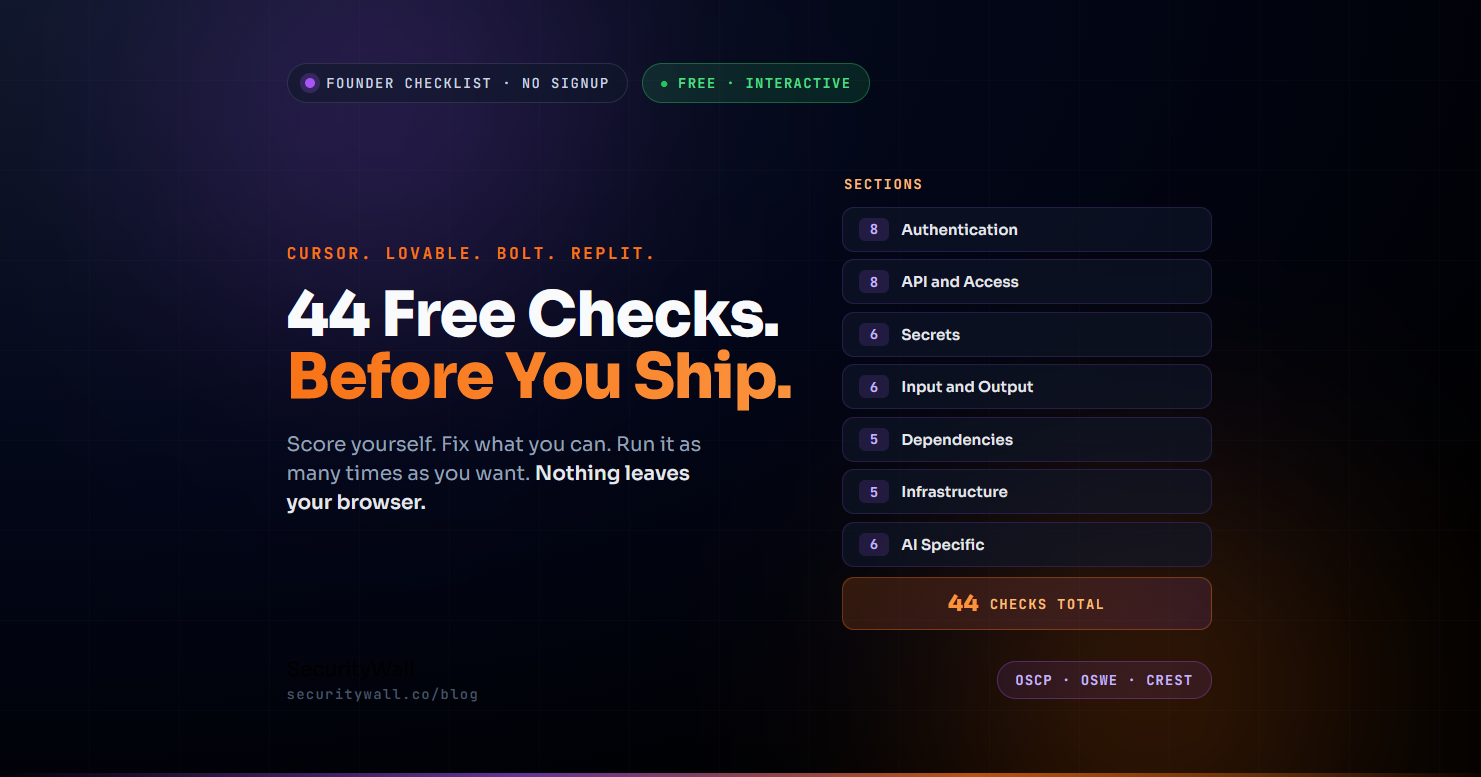
If you built something on Cursor, Lovable, Bolt.new, Replit, v0, Windsurf, GitHub Copilot, or Claude Code and you are getting ready to ship to your first paying user, your first enterprise demo, or your first compliance audit this is the checklist you run before that ship date.
44 checks across 7 sections. Every check is something you can verify yourself by looking at your code, your config, or your app behaviour no security expertise required. There is a score bar that updates as you go. There are no signups, no emails captured, nothing leaves your browser. Take the result and fix what you can; for the items that need deeper testing, our vibe coding security audit picks up where this checklist leaves off.
The data behind why this exists: Veracode found that 45% of AI-generated code contains OWASP Top 10 vulnerabilities, and Carnegie Mellon research shows only 10.5% of AI-generated code passes basic security review. Background context in our Vibe Coding Security Risks piece. This page is the practical companion.
Vibe Coding Security Checklist
44 self-verifiable checks across 7 sections. Run through it before you ship. Nothing leaves your browser.
Why Silicon Valley Founders Trust Our Methodology
A checklist is the floor, not the ceiling. The 44 items above catch the patterns that consistently fail in vibe-coded applications the ones a founder can verify alone. They do not catch the issues that need active testing: IDOR chains where a single endpoint leaks data across tenants, business-logic abuse where a payment flow can be replayed, attack chains where three small bugs combine into a full account takeover, or agentic risks where an LLM-driven workflow can be coerced into actions the developer never intended.
These are the issues we audit for and they are the reason founders from Silicon Valley, Y Combinator–style accelerators, and the broader emerging startup ecosystem bring their vibe-coded applications to us before enterprise launch, payment integration, or compliance audits.
Our approach is deliberately hybrid. Pure automated tools (Snyk, Veracode automated, Semgrep, SonarQube) are excellent at catching the structural patterns at scale and we use them inside every engagement for regression coverage. Pure manual pentesting catches what tools miss but is slower and more expensive than it needs to be when the automatable work is left to a human. We combine both:
- Automated tooling runs continuously through the engagement, covering known vulnerability classes, dependency CVEs, secret leakage, and configuration issues at scale
- Human-led testing focuses on application-specific failures business-logic abuse, authorisation chains, IDOR exploitation, agentic abuse, and the chains of small issues that combine into serious vulnerabilities
- AI-pattern awareness layers across both, because we know what Cursor, Lovable, Bolt, Replit, and v0 default to producing and we test for those specifically
The result is the depth of a senior pentest team with the speed and cost profile of a startup-friendly engagement. For the broader context on how this compares to the wider market, our vibe coding security audit guide covers pricing benchmarks across Big-4 consultancies, boutique pentest firms, and AI security specialists.
SLASH: How We Deliver
Engagements run through SLASH, our security orchestration and control platform. The difference SLASH makes for founders specifically: findings appear in your dashboard the same day they are discovered, not in a PDF that lands two weeks after the engagement ends. Your engineers can ask reproduction questions directly under each finding, internal notes stay private to your team, and remediation tracking moves issues through New → Ready for Retest → Resolved with full audit trail.
For a founder running a vibe-coded application, three SLASH features matter most:
- Same-day findings. If we find an authentication bypass on day two of the engagement, you do not wait two weeks to find out you start fixing immediately and reduce your exposure window.
- Threaded reproduction. Your engineers do not need to play email tag with our testers. Questions, evidence, and remediation discussion all live under the finding.
- Retest in the platform. When you ship a fix, request retest from inside SLASH. We validate closure and update status without scheduling overhead.
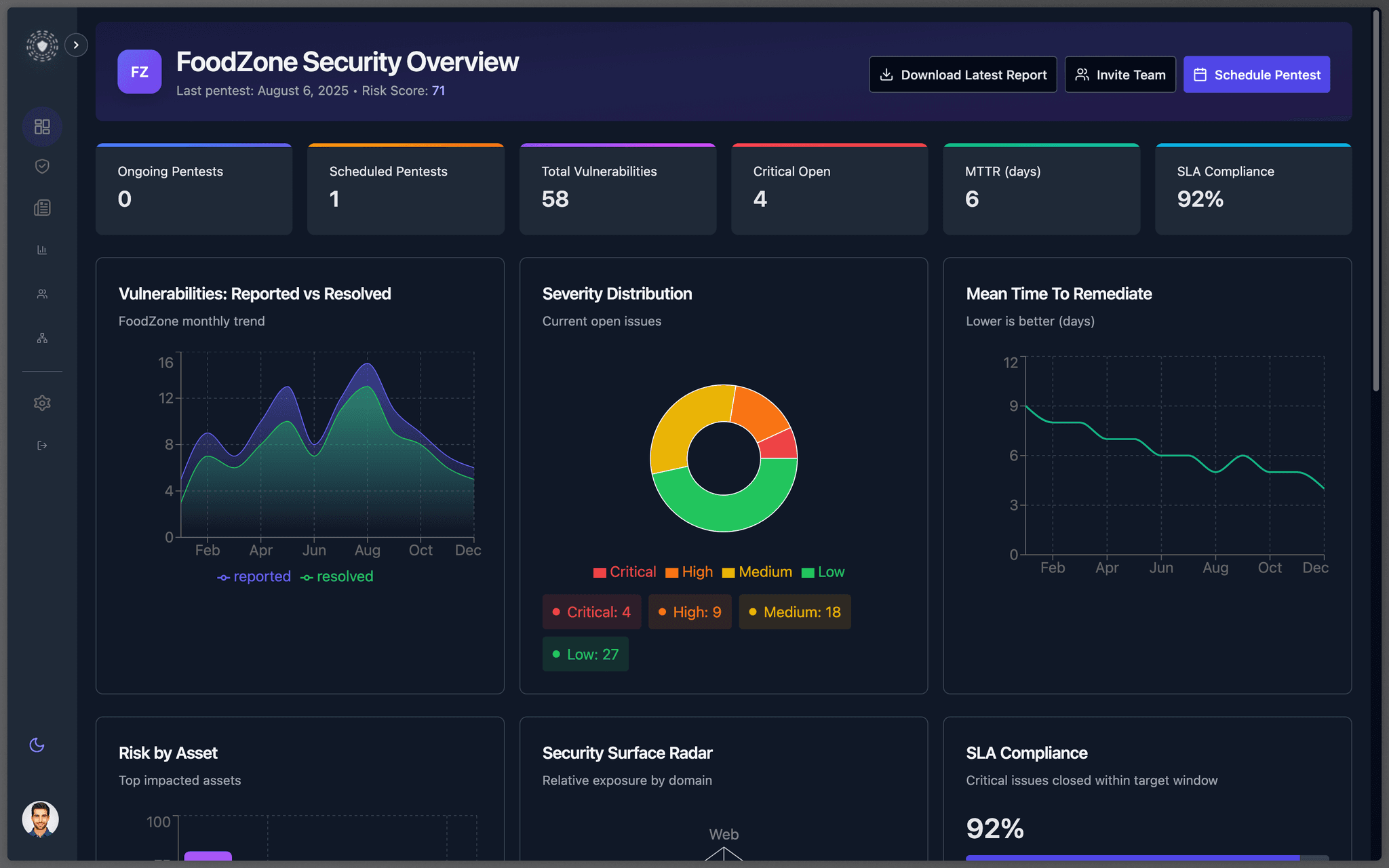
This is what your team sees as our testers work not what you read in a PDF that lands two weeks after closure. Real findings, real timestamps, real severity, real attack chains.
The findings stream into the wider SLASH dashboard, where your team can filter by severity, assign owners, drop internal notes, request retest, and watch status move through the engagement
Related reading:
- Vibe Coding Security Risks: What Founders Need to Know
- Vibe Coding Security Audit: What We Test and What We Find
- LLM Penetration Testing: How to Test AI Applications
- JWT Security Testing: Use the Free JWT Analyzer
Frequently Asked Questions
Is this checklist really free? Do I need to sign up?
Yes, free, no signup. The checklist runs entirely in your browser we don't store your answers, we don't capture your email, and nothing about your application leaves the page. Refresh the browser and the state resets. Bookmark the page and come back as many times as you want.
Will completing this checklist make my app secure?
It will catch the patterns that consistently fail in vibe-coded apps. It will not catch business-logic abuse (where a payment flow can be replayed), IDOR chains where small bugs combine into serious data exposure, or agentic-AI risks where an LLM-driven workflow can be coerced. For those, a scoped audit is the answer. The checklist is the floor; the audit is the ceiling.
How do I know if my app is at the level where I need an audit, not just the checklist?
If any of the following apply, the checklist alone is not enough: you are about to onboard your first enterprise customer, you are processing payment data, you handle personal data at any meaningful scale, you have a SOC 2 / ISO 27001 / NIS2 audit coming up, or you have made significant feature additions to vibe-coded code over multiple iteration rounds. The Shukla et al. 2025 study found 37.6% more critical vulnerabilities after just 5 iterations of AI refinement iterated code needs more than self-review.
Why does SecurityWall use a hybrid methodology instead of just automated tools?
Automated tools (Snyk, Veracode automated, Semgrep, SonarQube) are excellent at known patterns at scale and we use them. Pure automation misses business-logic abuse, authorisation chains, IDOR exploitation, and the chains where small individual findings combine into serious exploits. Pure manual testing catches those but is slower than necessary on regression work. Combining both automation for breadth, humans for depth is the methodology Silicon Valley founders trust for pre-launch validation.
Can you audit applications built with any AI coding tool?
Yes Cursor, Lovable, Bolt.new, Replit (Agent and Bounties), v0, Windsurf, GitHub Copilot, Claude Code, OpenAI Codex, and Devin. The vulnerability patterns are structural across the category, not specific to any single vendor, so the methodology works regardless of which tool you used.
Tags
About Hisham Mir
Hisham Mir is a cybersecurity professional with 10+ years of hands-on experience and Co-Founder & CTO of SecurityWall. He leads real-world penetration testing and vulnerability research, and is an experienced bug bounty hunter.