
Vibe Coding Security: How to Test Vibe Coded Apps?
Babar Khan Akhunzada
June 12, 2026
If you are reading this, you have most likely built something on Cursor, Lovable, Bolt.new, Replit, v0, Windsurf, GitHub Copilot, or Claude Code, and you are about to put it in front of real users. You want to know what an actual security audit covers, what we typically find when we run one, how long it takes, and what it costs. This article tells you exactly that.
The wider picture on why this matters the Veracode 45% number, the Carnegie Mellon 10.5% finding, the iteration paradox is covered in our Vibe Coding Security Risks piece. This article assumes you have decided you need an audit and you want to know what the engagement looks like.
- What a Vibe Coding Security Audit Is
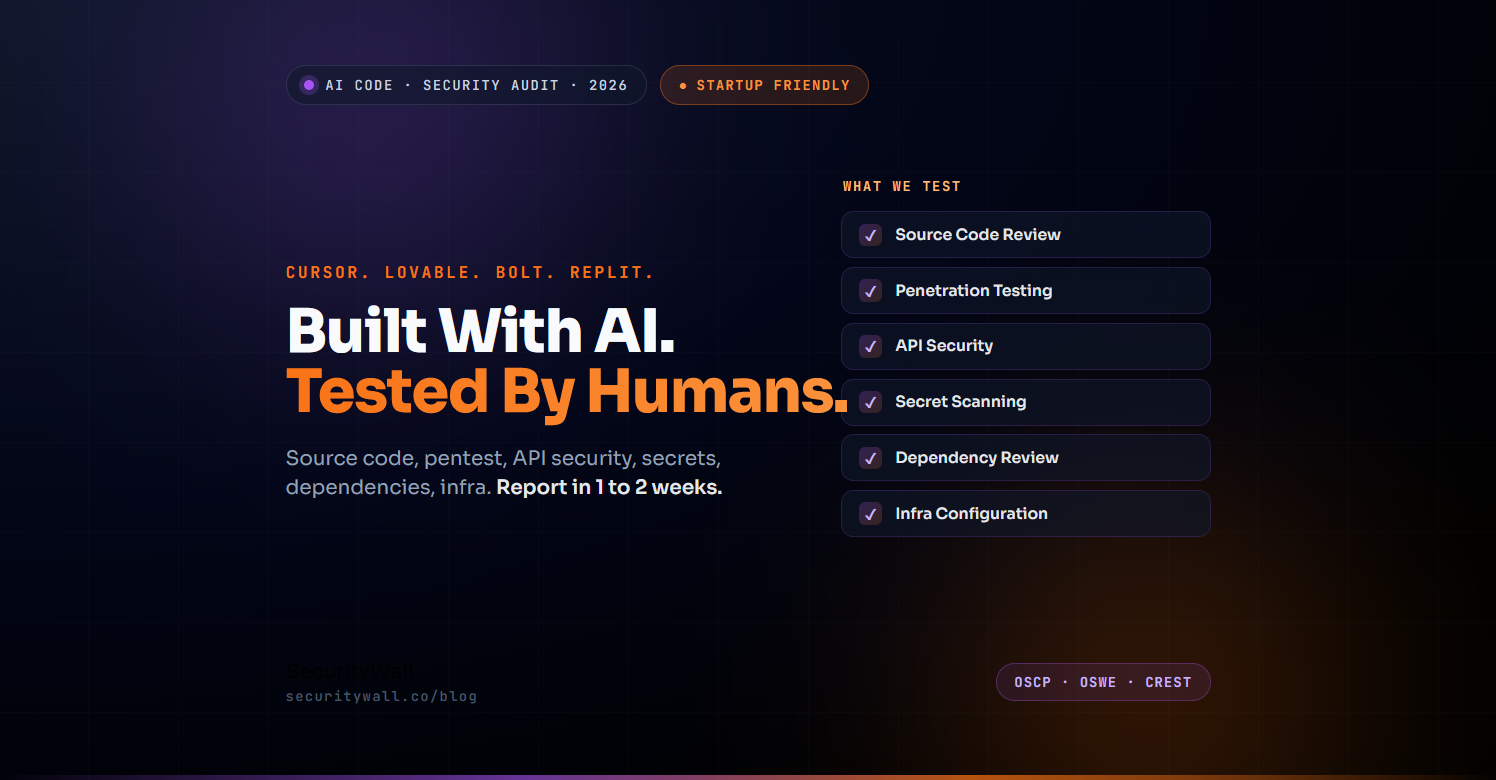
- What We Test
- What We Find
- What the Report Contains
- How Long It Takes and What It Costs
- When You Need This Audit
What a Vibe Coding Security Audit Is
A vibe coding security audit is a structured review of an AI-generated application designed to find the security failures that AI coding tools produce by default combined with the conventional application-security work that any web app needs before production.
The methodology differs from a generic application pentest in three ways. First, the source code review is AI-pattern aware we look for the specific defaults Cursor, Lovable, Replit, and v0 ship with, not generic SAST output. Second, we expect to find specific vulnerability classes (hardcoded secrets, missing CSRF, broken object-level authorisation) that automated tools miss in human-written code but surface predictably in AI-generated code. Third, we factor in the iteration history of the application because the Shukla et al. 2025 research shows critical vulnerabilities increase 37.6% after just five rounds of AI refinement, and the code shipped today is rarely the code generated on day one.
The engagement is delivered through SLASH, our security orchestration platform findings appear in your dashboard the same day they are discovered rather than in a PDF two weeks later, and your team can collaborate on each vulnerability through threaded comments.
What We Test
A scoped engagement exercises six surfaces.
Source code review. We read what the model generated, looking specifically for AI-default patterns: string-concatenated SQL queries instead of parameterised ones, hardcoded credentials in source rather than environment variables, missing server-side authorisation checks on endpoints that look authenticated client-side, weak crypto choices (MD5/SHA1 for passwords, ECB-mode ciphers), and output handling that pipes user input into HTML, SQL, shell commands, or browser contexts without sanitisation.
Hybrid Penetration testing. With combination of home-built tools and manual approach to Active exploitation of the running application from an attacker's perspective. Authentication and session bypass, account-takeover paths, IDOR (Insecure Direct Object References) testing, injection attacks, business-logic abuse, privilege escalation, and Server-Side Request Forgery probing. For the broader methodology see our penetration testing service.
API and authorisation review. Every API endpoint reviewed for: authentication enforcement, object-level authorisation (does the endpoint check whether the requesting user can access the requested record?), function-level authorisation (does the endpoint check whether the requesting user can perform this action?), rate limiting, input validation, and JWT handling see our JWT analyzer guide for the specific JWT testing approach. Row-Level Security (RLS) configuration in Supabase / Firebase / equivalent is reviewed closely, because AI tools routinely generate clients that assume RLS is on while the backend actually trusts client-supplied IDs.
Secret scanning. Source code, configuration files, deployment artefacts, environment files, and Git history are scanned for API keys, database credentials, cloud provider tokens, OAuth client secrets, and webhook signing keys. Anything found gets logged as a finding regardless of whether it is "currently exposed publicly" committed secrets need to be rotated, not just hidden.
Dependency and supply chain review. What packages the AI tool pulled in, whether they have known CVEs, whether transitive dependencies introduce risk, and whether anything in the dependency tree is typosquatted or known-malicious. AI tools have a tendency to pull packages by approximate name, and the gap between what was requested and what was installed is occasionally exploitable.
Infrastructure and configuration check. Cloud resources provisioned (or recommended) by the AI tool IAM roles, storage bucket permissions, network configurations, exposed endpoints, default credentials on platform services. Review of environment variables, secrets manager configuration, and deployment defaults that are easy to ship insecurely without realising.
What We Find
Across the vibe-coded applications we have audited, the same handful of patterns dominate the findings. These mirror what independent industry research shows which is the strongest signal that the patterns are structural, not accidents.
Hardcoded secrets. Almost every vibe-coded app we review has at least one hardcoded credential API keys, database connection strings, OAuth secrets, third-party tokens. Escape.tech scanned over 5,600 applications built with AI coding tools and found over 400 exposed secrets across them. The pattern is consistent in our work: secrets in source, secrets in committed .env files, secrets in deployment configs.
Missing CSRF protection and missing security headers. Tenzai's December 2025 study tested 15 applications built across Cursor, Claude Code, Replit, Devin, and OpenAI Codex. Zero implemented CSRF protection. Zero set any security headers (Content-Security-Policy, X-Frame-Options, Strict-Transport-Security). We see this every engagement.
Server-Side Request Forgery. The same Tenzai study found that every single one of the 15 applications had at least one SSRF vulnerability. SSRF in vibe-coded apps usually shows up in features that fetch URLs (image uploads from URL, link previews, webhook callbacks) and that fail to validate the destination against internal IP ranges.
Broken object-level authorisation (IDOR). The most consistently dangerous finding pattern. The API accepts an ID; the API returns the record; the API never checks whether the caller is authorised to see that specific record. We find this in almost every engagement, and it usually leaks customer data to anyone who can guess or enumerate IDs.
No rate limiting on authentication endpoints. Login forms, password reset endpoints, OTP verification credential stuffing is a real and trivial attack against most vibe-coded apps because the authentication endpoints accept unlimited attempts.
Output handling failures. Cross-site scripting through model-rendered content, SQL injection through string-concatenated queries, command injection through unsanitised inputs piped to shell commands. Veracode's 2025 benchmark found AI-generated code failed against XSS in 86% of test cases and against log injection in 88%.
Authorisation logic that "works" client-side. Auth guards enforced in React components or page-level checks, but server endpoints that trust the request. Anyone with browser dev tools can bypass these. Common in Cursor, Lovable, and v0 outputs.
These are not exotic findings. They are what AI defaults look like at scale.
What the Report Contains
The deliverable is structured for both your engineering team and any external party who needs to review it later (auditors, customers, future investors).
- Executive summary: Risk posture in plain language, suitable for showing to non-technical stakeholders
- Findings, each with: Severity rating, CVSS score where applicable, OWASP Top 10 mapping, reproduction steps, evidence (screenshots, requests, payloads), business impact framing, and specific remediation guidance with code-level recommendations
- Attack chains: Where individual findings combine into a more serious exploit, the chain documented end-to-end
- Methodology and scope: Exactly what was tested, what was not, against which version, with what approach
- Retest section: Original findings tracked with post-remediation status, dated
Findings are delivered as they are discovered through SLASH, with the final consolidated report available at engagement close. Retest is included when you fix something, request retest in the platform and we validate closure without scheduling back-and-forth.
How Long It Takes and What It Costs
Application security audit pricing varies dramatically by provider type. Here is what the market actually looks like for buyers scoping a vibe-coded application audit in 2026.
| Provider type | Typical engagement cost | Best for |
|---|---|---|
| Big consultancies (Deloitte, PwC, KPMG, EY) | $30,000 to $100,000+ | Fortune 500 retainers, enterprise audits with brand requirement |
| Pure-play pentest firms (NCC Group, Bishop Fox, Cobalt, Synack) | $15,000 to $50,000 | Mid-market enterprise, scaled SaaS with security budget |
| LLM/AI security specialists (Mindgard, HiddenLayer, Lakera) | $16,000 to $50,000+ | AI risk programmes, established AI products with budget |
| SecurityWall (vibe coding audits) | Founder-priced, scoped to your app | MVPs, early-stage SaaS, founder-built products on limited budgets |
Market figures above reflect typical engagement pricing across the wider application security industry. Specific quotes vary by scope, complexity, and provider.
The problem the market has not addressed yet: most vibe-coded applications are built by founders, indie hackers, and small teams with limited capital not enterprise security teams with five-figure annual security budgets. The pricing above reflects enterprise scope, enterprise process, and enterprise margins. A vibe-coded MVP being shipped by a two-person team should not pay Fortune-500 rates for security validation.
SecurityWall is deliberately positioned for early-stage founders, indie hackers, and emerging startups. We scope to your actual application surface a small MVP audit takes a fraction of the time, headcount, and budget of a mid-market enterprise engagement, and we price accordingly. We do not charge tiered enterprise rates. We do not run discovery-call sequences. We do not pad the scope to fit a fixed price.
The honest framing: ask us before committing anywhere. The first conversation is scoping, the quote comes back inside 24 hours, and you are free to compare it against any provider in the table above before deciding anything. Most founders we work with are pleasantly surprised by how scoped and how affordable a focused vibe-coding audit can actually be when it is not bundled into enterprise pricing. Timelines typically run 1 to 2 weeks from kick-off to final report, depending on application complexity.
For the broader penetration testing market context across the wider category, see our penetration testing cost guide.
When You Need This Audit
You need this audit before your first enterprise customer, before moving from free to paid product, before processing payment data, before handling personal data at scale, before any compliance audit (SOC 2, ISO 27001, NIS2, HIPAA), or after significant feature additions to existing vibe-coded code. If two or more of those apply and you have not audited, you are in the window where founders discover this category of risk the hard way.
Related reading:
- Vibe Coding Security Risks: What Founders Need to Know
- LLM Penetration Testing: How to Test AI Applications
- JWT Security Testing: Use the Free JWT Analyzer
- Penetration Testing Cost Guide 2026
Frequently Asked Questions
What does a vibe coding security audit cover?
A vibe coding security audit covers source code review with AI-pattern awareness, penetration testing of the running application, API and authorisation review, secret scanning across source and Git history, dependency and supply-chain review, and infrastructure / configuration checks on AI-provisioned cloud resources. Findings are mapped to OWASP Top 10 and delivered through our SLASH platform with reproduction steps, business impact, and remediation guidance.
How much does a vibe coding security audit cost?
Market rates for application security audits run from $15,000 to $100,000+ depending on the provider big consultancies (Deloitte, PwC, KPMG, EY) sit at the top end with engagements typically $30,000 to $100,000+, boutique pentest firms (NCC Group, Bishop Fox, Cobalt, Synack) range $15,000 to $50,000, and LLM/AI security specialists land at $16,000 to $50,000+. SecurityWall is deliberately positioned for early-stage founders and emerging startups: we scope to your actual application surface rather than charging tiered enterprise pricing, so MVPs and small SaaS audits typically come in at a fraction of the prevailing market cost. Quotes are free and scoped within 24 hours.
How long does a vibe coding security audit take?
Most engagements run 1 to 2 weeks from kick-off to final report, depending on application complexity. A focused audit on a small MVP completes inside a week. Larger applications with more endpoints, user roles, or integrated AI / LLM features extend the timeline correspondingly. Quote and timeline are confirmed within 24 hours of a scoping conversation.
What's the difference between a vibe coding audit and a regular penetration test?
A vibe coding audit applies the same offensive-security methodology as a regular pentest, but with three additions: source-code review that knows what AI tools default to producing, expectation of specific vulnerability classes (hardcoded secrets, missing CSRF, broken object-level authorisation, IDOR) that show up predictably in AI-generated code, and iteration-awareness because the Shukla et al. 2025 research shows critical vulnerabilities increase 37.6% after just five rounds of AI refinement.
Which AI coding tools do you audit applications built on?
Cursor, Lovable, Bolt.new, Replit (Agent and Bounties), v0, Windsurf, GitHub Copilot, Claude Code, OpenAI Codex, and Devin. The methodology works across all of them because the vulnerability patterns are structural, not vendor-specific.
Tags
About Babar Khan Akhunzada
Babar Khan Akhunzada leads security strategy, offensive operations. Babar has been featured in 25-Under-25 and has been to BlackHat, OWASP, BSides premiere conferences as a speaker.