
SOC 2 Penetration Testing: Requirements, Cost and Timeline
Hisham Mir
May 31, 2026
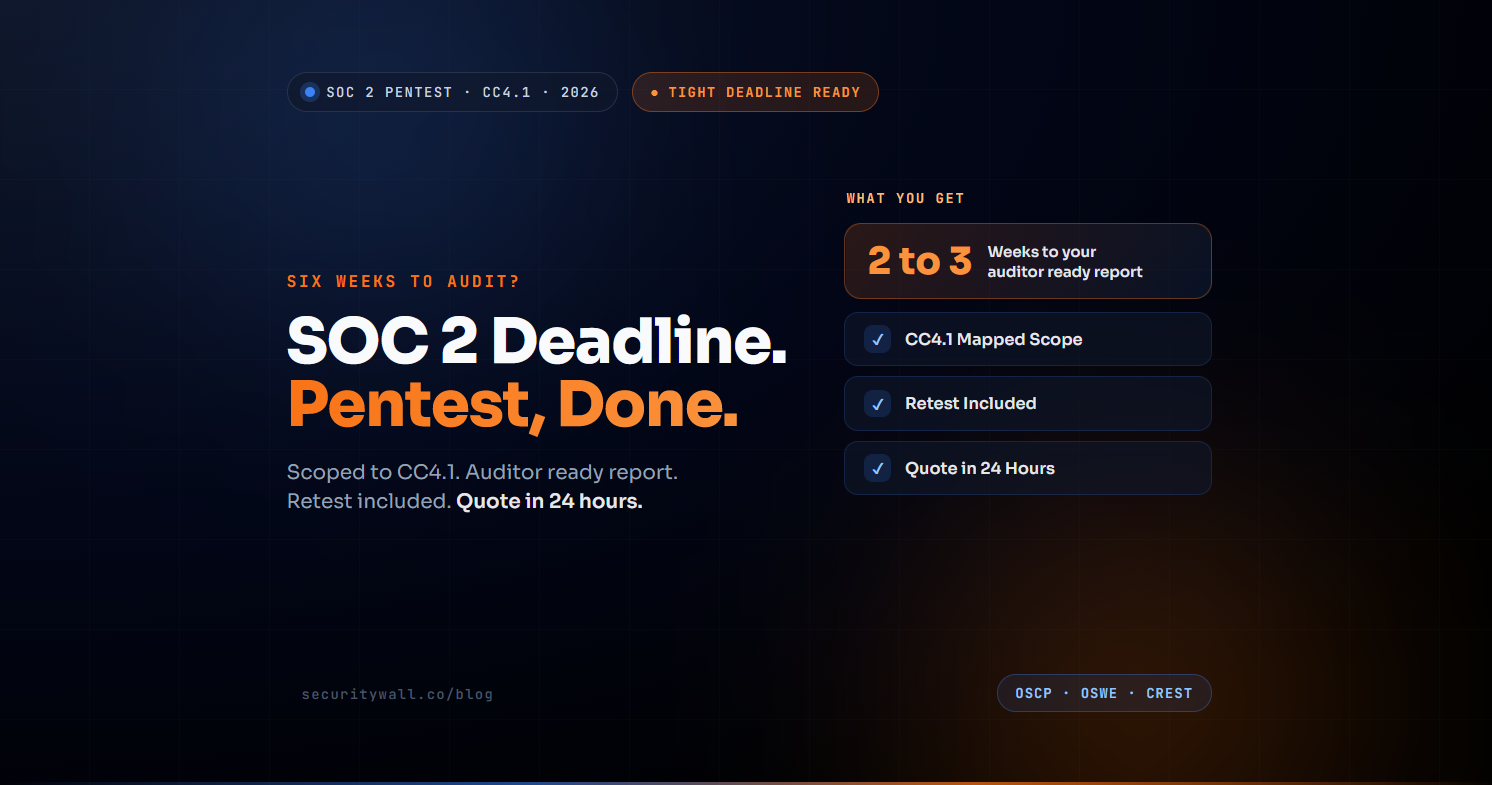
You have a SOC 2 audit on the calendar. Your auditor has told you a penetration test will need to be part of the evidence file, and now you have somewhere between four and twelve weeks to make it happen alongside everything else in the run-up to the audit window. The questions that surface in the next few hours look something like this: does SOC 2 actually require a pentest, what does it need to cover, how long does one take, how much will it cost, and can you somehow combine it with the SOC 2 readiness work you already have running.
This article is built to answer all of those in one pass. Each section is a direct answer to a real question buyers in this position are typing into Google. Where deeper coverage already exists in our cluster the requirements deep-dive, the cost article, and the multi-framework view we link out so you can click through when you need it. If your audit window is genuinely six weeks or less, skip ahead to the timeline section and the same-engagement section.
- Does SOC 2 Require Penetration Testing?
- What the Pentest Must Cover for CC4.1
- How Long a SOC 2 Pentest Takes
- What a SOC 2 Pentest Costs in 2026
- Can You Do SOC 2 and the Pentest in the Same Engagement?
- What the Report Must Contain for Your Auditor
- SecurityWall's SOC 2 Pentest in 2 to 3 Weeks
Does SOC 2 Require Penetration Testing?
Practically, yes even though SOC 2 does not name penetration testing as an explicit mandatory control. The AICPA's Trust Services Criteria do not contain the phrase "you must conduct a penetration test." But CC4.1's points of focus the supplemental implementation guidance the AICPA publishes alongside the criteria explicitly name penetration testing as one of the methods management uses to perform ongoing or separate evaluations of whether internal controls are present and functioning. Quoted directly: management uses "a variety of different types of ongoing and separate evaluations, including penetration testing, independent certifications made against established specifications (for example, ISO certifications), and internal audit assessments."
That language is why auditors universally expect to see pentest evidence in 2026. A scoped, third-party penetration test is the most accepted way to satisfy CC4.1's effectiveness-evaluation expectation, and the same engagement provides evidence across multiple other criteria:
- CC4.1 — ongoing and separate evaluations
- CC6.1 — logical and physical access controls (does access actually hold against attack?)
- CC6.6 — protection against threats from outside system boundaries
- CC7.1 — detection and monitoring procedures (do your detection systems catch real activity?)
- CC7.2 — system component monitoring
- CC9.1 — risk mitigation activities
The shortest accurate answer to the question your auditor and your management are asking: a third-party penetration test is the standard, expected evidence and the absence of one will become a finding in your audit. See our SOC 2 penetration testing requirements deep-dive for the full mapping.
What the Pentest Must Cover for CC4.1
For an auditor to accept the pentest as evidence, the scope has to match your SOC 2 system boundary the systems, components, and infrastructure that store, process, or transmit data covered by your audit. A test that excludes critical in-scope assets will be flagged; a test that wanders outside scope creates noise without value.
The expected coverage for a typical SaaS or technology organisation:
- External attack surface: Internet-facing applications, APIs, authentication systems, public-facing infrastructure
- Internal network: Segmentation, lateral-movement paths, internal authentication, sensitive-data stores
- Web applications and APIs: OWASP-aligned testing covering authentication, authorisation, input validation, business logic, session management
- Cloud infrastructure: IAM misconfigurations, exposed storage, network controls, key management (AWS, Azure, GCP scope as relevant)
- Authentication and access systems: SSO, MFA enforcement, federation, privileged access
Tests should be performed by a qualified, independent third party not an internal team by testers with recognised credentials (OSCP, OSWE, CREST CRT, and similar). The methodology should be defensible and stated in the report (OWASP testing standards, NIST SP 800-115, PTES). Vague methodology sections are a common reason auditors come back with supplemental-evidence requests.
The single most important scoping decision: testing must occur within the audit period. A pentest from twelve months ago does not satisfy a current-period audit; supervisors expect testing performed during, or shortly before, the period under examination.
How Long a SOC 2 Pentest Takes
For a typical SaaS or technology environment, expect 2 to 4 weeks from kick-off to final report and a tight engagement can deliver in 2 to 3 weeks when the scope is well-defined and your team is available for evidence requests.
A representative timeline:
- Day 0–3: Scoping call, statement of work, kick-off scheduling
- Week 1: Discovery, scope confirmation, environment and credential provisioning, OSINT
- Week 2: Active testing across the agreed scope
- End of Week 2 / start of Week 3: Draft report, walkthrough with the client
- Week 3: Final report; remediation window begins; retest scheduled when fixes are in
If you are working to a six-week SOC 2 deadline: yes, this is achievable. The maths is straightforward three weeks for the test and report, two weeks for remediation, one week for retesting and audit hand-off. The conditions: you have to commission the work now, the scope has to be agreed in the first scoping call, and your team has to be available for evidence requests during the engagement. The slowest variable, every time, is internal availability for kick-off interviews and access provisioning.
A common compression that works: combine the scoping call with the kick-off, agree the scope live, and start testing within 72 hours. This is the engagement pattern SecurityWall uses for tight-deadline SOC 2 buyers.
What a SOC 2 Pentest Costs in 2026
A scoped SOC 2 penetration test for a typical SaaS organisation falls into a wide range depending on the size of the attack surface, the number of applications, and the depth requested. The summary version:
- Small SaaS (one application, lean cloud footprint) typically $5,000–$15,000
- Mid-size SaaS (multiple applications, more complex cloud, internal scope) typically $10,000–$20,000
- Larger or more complex environments (multiple products, enterprise-scale infrastructure) $20,000–$40,000+
These are realistic 2026 ranges for engagements that include a qualified third-party tester, OWASP-aligned methodology, a written report formatted for auditor use, and a single retest. Cheaper offerings exist; they typically reflect lighter scopes, less experienced testers, or scanner-driven engagements that auditors increasingly do not accept on their own.
For the full breakdown what affects pricing, the cost categories within an engagement, and how to scope to control the bill see our dedicated SOC 2 penetration testing cost guide. The condensed version above is enough to plan around; the deep-dive is enough to negotiate.
Can You Do SOC 2 and the Pentest in the Same Engagement?
Yes and for organisations under deadline pressure, this is often the right move. The pentest and the SOC 2 readiness work do not have to run sequentially, and there are real efficiencies in running them coordinated.
The honest version: a penetration test and a SOC 2 audit are separate engagements with separate deliverables. The audit itself is performed by a CPA firm; the pentest is performed by a security testing firm and SOC 2 explicitly requires the pentest be conducted by a qualified independent third party (which means your auditor cannot do both). What can happen in a single coordinated engagement:
- Readiness assessment and pentest scoped together. The same provider can run your SOC 2 readiness assessment (mapping your environment to the Trust Services Criteria, identifying gaps) and your penetration test, in coordinated phases.
- Pentest scope informed by the readiness work. The readiness work tells you which systems are in your SOC 2 boundary; the pentest then tests those systems reducing scope guesswork.
- Findings consolidated into one evidence package. Gap findings from readiness and vulnerability findings from the pentest live in one tracked remediation backlog, so you address them once with one plan.
- Retesting handled by the same team. When you close findings, the same firm validates both the gap closures (process/control evidence) and the technical remediation (pentest retest).
Then your independent CPA firm conducts the actual SOC 2 audit and issues the report. Two providers, one coordinated programme, no duplicate work. This is how organisations under time pressure get to a defensible SOC 2 posture in weeks rather than months.
What the Report Must Contain for Your Auditor
Not every pentest report satisfies a SOC 2 auditor. The structural requirements supervisors look for:
- Scope and engagement dates: What was tested, when, against what version of your systems
- Methodology stated explicitly: OWASP, NIST SP 800-115, PTES, or equivalent, named directly; vague "industry best practice" language gets flagged
- Tester credentials: Named individuals where possible, with recognised credentials (OSCP, OSWE, CREST CRT)
- Independence statement: Confirming the testing team is independent of the systems being tested
- Findings with severity and CVSS scoring: Each finding rated consistently, with risk context
- Reproduction steps and evidence: Screenshots, request/response samples, exploit chains
- Remediation guidance: Specific, actionable, mapped to the finding
- Mapping to Trust Services Criteria: Findings cross-referenced to CC4.1, CC6.1, CC6.6, CC7.1, CC9.1 where relevant
- Retest section: Original findings with post-remediation status, dated
The most common reason auditors reject pentest reports: insufficient evidence of independence, vague methodology, or no mapping to the Trust Services Criteria. A report that ticks all of these boxes is one that goes into the evidence file without follow-up questions.
SecurityWall's SOC 2 Pentest in 2 to 3 Weeks
SecurityWall delivers SOC 2 penetration testing scoped to your Trust Services Criteria, on tight deadlines, with reports auditors actually accept. Our team holds OSCP, OSWE, CREST, CRT, CISM, and CISSP credentials, and we run SOC 2 engagements weekly across SaaS, fintech, and technology buyers.
Built for the SOC 2 Deadline
- 2 to 3 week delivery for tight engagements, when scope is agreed and your team is available
- Quote in 24 hours of an initial scoping call
- Kick-off within 72 hours of contract signature for time-critical engagements
- Coordinated with your SOC 2 readiness or gap analysis where you need it
Scoped to CC4.1 (and Beyond)
- External, internal, web application, API, and cloud infrastructure coverage
- Methodology stated in the report (OWASP, NIST SP 800-115, PTES)
- Findings cross-referenced to the relevant Trust Services Criteria (CC4.1, CC6.1, CC6.6, CC7.1, CC9.1)
- Coverage scoped to your SOC 2 system boundary not generic, not boilerplate
Auditor-Ready Reporting
- Scope, methodology, independence, credentials, findings with evidence, and remediation guidance
- Retest included your auditor sees original findings with verified closure status
- Reports formatted for direct evidence-file use; supplemental-evidence requests minimised
- Comfortable working alongside your CPA audit firm handoffs documented
One Programme Across Your Stack
- SOC 2 today and if you also face ISO 27001, PCI DSS, or NIS2, one engagement can satisfy multiple frameworks
- For Dutch SaaS organisations, see our Netherlands SOC 2 pentest guide
- Free SOC 2 Readiness Assessment tool to self-check before commissioning paid work
Related reading:
- SOC 2 Penetration Testing Requirements
- SOC 2 Pentest Cost Guide
- Penetration Testing for SOC 2, ISO 27001 and PCI DSS
- SOC 2 Readiness Assessment Guide
- SOC 2 Gap Analysis
- SOC 2 Type 1 vs Type 2
- SOC 2 Compliance for SaaS
- What Is SOC 2 Compliance?
Frequently Asked Questions
Does SOC 2 require penetration testing?
Practically yes. SOC 2 does not name penetration testing as an explicit mandatory control, but the AICPA's CC4.1 points of focus explicitly reference penetration testing as one of the methods management uses to perform required evaluations. Pentest evidence also supports CC6.1, CC6.6, CC7.1, CC7.2, and CC9.1. Auditors universally expect to see a third-party penetration test in the evidence file in 2026.
Is penetration testing required for SOC 2?
In effect, yes. While the Trust Services Criteria do not contain the literal phrase "penetration testing is required," CC4.1's points of focus name penetration testing as an accepted method for evaluating control effectiveness and modern SOC 2 audits universally expect a third-party pentest in the evidence file.
Can I get a SOC 2 pentest done in 6 weeks?
Yes. A typical SOC 2 pentest delivers in 2 to 3 weeks from kick-off when scope is well-defined and the client team is available. That leaves roughly two weeks for remediation and one week for retesting before the audit window. The constraint is starting now and being available for evidence requests during the engagement.
How much does a SOC 2 penetration test cost in 2026?
Realistic 2026 ranges: $8,000–$15,000 for a small SaaS with a lean cloud footprint, $15,000–$30,000 for a mid-size SaaS with multiple applications, $30,000–$60,000+ for larger or more complex environments. Pricing depends on attack surface, application count, cloud complexity, and depth requested. See the dedicated SOC 2 pentest cost guide for the full breakdown.
Can the SOC 2 audit and the penetration test be done in the same engagement?
The SOC 2 audit itself is performed by a CPA firm; the pentest must be performed by a qualified independent third party so the audit and the pentest are separate engagements. However, the readiness work and the pentest can run in a single coordinated programme with the same provider, which speeds up the timeline and consolidates findings. The CPA audit then sits on top.
What does the SOC 2 pentest scope need to cover?
The pentest must cover the systems that store, process, or transmit data within your SOC 2 system boundary external attack surface, internal networks, web applications and APIs, cloud infrastructure, and authentication/access systems. Methodology should be OWASP-aligned (NIST SP 800-115, PTES), and testing must occur within the audit period.
What does the SOC 2 pentest report need to contain for the auditor?
Scope and engagement dates, methodology stated explicitly, tester credentials, an independence statement, findings with severity and CVSS scoring, reproduction steps and evidence, remediation guidance, mapping to relevant Trust Services Criteria, and a retest section with verified closure status.
About Hisham Mir
Hisham Mir is a cybersecurity professional with 10+ years of hands-on experience and Co-Founder & CTO of SecurityWall. He leads real-world penetration testing and vulnerability research, and is an experienced bug bounty hunter.