SOC 2 Compliance for SaaS: The Complete Guide
Hisham Mir
May 25, 2026
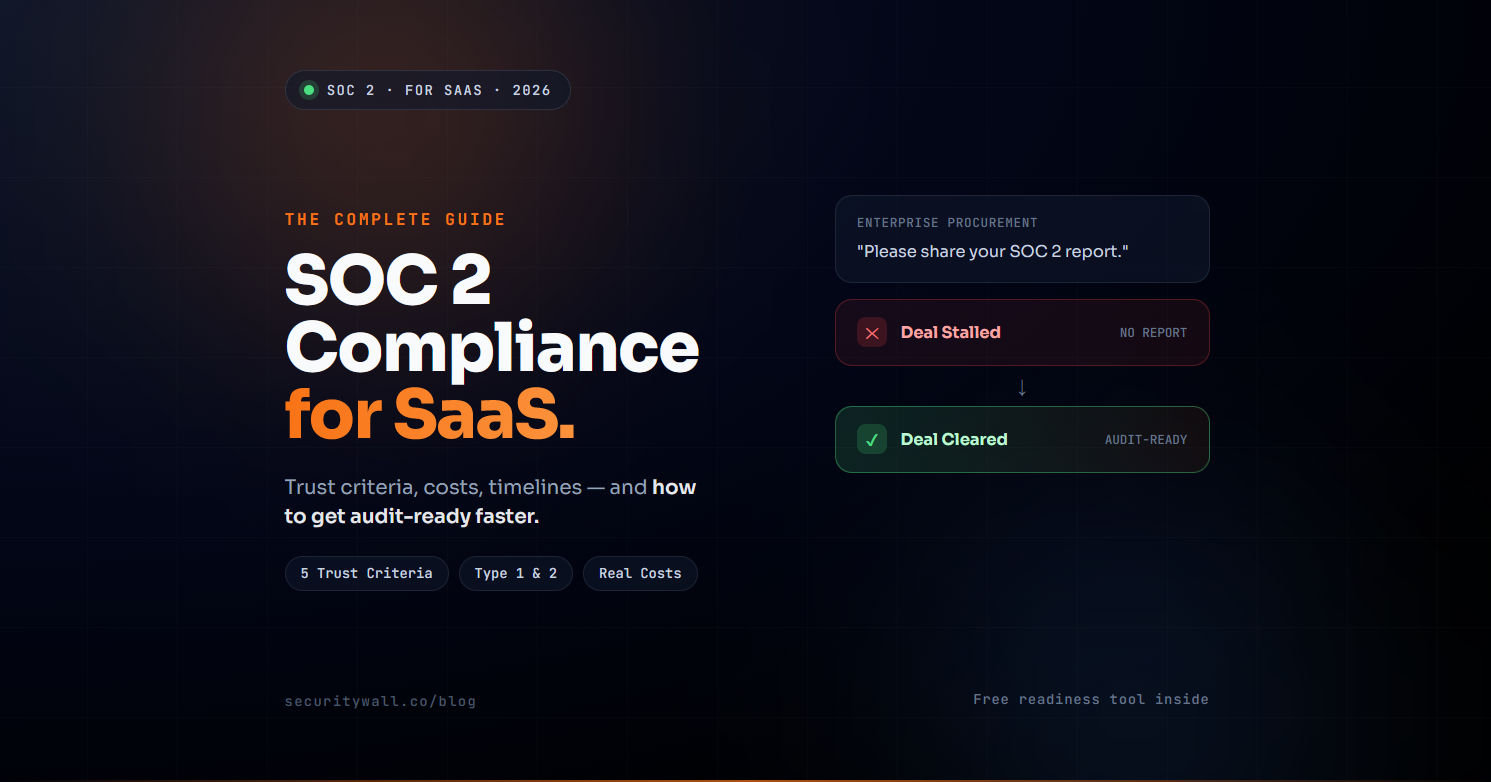
There is a moment almost every B2B SaaS company hits. A major enterprise deal is moving, an investor is circling, or a regulated customer enters procurement and then the email arrives: "Please share your SOC 2 report." If you do not have one, the deal stalls, sometimes for months, sometimes for good. SOC 2 has quietly become the price of entry for selling software to serious customers.
SOC 2 compliance for SaaS means having an independent auditor attest, in a formal report, that your company's controls protect customer data against the AICPA's Trust Services Criteria. It is not a certification and not a legal requirement it is a report your customers' security teams read before they trust you with their data. For SaaS, where the entire product is customer data in the cloud, it has become the default proof of security maturity.
The gap is widest exactly where it hurts most: in our research across SaaS companies, only around 7% of early-stage startups (under $1M funding) met SOC 2 standards, against roughly 45% of companies past $100M. The companies that win enterprise deals early are the ones that treat SOC 2 as a sales enabler, not a year-three problem.
This guide covers SOC 2 for SaaS end to end what it actually means, why your buyers demand it, the five Trust Services Criteria explained, Type 1 versus Type 2, the real audit process, honest costs and timelines, the gaps we most often find in SaaS environments, and how to get audit-ready faster. If you want the broader fundamentals first, see our guide to SOC 2 compliance; this page is the SaaS-specific playbook.
- What SOC 2 Compliance Means for a SaaS Company
- Why SaaS Companies Need SOC 2
- The Five Trust Services Criteria
- SOC 2 Type 1 vs Type 2 for SaaS
- The SOC 2 Compliance Process, Step by Step
- SOC 2 Cost and Timeline for SaaS
- The Gaps We Most Often Find in SaaS
- How SecurityWall Gets SaaS Companies Audit-Ready
What SOC 2 Compliance Means for a SaaS Company
SOC 2, System and Organization Controls 2 is an attestation framework created by the American Institute of Certified Public Accountants (AICPA). A SOC 2 engagement produces a report in which an independent, licensed CPA firm gives its opinion on whether your controls meet the Trust Services Criteria over the scope you select.
Two things matter for SaaS founders specifically. First, it is a report, not a certificate there is no logo or pass/fail stamp; your customer's security team reads the actual document, usually under NDA. Second, it is voluntary in law but mandatory in practice — no regulation forces a SaaS company to hold SOC 2, but enterprise procurement does. For a SaaS product, where customer data lives entirely in your cloud, SOC 2 is the most widely recognised way to prove you handle that data responsibly.
If you sell internationally as well as in the US, it is worth knowing how SOC 2 compares to the other dominant framework our SOC 2 vs ISO 27001 guide breaks down which your market actually demands.
Why SaaS Companies Need SOC 2
The reasons are commercial before they are technical.
- It unblocks enterprise sales. Mid-market and enterprise buyers put "provide your SOC 2 report" directly into security questionnaires and procurement gates. Without it, deals stall in vendor review or never start.
- It shortens security reviews. A SOC 2 Type 2 report answers dozens of questionnaire items in one document, compressing weeks of back-and-forth into a single attachment.
- It signals maturity to investors and acquirers. In diligence, SOC 2 is read as evidence of operational discipline and its absence as risk.
- It scales with you. Building the controls early avoids the expensive retrofit of bolting governance onto a product and team that grew without it.
The data backs the urgency. In our research across SaaS companies, only around 7% of startups under $1M in funding met SOC 2 standards, versus roughly 45% of companies past $100M compliance readiness tracks tightly with financial maturity, which means early-stage SaaS that gets ahead of SOC 2 turns a typical weakness into a competitive edge in enterprise deals.
The Five Trust Services Criteria
SOC 2 is built on five Trust Services Criteria (TSC). Only the first Security is mandatory; it is known as the Common Criteria. You select the others based on what you promise customers. Most SaaS companies scope Security plus Availability and Confidentiality, adding Processing Integrity or Privacy where the product demands it.
| Criterion | What it covers | For SaaS |
|---|---|---|
| Security Mandatory | Protection against unauthorised access, physical and logical | Always in scope — access control, MFA, monitoring, pentesting |
| Availability | System uptime and accessibility as committed | Common — SLAs, redundancy, DR for a hosted product |
| Confidentiality | Protection of data designated confidential | Common — encryption, access restrictions on customer data |
| Processing Integrity | Complete, accurate, authorised processing | If you process transactions or financial data |
| Privacy | Handling of personal information per your policy | If you handle significant PII beyond confidentiality |
Security is required for every SOC 2. The other four are scoped to the promises your product makes — adding criteria adds cost, so scope deliberately.
A practical note for SaaS: penetration testing sits squarely under the Security criterion. Auditors expect evidence that you actively test your systems for vulnerabilities, which is why a scoped SOC 2 penetration test is a near-universal part of a credible SaaS SOC 2 programme.
SOC 2 Type 1 vs Type 2 for SaaS
There are two SOC 2 report types, and the difference matters commercially.
Type 1 assesses whether your controls are designed appropriately at a single point in time. It is faster to achieve and useful as a first signal a way to tell a prospect "we are on the path" while you build toward the real thing.
Type 2 assesses whether your controls operated effectively over a period, typically 3 to 12 months. This is what enterprise buyers actually want, because it proves the controls work in practice, not just on paper. Most SaaS companies use Type 1 as a stepping stone, then move to Type 2 as the credential that closes enterprise deals.
The strategic move for SaaS is usually to go straight for Type 2 readiness designing controls correctly from the start so the observation window begins as early as possible. Our Type 1 vs Type 2 guide walks through which to choose given your sales timeline.
The SOC 2 Compliance Process, Step by Step
The path from "we have no SOC 2" to "here is our report" follows a consistent sequence. Knowing it lets you plan around your sales pipeline rather than scrambling when a deal demands it.
- Scope the engagement. Decide which Trust Services Criteria apply and which systems, products, and environments are in scope. Over-scoping is the most common way SaaS companies overspend.
- Run a readiness or gap assessment. Measure your current controls against the criteria to find what is missing before an auditor does. Start with the free readiness assessment, then a formal gap analysis for depth.
- Remediate the gaps. Implement and document the missing controls access reviews, MFA, logging and monitoring, change management, vendor management, encryption, and the policies behind them.
- Penetration test. Conduct testing that satisfies the Security criterion and produces auditor-ready evidence, with retesting of any findings.
- Observation period (Type 2). Operate the controls for the chosen window — commonly 3 to 12 months — generating the evidence the auditor will sample.
- The audit. A licensed CPA firm examines your controls and evidence and issues the report, with any exceptions noted.
- Maintain and renew. SOC 2 is continuous; reports are refreshed roughly annually, so the controls must keep operating.
One thing to be clear about: SecurityWall handles steps 1 through 5 and supports you through 6 and 7, but the audit itself must be performed by an independent CPA firm. That separation is a feature of SOC 2, not a limitation and we work alongside the audit firm rather than replacing it.
SOC 2 Cost and Timeline for SaaS by other Vendors (Not SecurityWall)
Costs vary with scope, size, and how much you build in-house, but the realistic first-year ranges for a SaaS company look like this. SecurityWall bring competitive costing in market to make sure SaaS can comply in budget.
| Cost component | Typical range |
|---|---|
| Readiness / gap assessment | $5,000 – $15,000 |
| Remediation (effort + tooling) | Variable — often the largest line |
| Penetration testing | $5,000 – $30,000 |
| CPA audit fee (Type 2) | $10,000 – $40,000+ |
| All-in first year | ~$30,000 – $100,000+ |
The CPA audit fee is only a fraction of the total — readiness, remediation, and testing usually dominate. Tight scoping is the biggest lever on cost.
On timeline, plan for 6 to 12 months end to end. A Type 1 can be reached in a few months once controls are designed; a Type 2 adds the observation window on top. The single biggest accelerator is starting from an accurate readiness baseline so remediation is targeted rather than exploratory.
The Gaps We Most Often Find in SaaS
This is where SaaS SOC 2 differs from generic compliance advice. Because we approach readiness from an offensive-security angle, we see the same gaps surface repeatedly in SaaS environments the ones that turn into audit exceptions or, worse, real breaches.
- Multi-tenant isolation weaknesses. The defining SaaS risk: horizontal privilege escalation, tenant ID enumeration, and shared-resource or database access that lets one customer reach another's data. Generic checklists miss this entirely; it only surfaces under real testing.
- Access reviews that do not happen on schedule. The single most common SOC 2 exception across the board reviews not performed quarterly, or performed but undocumented, plus terminated users who keep access.
- Logging without monitoring. Events are captured but no one is alerted, so detection gaps stay invisible until an incident or an assumed-breach test exposes them.
- Secrets and credentials in code. Hardcoded keys and tokens in repositories common in fast-moving SaaS teams and a direct hit to the Security criterion.
- No separation of development and production, or production changes deployed without recorded review and approval.
- Vendor and subprocessor blind spots. Critical SaaS dependencies onboarded with no security assessment and no contractual security terms.
Our research bears out the value of testing-led readiness: across 50 SaaS assessments in 2025, integrating offensive security testing into the readiness process raised SOC 2 readiness scores by an average of 68%. Finding these gaps with a penetration test before the auditor does is the difference between a clean report and a remediation scramble.
Score your SaaS against 200+ SOC 2 controls in 10 minutes with the free SOC 2 Readiness Assessment, or work through the interactive SOC 2 compliance checklist.
How SecurityWall Gets SaaS Companies Audit-Ready
SecurityWall takes SaaS companies from "no SOC 2" to audit-ready the readiness, remediation, and testing that come before the CPA audit, built around the realities of multi-tenant SaaS. Our team holds OSCP, OSWE, CREST, CISM, and CISSP credentials and approaches SOC 2 from a security-first, not a checkbox-first, perspective.
Free SOC 2 Readiness Assessment
- Weighted score across 12 control domains in about 10 minutes
- A critical gap list and an executive summary you can share internally or with a buyer
- 200+ controls, 100% browser-based, no sign-up — start here
Gap Analysis and Remediation
- A formal gap analysis scoped to your chosen Trust Services Criteria
- A prioritised remediation roadmap and evidence-collection support
- Help scoping tightly so you are not paying to audit systems that do not need to be in scope
SaaS-Focused Penetration Testing
- Penetration testing built for multi-tenant SaaS tenant isolation, API security, privilege escalation with auditor-ready reporting and retesting
- The same expertise behind our SaaS security work
Alongside Your Auditor, Not Instead of It
- SecurityWall is not a CPA firm and does not issue SOC 2 reports that independence is core to SOC 2
- We get you audit-ready and coordinate with your chosen CPA firm through Type 1 or Type 2
- For tooling options, see our honest comparison of the best free SOC 2 tools
Related reading:
- What Is SOC 2 Compliance? An Easy Guide
- SOC 2 Type 1 vs Type 2: Which One Do You Actually Need?
- SOC 2 vs ISO 27001: Differences and Which You Need
- SOC 2 Compliance Checklist 2026 (Interactive, 12 Domains)
- SOC 2 Gap Analysis: What It Covers and How to Prepare
- SOC 2 Penetration Testing Requirements
Frequently Asked Questions
What is SOC 2 compliance for SaaS?
It means an independent CPA firm has attested, in a formal report, that your SaaS company's controls meet the AICPA Trust Services Criteria. For SaaS, where customer data lives in your cloud, it is the standard proof of security maturity that enterprise buyers expect before they purchase.
Do SaaS companies need SOC 2?
It is not legally required, but in practice most B2B SaaS companies need it to sell to mid-market and enterprise customers, who request a SOC 2 report during procurement. Without one, deals frequently stall in vendor security review.
How much does SOC 2 cost for a SaaS company?
A realistic first-year all-in cost is roughly $30,000 to $100,000+, covering readiness, remediation, penetration testing, and the CPA audit fee. The audit fee itself is only part of the total; readiness and remediation usually cost more. Scope tightly to control the figure.
How long does SOC 2 take for SaaS?
Typically 6 to 12 months. A Type 1 report can be reached in a few months once controls are designed; a Type 2 adds an observation period of 3 to 12 months during which the controls must operate effectively.
Should a SaaS startup get SOC 2 Type 1 or Type 2?
Most SaaS startups aim for Type 2 because enterprise buyers want proof that controls work over time, not just at a point in time. Type 1 is a useful interim signal while you build toward Type 2.
Is penetration testing required for SOC 2?
SOC 2 does not name penetration testing as a line item, but it falls under the Security criterion, and auditors expect evidence that you test for vulnerabilities. For multi-tenant SaaS, a scoped penetration test is effectively a standard part of a credible SOC 2 programme.
Does SOC 2 cover GDPR or HIPAA for SaaS?
No. SOC 2 is a security attestation, not a data-protection law. It can demonstrate strong controls that support GDPR or HIPAA efforts, but it does not by itself make you compliant with either those have their own requirements.
Tags
About Hisham Mir
Hisham Mir is a cybersecurity professional with 10+ years of hands-on experience and Co-Founder & CTO of SecurityWall. He leads real-world penetration testing and vulnerability research, and is an experienced bug bounty hunter.