
PTaaS vs Traditional Pentest vs Bug Bounty
Muhammad Khizer Javed
November 7, 2026
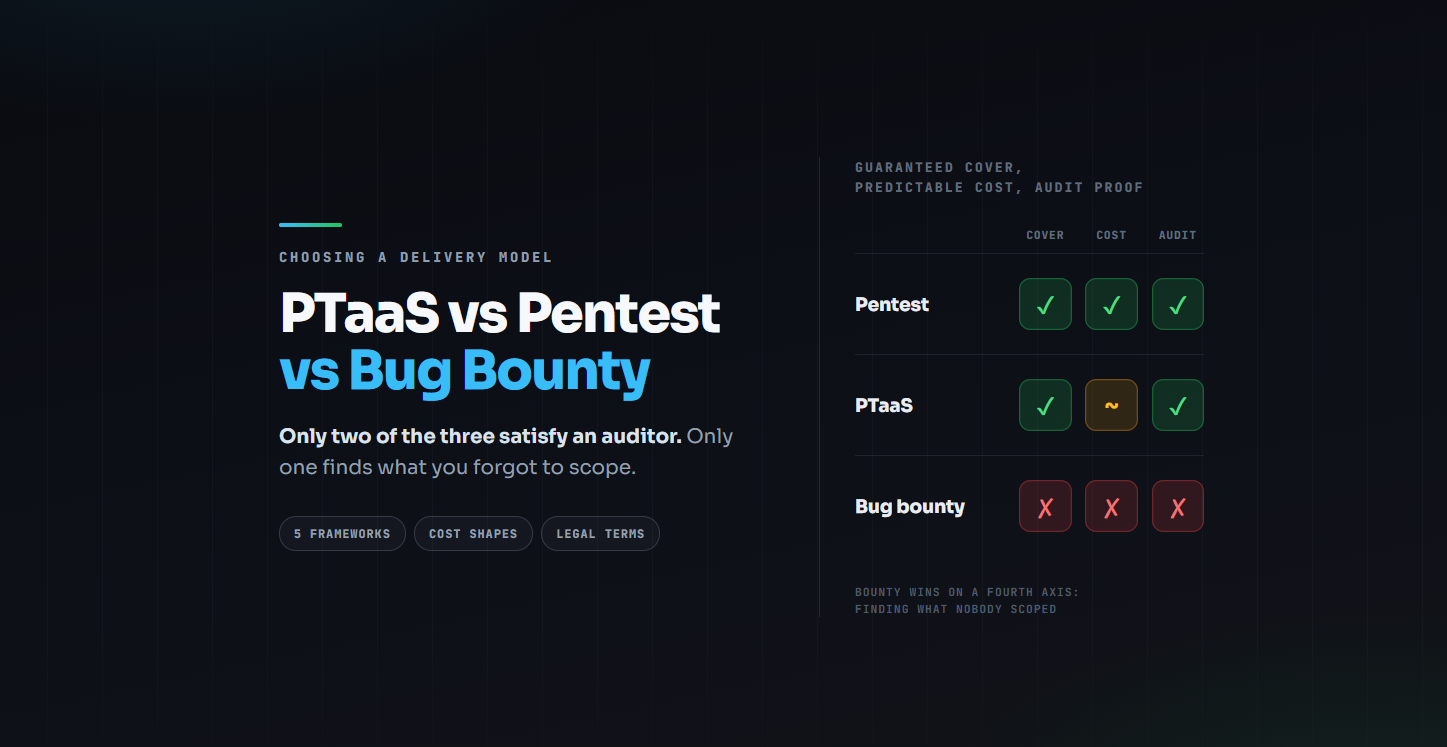
Three ways to buy offensive security, and they are not substitutes. A traditional pentest, a PTaaS subscription and a bug bounty programme buy different things, bill in different shapes, and only some of them satisfy an auditor.
Which should we buy: a traditional pentest, PTaaS, or a bug bounty?
If a framework or a customer is asking for evidence, buy a traditional pentest or PTaaS, because a bug bounty is almost never accepted as the required test. If you already have that evidence and want continuous coverage between tests, add a bug bounty. PTaaS sits between the two: scheduled testing delivered through a platform rather than a PDF. SecurityWall delivers both traditional and platform based testing, and will tell you when a bug bounty is the better spend.
SecurityWall sells penetration testing and operates SLASH, its own delivery platform, so we have a commercial interest in two of the three models below. SLASH is provided to SecurityWall clients as part of an engagement. We have tried to be accurate about where a bug bounty beats both.
What each model actually is
The words have drifted, so it is worth being precise before comparing anything.
Traditional penetration testing is a scoped engagement for a fixed period, performed by a named team against an agreed asset list, delivered as a report. You buy tester days. The defining characteristic is not the PDF, it is that scope is agreed in advance and coverage is the vendor's obligation.
PTaaS, penetration testing as a service, is the same testing delivered through a platform instead of a document. Findings appear live as they are discovered, scope and scheduling run through the application, retesting is usually built in, and billing moves to a subscription or credit model. The testing itself is still scoped, still human, still point in time. What changes is delivery and the feedback loop, not the method. Some vendors use the term for continuous scanning with occasional human review, which is a different product wearing the same label.
A bug bounty is an open or invited programme that pays researchers per valid finding. Nobody is obliged to look at anything, nobody guarantees coverage, and you pay only for results. The defining characteristic is that you buy outcomes, not effort, and the trade for that is that you cannot predict what you get.
That last distinction drives almost everything below. In the first two models you are buying a guarantee that someone looked. In the third you are not.
Our own platform, SLASH, sits in the first category: human testing delivered live, with hybrid automated coverage running alongside it and retesting built in rather than quoted separately. It is provided to SecurityWall clients as part of an engagement, which is how we keep the tester and the platform accountable to the same scope.
Three different products are sold as PTaaS
Before comparing anything to PTaaS it is worth knowing that the label covers at least three products with very different value. This is the most common way buyers in this category end up with something they did not intend.
| What it really is | How to recognise it | What it is worth |
|---|---|---|
| Human testing, platform delivery | Named testers, stated tester days, findings appear live, retest included | The real thing. Pays for itself above roughly three engagements a year. |
| Scanning with periodic human review | No tester day count anywhere in the proposal, pricing by asset rather than by effort, continuous language | Useful as monitoring. Will not satisfy a framework asking for a penetration test. |
| A portal bolted to a consultancy | Platform is a report viewer. No live findings, retest quoted separately | A traditional engagement with a nicer delivery. Fine, but do not pay a subscription for it. |
One question separates all three: how many tester days are in this subscription, and who are the testers? A vendor selling human testing answers immediately. A vendor selling scanning changes the subject to coverage and continuity.
The same question protects you in the other direction. If a framework is driving the purchase and your PTaaS subscription turns out to be the second row, you will discover it at audit rather than at procurement, which is the expensive moment to find out.
The three models at a glance
| Traditional pentest | PTaaS | Bug bounty | |
|---|---|---|---|
| What you buy | Tester days | Tester days plus a platform | Validated findings |
| Coverage guaranteed | Yes, by scope | Yes, by scope | No |
| Billing shape | Fixed fee or day rate | Subscription or credits | Per finding, unbounded |
| Cost predictable | Yes | Yes | No |
| Findings arrive | At the end, in a report | Live, as discovered | Continuously |
| Retesting | Often billed separately | Usually included | Researcher dependent |
| Accepted as audit evidence | Yes | Yes | Generally not |
| Finds business logic flaws | Yes | Yes | Yes |
| Covers what nobody thought to scope | No | No | Yes |
| Signal to noise | High | High | Triage burden on you |
| Needs internal capacity | Low | Low to medium | High, ongoing |
| Time to first finding | Days to weeks | Days | Hours to never |
The two rows that matter most sit next to each other: a bug bounty is the only model that covers what you did not think to scope, and the only one that cannot promise anyone looked at all.
Which one satisfies an auditor
This is the section every other comparison skips, and it is usually the reason the budget exists. Frameworks are more specific than vendors imply, and the specificity rules bug bounty out in most cases.
| Framework | What it asks for | Pentest or PTaaS | Bug bounty |
|---|---|---|---|
| PCI DSS v4.0.1 | Requirement 11.4: testing per a defined methodology, by a qualified resource, annually and after significant change | Accepted | Not accepted as the required test. No defined methodology, no scope guarantee, no qualified resource named. |
| ISO 27001:2022 | Annex A 8.8 and 8.29: evidence of technical vulnerability evaluation and security testing | Accepted | Supporting evidence at best. Auditors want scope tied to the ISMS, which a bounty cannot provide. |
| SOC 2 | CC4.1: an independent evaluation with defined scope, dated and documented | Accepted | Rarely sufficient alone. Defined scope is the sticking point. |
| DORA | Threat led penetration testing for significant financial entities | Accepted, with a scoped TLPT programme | No |
| Customer questionnaires | Usually a current dated report plus remediation confirmation | Accepted | A bounty programme is a positive signal, not a substitute for the report |
The pattern is consistent. Frameworks ask for defined scope, a named qualified tester, and a dated report. A bug bounty provides none of those by design, which is exactly why it finds things scoped testing misses.
If an auditor or a customer is driving the purchase, the decision is already made: you need a scoped test, delivered traditionally or through a platform. A bounty can run alongside it, and it will not replace it. Our ISO 27001 penetration testing and PCI DSS compliance pages cover what each one needs in the report.
How each one bills, and what goes wrong
The three models fail financially in three completely different ways, and knowing which failure you can tolerate is more useful than comparing headline prices.
| Model | How it bills | Budget behaviour | Characteristic failure |
|---|---|---|---|
| Traditional pentest | Fixed fee, or tester days at a day rate | Fully predictable, set at purchase order | Retest bought separately turns a two week fix into a six week procurement cycle. Negotiate it into the original order. |
| PTaaS | Annual subscription, or credits drawn down per test | Predictable, but committed up front | Paying for a platform you use twice a year. The subscription only beats project pricing above a certain test frequency, so work out yours before committing. |
| Bug bounty | Per valid finding, plus platform fee and triage | Unbounded by design | A good month is a budget problem. Success costs more than failure, which is a genuinely strange thing to explain to a finance team. |
Published list prices are scarce across all three, because scope drives everything. The useful comparison is not price, it is which of these three failure modes your organisation can absorb.
Two hidden costs are routinely left out of bug bounty business cases. Triage is yours, unless you pay the platform to do it, and the volume of invalid and duplicate submissions is the part nobody forecasts. And remediation pressure arrives on the researcher's schedule, not yours, which is fine until three criticals land during a release freeze.
Ask of each model: what do I get if nobody finds anything? With a pentest or PTaaS you get a scoped, evidenced statement that the tested surface held, which is itself the deliverable an auditor wants. With a bug bounty you get an invoice for the platform fee and no evidence of anything, because absence of reports is not evidence of absence of bugs.
That asymmetry is the clearest reason the three are complements rather than alternatives.
What each one actually finds
All three find real vulnerabilities. They find systematically different ones, and the difference is a direct consequence of how each is scoped.
| Finding type | Best source | Why |
|---|---|---|
| Systematic coverage of a known surface | Pentest or PTaaS | Scope obliges the tester to cover everything listed, including the boring parts nobody would hunt. |
| Business logic and authorisation flaws | Pentest or PTaaS | Needs sustained context on one application. Bounty hunters rarely invest that depth without a guaranteed payout. |
| Chained low findings into one high | Pentest or PTaaS | Chaining requires seeing the whole scope at once. Bounty submissions arrive atomised. |
| Assets nobody declared | Bug bounty | Researchers test what is reachable, not what is listed, which is also why the legal terms below matter. |
| Novel and creative attack paths | Bug bounty | Hundreds of unaligned minds beat two aligned ones on originality. |
| Regressions between tests | Bug bounty | Continuous presence catches what a point in time test cannot. |
| Evidence that a fix worked | Pentest or PTaaS | Retest of the original attack path by a named tester. A bounty has no mechanism for this. |
Read it as a split rather than a ranking. Scoped testing proves the surface you know about. A bounty surfaces the surface you do not. Neither substitutes for the other, and most teams need the first before the second is worth running.
The contractual differences nobody mentions
Every comparison covers cost and coverage. Almost none cover the paperwork, which is where bug bounty programmes actually go wrong.
Authorisation works in opposite directions. A pentest has rules of engagement signed by both parties, naming assets, windows and excluded activity. A bug bounty needs published safe harbour terms that tell researchers what they may test and promise you will not pursue them for good faith research. Without that, you will eventually receive a report from someone who tested something you did not intend to be in scope, and you will have no good options.
Duplicates need a written policy before launch. Two researchers find the same issue three days apart. Who gets paid, and who decides? Published rules prevent the public argument, and public arguments with researchers damage programmes more than the bugs do.
Disclosure timelines are the researcher's leverage. Most expect a response within days and resolution within a defined window, after which some will publish. A pentest report is confidential indefinitely. A bounty finding has a clock on it that you do not fully control.
Non disclosure is asymmetric. A pentest vendor signs an NDA covering everything they see. A bounty researcher agrees to programme terms that are usually narrower, and the population changes constantly.
And consider what you can show a customer. A pentest or PTaaS engagement produces a dated report and, from some providers, a shareable summary you can send to a prospect without releasing the technical detail. A bug bounty produces no artefact of this kind at all. For teams whose main driver is answering customer security questionnaires, that alone decides it.
Running more than one
Most mature programmes run two, and the order matters more than the mix.
Findings from all three need to land in one backlog or the counts stop being believable. That mechanic is covered in pentest findings management.
Questions buyers ask
Is PTaaS better than a traditional pentest? It is the same testing with a better delivery mechanism, not a better test. PTaaS gives you findings live rather than at the end, retesting usually included, and scope and scheduling in an application instead of email. If those things solve a problem you have, it is worth the subscription. If you run one test a year and the PDF is fine, a traditional engagement is cheaper and no less rigorous.
Can a bug bounty replace a penetration test for compliance? Generally no. PCI DSS, ISO 27001 and SOC 2 all want defined scope, a qualified named tester and a dated report, and a bug bounty is designed to provide none of those. Run one alongside your scoped testing, not instead of it.
Which model is cheapest? Traditional testing has the lowest and most predictable total cost for one or two engagements a year. PTaaS wins above a certain test frequency, so calculate yours before committing to a subscription. A bug bounty has the lowest entry cost and the least predictable total, because you pay per finding and a successful month costs more than a quiet one.
How do we stop a bug bounty blowing the budget? Run a private programme with invited researchers, define scope narrowly, publish a payout table with caps, and set a monthly ceiling with a clear process for what happens when it is reached. Start with a vulnerability disclosure programme first to measure the volume you would be paying for.
Do we need a VDP if we have a bug bounty? Yes, and ideally first. A VDP is the published route for someone to report something without expecting payment, plus safe harbour terms. It costs nothing but process, and it is how you discover whether you can triage inbound reports before you start paying for them.
What does an auditor want to see? A dated report, defined scope tied to what is being certified, a named tester with verifiable competence, and evidence that findings were remediated and verified. Scope mismatch and missing retest evidence are the two most common reasons testing evidence is rejected, and neither is about which model you chose.
Where to start
If something external is forcing the purchase, buy a scoped test, traditional or platform delivered, and choose between those two on whether live findings and included retesting are worth a subscription to you.
If nothing external is forcing it and you have never tested, still buy the scoped test first. The baseline is worth more than the coverage, and it stops you paying bounty rates for findings a fixed price engagement would have handed you.
Only once that surface is tested, fixed and verified does a bounty start buying something the other two cannot.
We deliver traditional and platform based testing, and we will say plainly when a vulnerability disclosure programme or a bounty is the better use of your next budget cycle. Clients run their testing through SLASH, our flagship platform, with findings live and retesting included.

Twenty minutes, a scoped price, and an honest answer on whether SLASH fits your workflow.
Book a walkthrough →About Muhammad Khizer Javed
Muhammad Khizer Javed is a member of the SecurityWall team, contributing expert insights on cybersecurity and penetration testing.