
NCA ECC Checklist: Score Your Readiness, No Sign-Up
Babar Khan Akhunzada
May 25, 2026
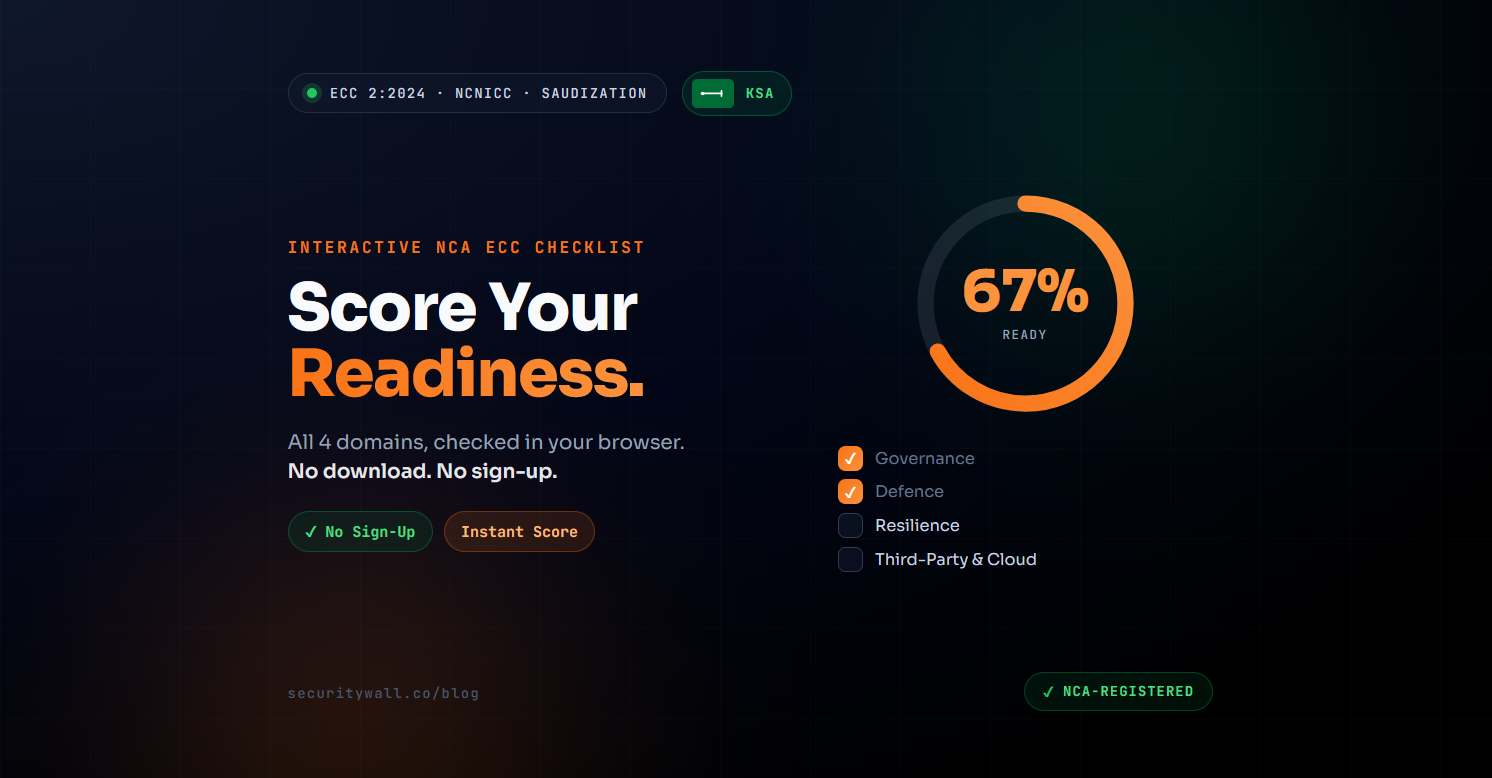
Most NCA Essential Cybersecurity Controls checklists are static spreadsheets you download, fill in once, and forget. This one scores your readiness instantly no form, no download and shows you exactly where a checklist stops and a formal, NCA-registered assessment begins.
This is an interactive, use-it-now National Cybersecurity Authority Essential Cybersecurity Controls compliance checklist covering scope, all four ECC-2:2024 domains, the new NCNICC-1:2025 requirements for private companies, and the Saudization rule. Tick items as you go the progress bar tracks your readiness, and each section tells you exactly what evidence auditors look for and the failure they most often find. Nothing is saved or sent anywhere; it runs entirely in your browser.
It is based on the NCA's official ECC-2:2024 document distilled into the checkpoints that matter, so you do not have to read 100-plus pages of regulatory text to know where you stand. If you want the dense primary source, it is on the NCA's regulatory documents portal; this checklist is the readable version.
A point on what it is and isn't: this gives you the shape of ECC readiness the key checkpoints in each domain, not the full 108 controls. When you need an audit-ready answer, a formal gap assessment scores every applicable control and produces the evidence the NCA expects. New to the framework? Start with what the NCA is and the ECC 2:2024 requirements explained, then come back here to check yourself.
This checklist shows you the key checkpoints. A formal ECC gap assessment scores every applicable control across all four domains and gives you a prioritised remediation roadmap — report in 2–3 weeks. SecurityWall is NCA-registered.
Book an ECC Gap Assessment →What Your Readiness Score Means
Your percentage is a self-read, not an assessment result a checklist can confirm a control exists, but it cannot weight domains by audit scrutiny, score partial implementations, or judge whether your evidence would satisfy the NCA. Use the band below to decide your next step.
| Readiness | What it means | Recommended next step |
|---|---|---|
| Below 50% | Significant control gaps; not assessment-ready | Foundational remediation before a formal assessment |
| 50–75% | Core controls exist; specific domains need work | Targeted remediation, then a formal gap assessment |
| 76–90% | Largely in place; evidence and documentation gaps | Formal gap assessment to close the last items |
| Above 90% | Strong posture across the domains | Pre-audit validation, then maintain and monitor |
Wherever you land, a formal gap assessment converts a self-read into an evidence-backed position the NCA will recognise.
This checklist distils the NCA's primary documents into a usable format. The full regulatory text is published by the NCA — the Essential Cybersecurity Controls page and the complete ECC-2:2024 control document (PDF). They run to over a hundred pages of formal controls; this guide is the readable companion to them.
Related reading:
- What Is the NCA? Saudi Arabia's National Cybersecurity Authority Explained
- NCA ECC 2:2024 Requirements: Every Control Domain Explained
- NCA Penetration Testing Requirements
- SAMA Cybersecurity Compliance in Saudi Arabia
- SAMA Cybersecurity Guide 2026
- SAMA Penetration Testing Guide
- SAMA Red Teaming in Saudi Arabia
For financial-sector organisations, the SAMA compliance service covers the second regulator you fall under. Offensive testing options include penetration testing, red teaming, and mobile app penetration testing.
Frequently Asked Questions
Is this NCA ECC compliance checklist free?
Yes it is completely free, requires no sign-up, and saves nothing; it runs entirely in your browser. For an audit-ready answer across all 108 controls, SecurityWall's NCA-registered team runs formal ECC gap assessments with a report in 2–3 weeks.
Does this checklist cover all 108 ECC controls?
No. It covers the key checkpoints across all four domains plus NCNICC-1:2025 and Saudization, so you can understand the shape of your readiness. ECC-2:2024 has 108 main controls and 92 subcontrols; a formal gap assessment scores every applicable one.
What is the difference between this checklist and a formal gap assessment?
This is a self-guided overview. A formal gap assessment is a consultant-led engagement control-by-control evaluation, evidence review, and a written remediation roadmap aligned to how the NCA assesses compliance. Most organisations self-check first, then commission an assessment.
Do private companies need to complete the NCNICC section?
If you are a non-CNI private sector entity in Saudi Arabia, NCNICC-1:2025 likely applies to you, so yes. Government entities and CNI operators follow the ECC and, where relevant, the CSCC instead.
How long does a formal NCA ECC gap assessment take?
SecurityWall typically delivers an ECC gap assessment report within 2–3 weeks, depending on organisation size and scope. The report covers every applicable control, prioritised gaps, and a remediation roadmap.
We are a financial company do we also need SAMA compliance?
Most likely, yes. Financial-sector organisations are typically regulated by both the NCA and SAMA, and meeting one does not satisfy the other. SecurityWall runs NCA and SAMA programmes together so financial-sector clients cover both in one engagement.
Tags
About Babar Khan Akhunzada
Babar Khan Akhunzada leads security strategy, offensive operations. Babar has been featured in 25-Under-25 and has been to BlackHat, OWASP, BSides premiere conferences as a speaker.