NCA Compliance for Startups in Saudi Arabia
Hisham Mir
June 6, 2026
Saudi Arabia is building one of the most active startup ecosystems in the region. The Public Investment Fund, STV, Monsha'at, and a wave of local and regional VCs are funding hundreds of companies under Vision 2030, and most of their founders are focused on exactly what they should be: product, growth, and the next round. Cybersecurity compliance is rarely on the radar until a SAMA licence, an enterprise deal, or a due-diligence questionnaire makes it urgent overnight.
Here is what most startup CTOs do not yet know: as of 2026, the answer to "does my startup need NCA compliance?" is yes. The NCA's NCNICC-1:2025 brought the private sector including startups into mandatory scope for the first time. You no longer have to be a bank or critical infrastructure to have cybersecurity obligations in the Kingdom; being a private company operating there is enough.
The good news is that for an early-stage company the baseline is achievable, affordable, and worth doing early because the same controls that satisfy the NCA also unblock enterprise sales and survive investor diligence. This guide is the startup entry point: whether you are in scope, what NCNICC requires, the four things every startup must have, when you need a penetration test, realistic costs in riyals, a 60-day roadmap, and why your choice of partner matters when you are fundraising. For the regulation itself, see our guide to NCNICC-1:2025.
- Do Startups in Saudi Arabia Need NCA Compliance?
- What NCNICC-1:2025 Requires From a Startup
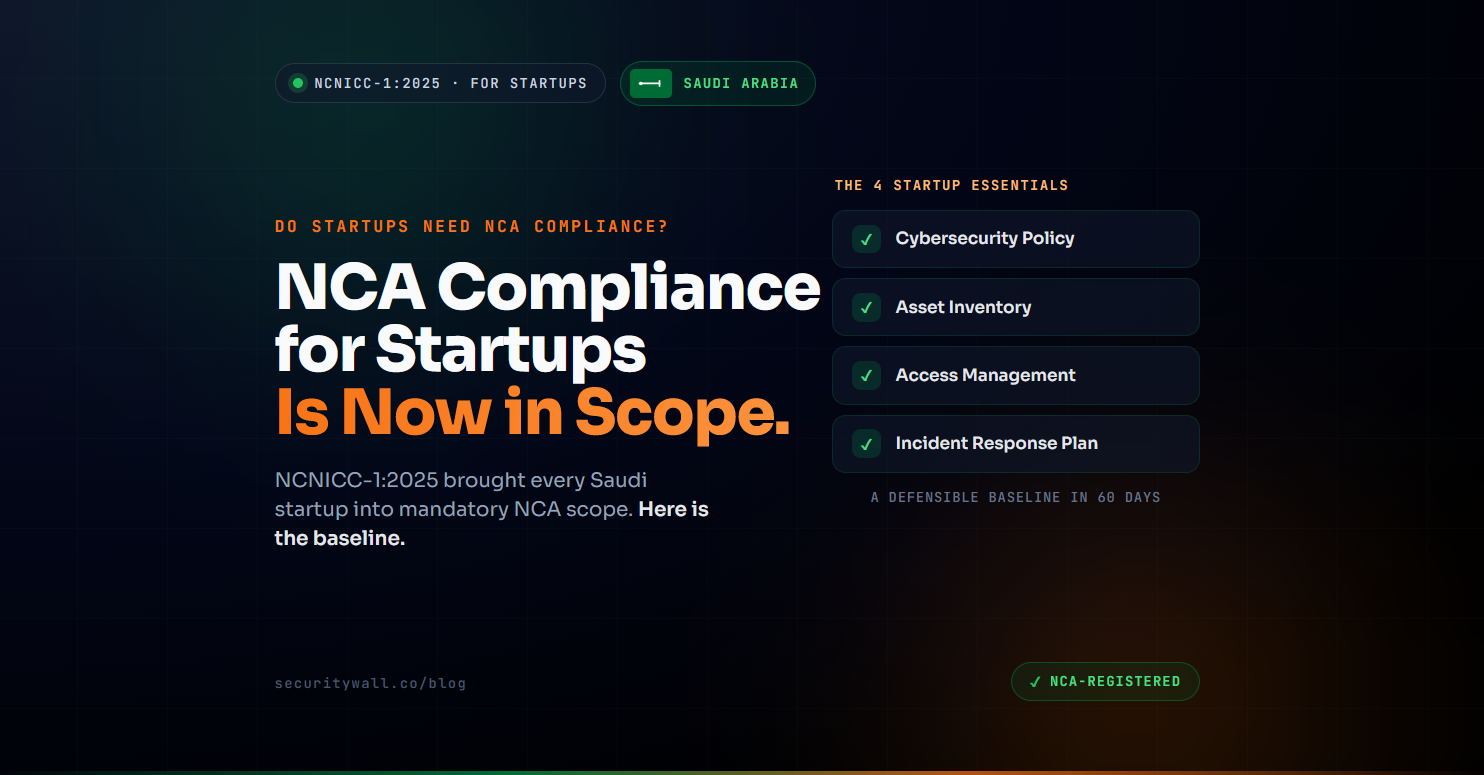
- The Four Things Every Saudi Startup Must Have
- When Does Your Startup Need a Penetration Test?
- NCA Compliance Costs for Startups
- The 60-Day Startup Compliance Roadmap
- Why an NCA-Registered Partner Matters
- SecurityWall's Startup Support
Do Startups in Saudi Arabia Need NCA Compliance?
Yes. Since the NCA released NCNICC-1:2025 its Cybersecurity Controls for Non-CNI Private Sector Entities in January 2026, private companies of all sizes, startups included, fall under mandatory cybersecurity obligations. Previously the NCA's reach was limited to government and Critical National Infrastructure, which is why so many founders assumed it did not apply to them. That assumption is now out of date.
For most startups, the relevant framework is NCNICC-1:2025 rather than the heavier Essential Cybersecurity Controls (ECC), which apply to critical infrastructure. NCNICC sorts entities into Class A (large) and Class B (SMEs), and the vast majority of startups land in Class B a baseline calibrated to their size rather than the full enterprise regime. You can sanity-check where you stand in a few minutes with our free NCA ECC checklist, and read the foundations in what the NCA is.
What NCNICC-1:2025 Requires From a Startup
NCNICC-1:2025 is built on the three pillars of cybersecurity people, processes, and technology — and translates them into a baseline of practical controls. For a startup, the mandated technical controls are concrete and largely achievable with tools you may already use: multi-factor authentication, encryption of sensitive data, backups with the ability to recover, endpoint protection, patching, and logging and monitoring.
Around those sit the governance and process basics: knowing who owns cybersecurity, having written policies, assessing your risks, managing your vendors, and critically keeping the evidence that shows your controls actually operate. The recurring theme of NCNICC is that documentation matters as much as the controls themselves. A startup that does the right things but cannot demonstrate them is not yet compliant.
The Four Things Every Saudi Startup Must Have
If you do nothing else first, get these four in place. They are the foundation auditors look for and the items most startups are missing.
- A written cybersecurity policy. A documented, leadership-approved policy that sets out how your company handles security. Not a template left in a drawer — a real policy people follow.
- An asset inventory. A maintained list of your systems, services, and data. You cannot protect what you have not catalogued, and assessors start here.
- Access management documentation. Who has access to what, why, and with MFA enforced plus evidence that access is reviewed and removed when people leave.
- An incident response plan. A documented, tested plan for what happens when something goes wrong, with roles and escalation defined before you need them.
These four cover the highest-weighted gaps for an early-stage company and are achievable in weeks, not months. They are also exactly what an enterprise customer's security questionnaire will ask about.
When Does Your Startup Need a Penetration Test?
Not every startup needs a penetration test on day one, but three triggers make it necessary and they arrive sooner than founders expect.
- You are seeking SAMA licensing. Any fintech pursuing a SAMA licence is heading into a regime where penetration testing is expected. If that is your path, see our fintech compliance guide.
- You have a cloud SaaS product processing customer data. Once you hold other companies' data in a multi-tenant product, testing for issues like tenant isolation and access control stops being optional in practice.
- You are pitching enterprise clients who require it. Large customers increasingly ask for a recent penetration test report as part of vendor onboarding. No report, stalled deal.
When the time comes, a scoped test should cover your real attack surface web, API, and cloud — and produce a report an auditor or enterprise buyer will accept. The detail is in our NCA penetration testing requirements guide.
NCA Compliance Costs for Startups
Costs vary with scope and how much you build in-house, but these are realistic ranges for an early-stage company getting compliant in the Kingdom.
| Item | Typical range (SAR) |
|---|---|
| Gap assessment | 15,000 – 50,000 |
| Penetration test | 25,000 – 75,000 |
| Implementation support | 30,000 – 100,000 |
| Realistic Year 1 total | 70,000 – 225,000 |
Ranges, not quotes — your number depends on scope, product complexity, and how much you do in-house. A Class B startup with a simple stack sits at the lower end.
Two ways startups keep this down: scope tightly (do not pay to assess systems that are out of scope), and start from a free self-check before commissioning paid work, so remediation is targeted rather than exploratory.
The 60-Day Startup Compliance Roadmap
A focused startup can reach a defensible baseline in about 60 days. The sequence matters assess before you build, and leave testing to the end only if it is actually triggered.
| Phase | Focus | Key actions |
|---|---|---|
| Days 1–15 | Assess | Confirm your NCNICC class, run the free checklist, then a gap assessment |
| Days 16–45 | Implement | The four basics plus MFA, encryption, backups, logging; write the evidence as you go |
| Days 46–60 | Test and prove | Penetration testing if triggered, assemble evidence packs, complete self-assessment |
Sixty days is realistic for a Class B startup with focus and the right support.
Why an NCA-Registered Partner Matters
When you are fundraising or pitching enterprises, who you work with becomes part of your story. Since August 2022, any firm providing cybersecurity services in Saudi Arabia is required to be registered with the NCA so using an NCA-registered partner is not just good practice, it signals to investors and enterprise buyers that you took the regulatory route seriously.
For a startup, that has practical weight in two moments. In fundraising diligence, investors increasingly probe security and compliance posture; being able to say your programme was built and tested by an NCA-registered firm is a clean answer to a question that can otherwise stall a round. And in enterprise sales, a buyer's security team is reassured to see a recognised, registered provider behind your testing and controls, rather than an unverified vendor. The cheapest mistake to avoid is engaging a non-registered provider and discovering, mid-diligence, that it raises more questions than it answers.
SecurityWall's Startup Support
SecurityWall is an NCA-registered cybersecurity firm that helps Saudi startups get compliant without slowing down a baseline built for early-stage speed and budget, and ready to scale as you grow. Our team holds OSCP, ISO, OSWE, CREST, CRT, CISM, and CISSP credentials.
Right-Sized for Startups
- Scoping and a gap assessment calibrated to your NCNICC class, not an enterprise template
- The four foundations plus the technical controls, implemented pragmatically
- A free NCA ECC checklist to self-assess before you spend
Penetration Testing When You Need It
- Penetration testing scoped to your product web, API, and cloud
- Reports that satisfy enterprise buyers, SAMA, and the NCA alike
- Triggered by your milestones: SAMA licensing, a SaaS launch, or an enterprise deal
Built for Fundraising and Enterprise Sales
- NCA-registered, so your diligence and vendor-onboarding answers are clean
- Evidence and documentation your investors and customers will actually accept
- A partner across the NCA and, if you become a fintech, SAMA too
Local and Verifiable
- A recognised provider within the Kingdom's regulated cybersecurity ecosystem
- See our Saudi cybersecurity services
- Registration details provided on request for you to verify with the NCA
Related reading:
- NCNICC-1:2025: Every Saudi Private Company Now in Scope
- What Is the NCA? Saudi Arabia's Cybersecurity Authority
- NCA ECC Compliance Checklist (Interactive)
- NCA Compliance for Fintech and BNPL in Saudi Arabia
- NCA ECC Gap Assessment in Saudi Arabia
- NCA Penetration Testing Requirements in Saudi Arabia
Frequently Asked Questions
Do startups in Saudi Arabia need NCA compliance?
Yes. Since the NCA released NCNICC-1:2025 in January 2026, private companies of all sizes including startups fall under mandatory cybersecurity obligations. Most startups are Class B (SME) under NCNICC, with a baseline calibrated to their size rather than the full ECC regime.
What is the minimum a startup needs for NCA compliance?
At minimum: a written cybersecurity policy, an asset inventory, access management documentation with MFA, and a tested incident response plan, alongside core technical controls like encryption, backups, logging, and patching. These cover the highest-weighted gaps and are achievable in weeks.
How much does NCA compliance cost a Saudi startup?
It really depend on the scope and SecurityWall beat market rates always. As realistic ranges, a gap assessment runs around. The figure depends on scope and product complexity.
Does a startup need a penetration test for NCA compliance?
Not always on day one, but three triggers make it necessary: seeking a SAMA licence, running a cloud SaaS product that processes customer data, or pitching enterprise clients who require a test report. When triggered, the test should cover web, API, and cloud.
How long does it take a startup to become NCA compliant?
A focused Class B startup can reach a defensible baseline in around 60 days: assess in the first two weeks, implement controls over the next month, and test and document in the final stretch.
Why does using an NCA-registered partner matter for startups?
Any firm providing cybersecurity services in Saudi Arabia must be NCA-registered, so using a registered partner keeps your fundraising-diligence and enterprise-sales answers clean. It signals to investors and buyers that your security programme was built and tested by a recognised provider.
Tags
About Hisham Mir
Hisham Mir is a cybersecurity professional with 10+ years of hands-on experience and Co-Founder & CTO of SecurityWall. He leads real-world penetration testing and vulnerability research, and is an experienced bug bounty hunter.