
DORA Compliance Assessment - Gap Analyzer Tool
Babar Khan Akhunzada
December 30, 2025
The Digital Operational Resilience Act (DORA) is a landmark EU regulation that fundamentally changes how financial entities must demonstrate digital operational resilience, including robust systems for managing ICT risks, major incident reporting, resilience testing, and third-party oversight. The regulation entered into force on 17 January 2025, and its requirements are being actively supervised across EU member states.
Firms still seeks for what is DORA compliance in actionable terms, highlights recent EU supervisory developments, and positions structured gap analysis as a core step in preparing for ongoing regulatory engagement.
“The EU must act as a stable and reliable partner in shaping the global digital order,” said Henna Virkkunen, EU Digital Strategy Chief. This strategic stance extends to operational resilience in critical sectors — including finance as part of broader digital governance efforts.(Reuters)
What Is DORA Compliance in Practice
DORA compliance is not just a checklist. The Digital Operational Resilience Act requires financial entities to demonstrate they can identify, protect, detect, respond to, and recover from ICT-related disruptions in a disciplined and documented way.
Under DORA, EU supervised entities must have evidence that:
• ICT risk management frameworks are aligned with RTS expectations
• ICT-related major incidents are classified and reported consistently
• Resilience testing is conducted with documented outcomes
• Risks from ICT third-party providers are understood and controlled under contractual and oversight frameworks
These requirements come from both Level 1 regulation (the core text of DORA) and detailed supporting standards including draft RTS on ICT risk management, incident classification, and third-party policies.(ESMA)
Recent EU Signals on DORA Implementation and Supervision in 2025
EU regulatory bodies and the European Supervisory Authorities (ESAs) continue to issue signals that DORA EU compliance is moving into a sustained supervisory phase:
The ESAs issued a technical opinion in March 2025 regarding the amended RTS on ICT subcontracting for critical or important functions under DORA advising the European Commission to adopt the RTS without delay, reinforcing contractual expectations for ICT third-party arrangements.(EIOPA)
In late 2024, the ESAs reported on a Dry Run exercise testing registers of ICT third-party arrangements designed to prepare firms for mandatory reporting under the DORA Article 13 regime. This exercise highlighted data quality issues and preparatory outcomes that will smooth compliance reporting in 2025.(EIOPA)
The European Banking Authority (EBA) has included DORA oversight in its multi-year work programmes, signalling that joint supervision of digital operational resilience and critical third-party providers will be a priority.(European Banking Authority)
Board and Executive Accountability under the DORA Act
One of the most important aspects of the DORA Act is its assignment of responsibility. DORA explicitly makes the management body accountable for ICT risk frameworks, governance structures, and resilience testing outcomes. This means boards must see ICT resilience as a regulatory obligation, not just an IT function.
For compliance officers and CISOs, this often requires translating technical risk into supervisory-relevant metrics that demonstrate alignment with DORA’s regulatory expectations particularly those embodied in the RTS and ITS.
Why Many Organizations Misjudge DORA Readiness
A common misconception is that existing frameworks (like ISO 27001 or vendor risk programmes) automatically result in dora compliance. In reality, DORA’s requirements for incident reporting, testing, and third-party oversight extend beyond generic security standards. Supervisory experience has shown entities often lack documentation that maps controls directly to specific regulatory provisions.
This is where reliable compliance gap analysis becomes central and SecurityWall fill. DORA Gap Analyzer is free and takes only 5 minutes to complete and totally based on official DORA regulations to get instant compliance gap analysis.
Free Assessment of DORA Compliance Readiness with DORA Gap Analyzer Tool
Understanding DORA text and supervisory expectations is essential, but organisations need evidence-based assessments of how existing practices align with regulatory requirements.
A structured readiness review mapping operations to specific DORA obligations helps organisations identify weaknesses before they surface in a supervisory review.
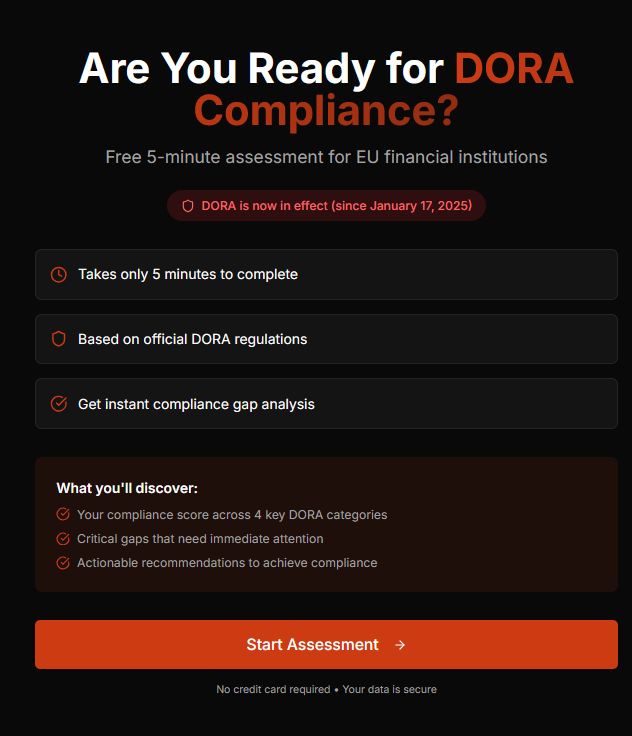
SecurityWall’s DORA Gap Analyzer translates organisational practices into a comparison against DORA’s compliance demands across governance, ICT risk management, incident handling, resilience testing, and third-party oversight. By focusing on measurable gaps rather than abstract maturity narratives, such assessments support governance discussions and prepare entities for structured regulator engagement.
From Gap Identification to Regulatory-Defensible Action
Identifying gaps is only the beginning. Remediation plans must link back to specific regulatory articles and supporting standards so that internal and external reviews understand how risks are being mitigated. This structured approach builds confidence in governance reporting and creates defensible documentation for supervisory dialogue.
Third-Party Oversight and Emerging Critical Provider Designations
DORA’s supervisory architecture enables the ESAs to designate Critical Third-Party ICT Providers (CTPPs) that serve financial institutions across the EU. These designations subject such providers to direct oversight, enhancing systemic resilience but also raising compliance expectations for entities that contract with them. Most markets expect initial CTPP designations and oversight engagements to accelerate through 2025–2026 as supervisory programmes mature.(Digital Operational Resilience Act)
Continuous Compliance in a Dynamic Regulatory Ecosystem
DORA is not a one-off compliance project. ICT environments evolve, vendor ecosystems change, and regulators refine expectations. Ongoing preparedness, periodic reassessment, and alignment with supervisory signals (including future RTS enhancements) are critical for maintaining compliance.
Achieving dora compliance and dora eu compliance requires both conceptual understanding and structured evaluation of operational practices. With supervisory emphasis shifting from readiness planning to active oversight, organisations benefit from clarity, evidence, and governance engagement.
Tools like the SecurityWall DORA Compliance Assessment & GAP Analyzer help bridge the gap between regulatory text and organisational reality enabling stakeholders to make informed decisions and articulate resilience progress to boards and regulators alike.
Identify compliance gaps and assess your readiness for the EU DORA regulation.
Run DORA Gap Analysis →Tags
About Babar Khan Akhunzada
Babar Khan Akhunzada leads security strategy, offensive operations. Babar has been featured in 25-Under-25 and has been to BlackHat, OWASP, BSides premiere conferences as a speaker.