Best Free SOC 2 Tools in 2026
Babar Khan Akhunzada
May 23, 2026
Most companies evaluating SOC 2 readiness tools are about to make an expensive decision. A SOC 2 programme between audit fees, tooling, and remediation routinely runs $30,000 to $100,000 in the first year, and the people researching free tools want to know where they stand before committing a dollar of it.
The problem is that "free SOC 2 tool" describes a wide and inconsistent range of things interactive scored assessments, downloadable checklists, vendor-risk templates, and platform onboarding funnels that demand your email before they show you anything. They are not interchangeable, and several are not really free in the sense most searchers mean by the word.
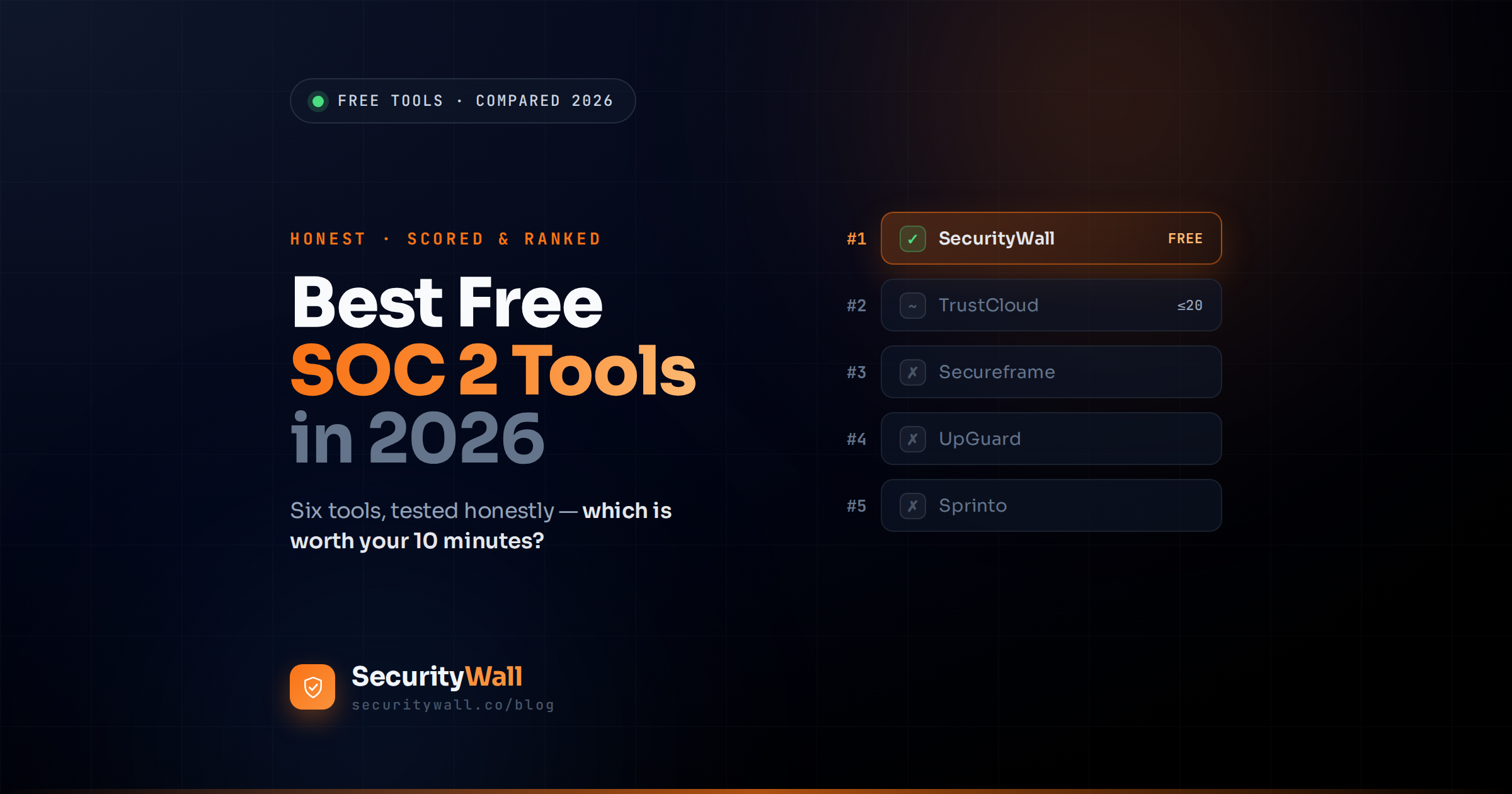
This article compares the main options honestly: what each one actually does, what it costs you (in friction, sign-ups, or dollars), and which is right for your specific situation. We score them against six criteria that genuinely affect whether a tool is useful at the moment you need it and we put every tool in a single comparison matrix so you can scan the differences in ten seconds.
Full disclosure: SecurityWall makes one of the tools compared here. We have ranked it first for one specific use case a free, no-commitment readiness baseline and explained exactly why, including where it falls short and which competitor is the better choice for other situations. Where a competitor wins, we say so plainly.
How We Evaluated These Tools
This comparison is based on publicly available access to each tool, the vendors' own documentation, and our experience as SOC 2 practitioners who prepare SaaS, fintech, and cloud companies for audit. We did not rank tools on brand or marketing we ranked them on whether they do useful work at the specific moment a buyer reaches for one: before committing to an auditor or a compliance platform, when the only question is "how ready am I, and what do I need to do next?"
Six criteria decide that. They are the difference between a tool that helps and a tool that captures your contact details in exchange for a number.
| Criterion | Why It Matters |
|---|---|
| No sign-up required | Friction kills tool usage. A score locked behind an email gate is a lead-gen funnel, not a free tool. |
| Controls covered | More controls means a more accurate baseline. A 10-question quiz produces a 10-question-deep result. |
| Instant vs delayed results | A score you get now beats one emailed "within 48 hours" after a sales qualification call. |
| In-browser privacy | Your control gaps are sensitive. Answers shouldn't leave your device unless you choose to share them. |
| Follow-on support | What happens after your score — human expertise, or an automated push into a paid subscription? |
| Cost of next step | Platform subscription, consultancy, or nothing. The "free" tool can lead straight to a five-figure annual commitment. |
The Free SOC 2 Tools, Compared at a Glance
Before the detail, here is every tool scored against the six criteria. Marks reflect the tool's free offering specifically not the vendor's paid platform.
| Tool | No Sign-Up | Controls | Instant | In-Browser | Next Step |
|---|---|---|---|---|---|
| SecurityWall | ✓ | 200+ | ✓ | ✓ | Consultancy (optional) |
| TrustCloud | ✗ | Full SOC 2 | ✗ | ✗ | Platform (free ≤20 staff) |
| Secureframe | ✗ | Checklist | ✗ | n/a | Platform |
| UpGuard | ~ | Vendor-focused | ✗ | n/a | Platform |
| Sprinto | ✗ | Lighter | ~ | ✗ | Platform |
| Vanta / Drata | ✗ | Platform | ✗ | ✗ | Platform |
✓ Yes ~ Partial / conditional ✗ No. Marks reflect each tool's free offering, not the vendor's paid platform.
The pattern is visible at a glance: most "free SOC 2 tools" are entry points into paid platforms, gated behind sign-up, or designed for a different job entirely. The detail below explains what each one actually does and where each genuinely wins.
1. SecurityWall SOC 2 Readiness Assessment
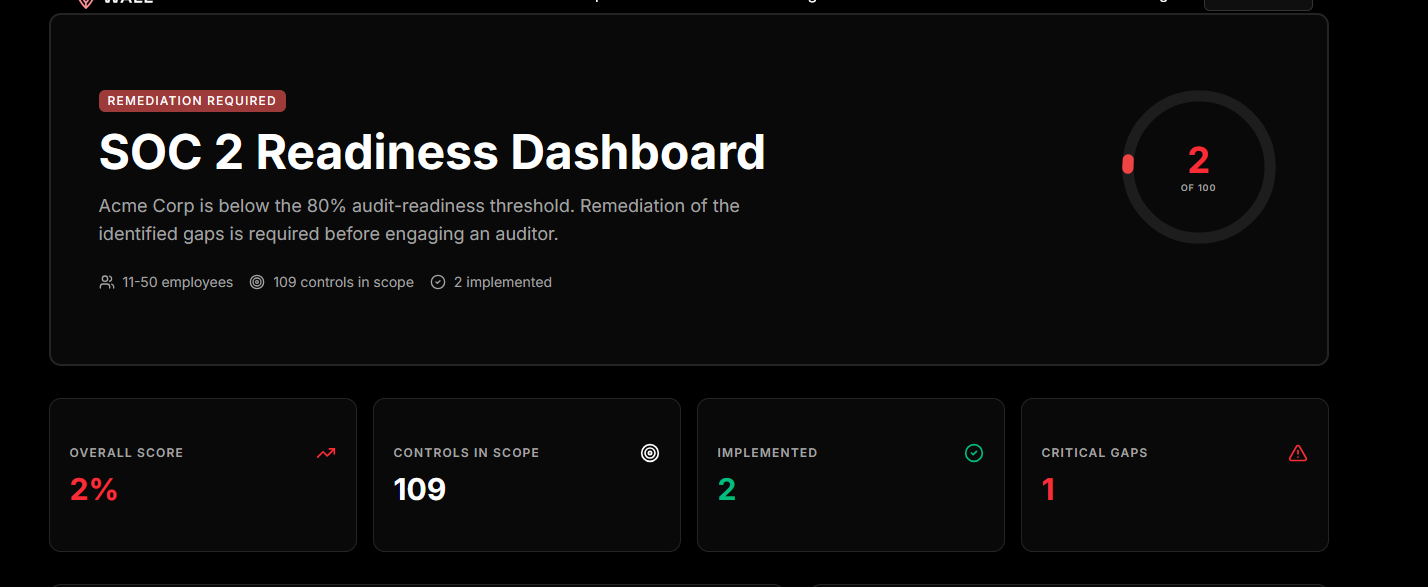
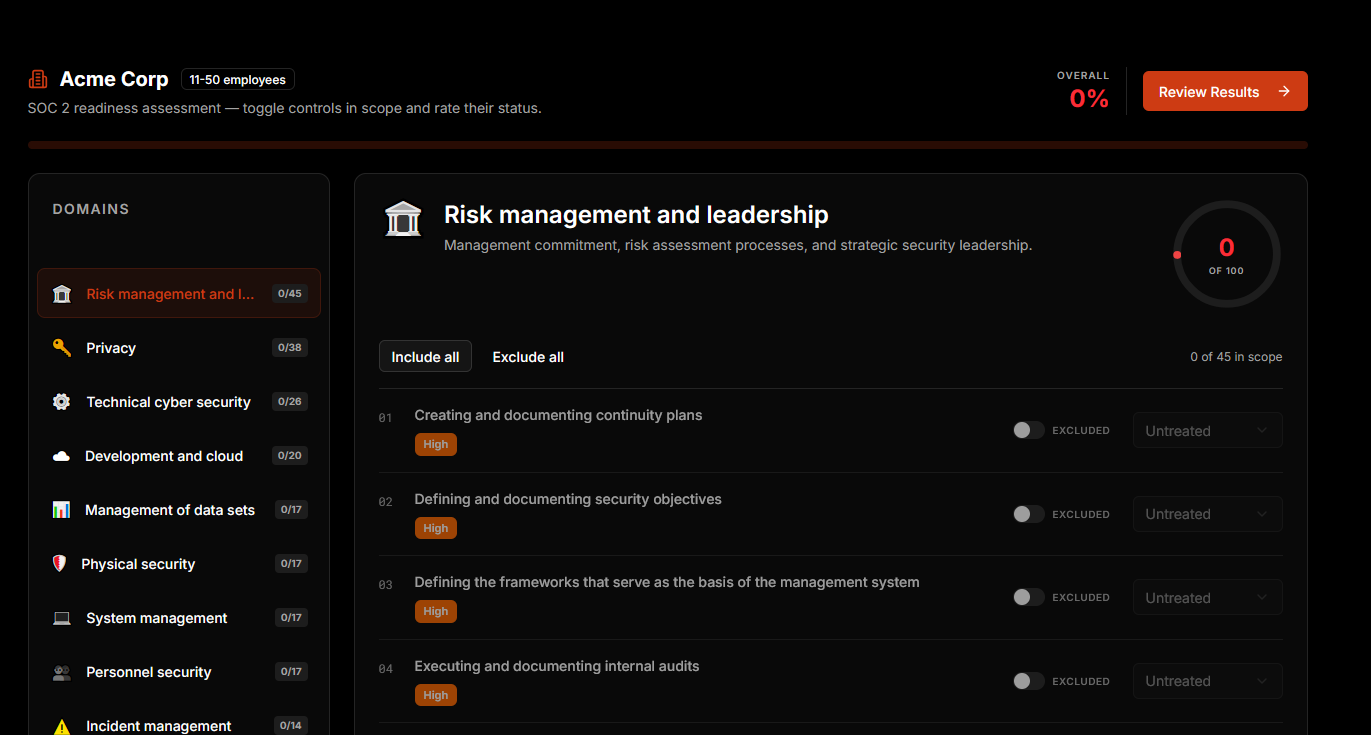
The most complete genuinely-free assessment in this comparison. It scores your organisation against 200+ controls across 12 domains mapped to the AICPA Trust Services Criteria, with weighted scoring Common Criteria 6 (logical access) and Common Criteria 7 (monitoring and detection) carry more weight, because that is where SOC 2 auditors find the most consequential gaps.
Strengths:
- Genuinely free with no sign-up and no email gate you get the result without surrendering contact details
- The deepest control coverage of any free tool here (200+ controls across all 12 domains)
- Instant in-browser scoring, with a domain-level breakdown and a critical gap list
- 100% browser-based no answers are transmitted to any server
- Produces an executive auditor summary you can share with your board or investors
- Follow-on is human-led: a consultation with an OSCP, OSWE, and CREST-certified team, plus optional gap analysis and penetration testing not a forced subscription
Limitations — stated honestly:
- It is a self-assessment, so the result is only as accurate as your input the "Partial" option exists precisely for controls that function but lack documented evidence
- It is a readiness diagnostic, not a formal audit; no readiness tool, free or paid, replaces the opinion of a licensed CPA firm for free.
Best for: SaaS, fintech, and cloud companies preparing for SOC 2 Type 1 or Type 2, and CTOs who want an honest starting-point baseline before budgeting compliance spend.
Take the SecurityWall SOC 2 Readiness Assessment — 10 minutes, no sign-up, instant results, your data never leaves your browser.
2. TrustCloud SOC 2 Readiness (Free Tier)
TrustCloud offers one of the genuinely free options in this comparison a free tier that lets qualifying startups work towards SOC 2 audit-readiness at no cost, with an automated readiness assessment generated from its TrustOps platform. TrustCloud markets it as the first free, self-service SOC 2 readiness offering for startups.
Strengths:
- A genuinely free tier startups with 20 employees or fewer can work towards full SOC 2 (Type 1 and Type 2) audit-readiness at no cost
- Automated readiness assessment from the TrustOps dashboard, mapping your controls and evidence to SOC 2 requirements
- Full platform capabilities evidence collection, control mapping, compliance mentoring included in the free tier for qualifying startups
- A real, supported product, not a static checklist
Limitations:
- The free tier is capped at companies with 20 employees or fewer above that threshold, it becomes a paid platform
- Requires sign-up and onboarding before you see results it is not a no-commitment, instant baseline
- It is a full platform adoption, best suited to startups ready to make TrustCloud their long-term compliance home rather than run a quick independent check
Best for: Early-stage startups (20 employees or fewer) willing to adopt TrustCloud's platform as their ongoing compliance home.
3. Secureframe SOC 2 Readiness Checklist
A downloadable checklist rather than an interactive scored tool. Useful for offline review and for teams who prefer a spreadsheet-style artefact they can annotate and circulate internally.
Strengths:
- A structured, comprehensive checklist you can work through at your own pace
- Easy to circulate internally and annotate across a team
- Produced by an established compliance automation vendor with real domain expertise
Limitations:
- Accessing the full resource typically involves a demo or contact request
- It is not scored and produces no gap analysis output you do all the interpretation yourself
- It is a reference document, not a diagnostic; it tells you what to check, not where you stand
Best for: Teams who want a checklist to work through manually and mark up, rather than an automated score.
4. UpGuard SOC 2 Assessment Template
A downloadable template focused primarily on third-party vendor risk assessment rather than internal control readiness. UpGuard's core product is attack surface and vendor risk management, and its SOC 2 resources reflect that orientation.
Strengths:
- Strong fit for assessing other organisations' SOC 2 posture as part of a vendor risk programme
- Backed by UpGuard's genuine expertise in third-party and supply-chain risk
- A useful artefact for security teams running vendor due diligence at scale
Limitations:
- It is not an internal readiness tool it answers "how do I assess my vendors," a different job
- No internal control scoring or audit-readiness output
- If your question is "how ready am I for a SOC 2 audit," this is the wrong instrument
Best for: Security teams conducting vendor due diligence, not internal SOC 2 preparation.
5. Sprinto SOC 2 Readiness Check
A questionnaire-based readiness check, lighter in coverage than SecurityWall's or TrustCloud's assessments, that feeds into Sprinto's compliance automation platform. Sprinto's genuine strength is continuous compliance automation always-on monitoring, drift detection, and evidence collection during the audit period.
Strengths:
- Quick to complete for an initial directional read
- Connects directly into a mature compliance automation platform if you adopt it
- Strong continuous-monitoring capabilities once you are inside the paid ecosystem
Limitations:
- Accessing full results generally requires sign-up
- Lighter control coverage than the dedicated assessments
- The check functions as a funnel into Sprinto's paid platform; pricing is quote-based and packaged by company size, so the "free check" leads to a quoted annual commitment rather than a free outcome
Best for: Startups planning to adopt Sprinto's compliance automation platform for ongoing SOC 2 management.
6. Vanta and Drata — Platforms, Not Free Tools
Worth addressing directly, because buyers routinely compare them to free assessments: Vanta and Drata are continuous compliance automation platforms, not free readiness tools. Both are excellent at what they do integrating with your cloud, identity provider, and HR systems to continuously collect evidence and maintain audit-readiness across the period.
Strengths:
- Best-in-class continuous evidence collection and monitoring once you are committed to SOC 2
- Deep integrations across cloud, identity, HR, and code-repository systems
- Strong fit for companies running SOC 2 plus additional frameworks at scale
Limitations:
- Not free pricing is quote-based and typically lands in the five figures annually
- Readiness checks are offered only as part of paid platform onboarding
- Over-specified for a company that simply wants to know whether it is ready to start
If you are comparing Vanta or Drata to a free assessment tool, you are at two different stages of the journey: the free tool tells you whether you are ready to start; the platform manages the work once you have started.
Free Tool, Paid Platform, or Consultant — When You Actually Need Each
The most common mistake in this market is buying the wrong layer at the wrong time. The three layers solve different problems, and the right sequence saves both money and months.
Layer 1 — Free readiness assessment (10 minutes, $0). Tells you where you stand and what the gap to audit-ready looks like. Right for everyone at the start, before any spend. There is no downside to running one the only question is which one wastes the least of your time and contact details.
Layer 2 — Consultant-led gap analysis ($, 1–3 weeks). A structured engagement with interviews, evidence sampling, and a formal remediation roadmap. Right when your free assessment reveals meaningful gaps generally a score below 60% and you need detailed, evidenced findings to act on. See what a SOC 2 gap analysis covers for the full breakdown.
Layer 3 — Compliance automation platform ($$$/year). Continuous evidence collection and monitoring across your audit period and beyond. Right after you have implemented controls and want to automate the ongoing evidence work — not before. Buying a platform first is how companies end up paying five figures a year to automate evidence collection for controls they have not yet built.
The efficient path for most companies: free assessment first, gap analysis if the score warrants it, platform once you are implementing and need automation. Each layer answers a different question, and skipping ahead almost always costs more than it saves.
What This Assessment Would Cost You Elsewhere
The three outputs of a SOC 2 readiness assessment a scored baseline, a control-by-control gap list, and a board-ready summary are not usually free. They are normally the deliverables of a paid engagement. Here is what the equivalent typically costs through the other routes available to you.
Consultant-led readiness assessment or gap analysis: $5,000–$15,000. A consultant produces a detailed score, evidenced findings, and a remediation roadmap over a one-to-three-week engagement. This is deeper than any self-assessment it includes interviews and evidence sampling but the core deliverables (score, gaps, roadmap) are the same three outputs the free tool produces directionally.
| Deliverable | Typical Cost via Paid Routes | SecurityWall Tool |
|---|---|---|
| Weighted readiness score across all domains | Part of a $5,000–$15,000 gap analysis | Free |
| Control-by-control gap list | Part of a $5,000–$15,000 gap analysis | Free |
| Board-ready executive summary | Bundled into consultant or platform fees | Free |
| Readiness check without a subscription | Requires a five-figure annual platform plan | Free |
Figures reflect typical market pricing for paid readiness work. The free tool produces directional versions of these outputs — it does not replace a paid gap analysis when you need audit-grade, evidenced depth.
To be clear about what "free" does and does not mean here: the SecurityWall assessment gives you the same three starting-point outputs weighted score, gap list, executive summary that paid routes charge thousands for, at no cost, with no sign-up and no sales call.
Which Tool Should You Use?
The honest answer depends entirely on what you are trying to do right now.
| Your Situation | Best Tool |
|---|---|
| "I want to understand my starting point with free, no commitment, right now" | SecurityWall |
| "I'm an early-stage startup (20 staff or fewer) wanting a free compliance platform" | TrustCloud |
| "I need to assess my vendors' SOC 2 posture" | UpGuard |
| "I want a checklist to print and annotate" | Secureframe |
| "I'm adopting Sprinto for compliance automation" | Sprinto |
| "I'm ready to invest in continuous monitoring tooling" | Vanta / Drata |
For the most common situation — "I want to know where I stand before I spend anything" — a free, no-sign-up, instant assessment is the right starting point. Everything else is a decision you make after you have your baseline.
Related reading:
- SOC 2 Readiness Assessment: Free Tool, Instant Score
- What Is SOC 2 Compliance? A Guide for SaaS Companies in 2026
- SOC 2 Type 1 vs Type 2: Which One Do You Actually Need?
- SOC 2 Gap Analysis: What It Covers and How to Prepare
- SOC 2 Penetration Testing Requirements: What Auditors Expect
Frequently Asked Questions
What is the best free SOC 2 readiness tool?
For a genuinely free, no-sign-up, instant assessment, SecurityWall's SOC 2 Readiness Assessment covers the most controls (200+ across 12 domains) without an email gate or data leaving your browser. TrustCloud's free tier is a strong alternative for early-stage startups (20 employees or fewer) willing to adopt its platform. The "best" tool depends on whether you want a no-commitment baseline (SecurityWall) or a free platform you plan to grow into (TrustCloud).
Are SOC 2 readiness tools actually free?
Some are; many are not, in the sense most people mean. Several "free" tools require sign-up before showing results and function as lead-generation funnels into paid platforms costing five figures annually. SecurityWall's assessment is free with no sign-up and no upsell into a subscription the follow-on is optional human consultancy, not mandatory software.
Is Vanta or Drata a free SOC 2 tool?
No. Vanta and Drata are continuous compliance automation platforms with quote-based pricing typically in the five figures annually. They offer readiness checks only as part of paid onboarding. They are excellent platforms for managing compliance once you have committed but they are not free assessment tools.
How many controls should a SOC 2 readiness tool cover?
The more the better, within reason. A genuine SOC 2 baseline spans the full Common Criteria plus any additional Trust Services Criteria in scope typically well over a hundred controls across the security, availability, processing integrity, confidentiality, and privacy categories. A 10- or 20-question quiz produces a directional impression, not a baseline. SecurityWall's 200+ control coverage is the deepest among the free tools compared here.
Should I use a readiness tool or hire a consultant?
Use a free readiness tool first to baseline your position in 10 minutes. If the score reveals significant gaps generally below 60% a consultant-led gap analysis is the right next step. The free tool tells you whether the paid gap analysis is worth commissioning. Doing both, in that order, is the most cost-efficient path.
Does a free assessment replace a SOC 2 audit?
No. No readiness tool, free or paid, replaces a formal SOC 2 audit. SOC 2 reports must be issued by an independent licensed CPA firm. A readiness tool tells you whether you are prepared for that audit it does not produce the report customers and investors ask for.
Do free SOC 2 tools keep my data?
It varies, and it matters. Tools that require sign-up store your responses on their servers and use them for sales follow-up. SecurityWall's assessment runs entirely in your browser no answers are transmitted anywhere, which matters because your honest control gaps are sensitive information. Always check whether a "free" tool is free in exchange for your data.
What should I do right after my readiness assessment?
It depends on your score. Below 50%: commission a formal gap analysis before engaging an auditor. Between 50–80%: targeted remediation, then penetration testing, then auditor engagement. Above 80%: a pre-audit review and direct auditor engagement within 1–3 months. Our readiness assessment guide walks through each path in detail.
Tags
About Babar Khan Akhunzada
Babar Khan Akhunzada leads security strategy, offensive operations. Babar has been featured in 25-Under-25 and has been to BlackHat, OWASP, BSides premiere conferences as a speaker.