AI Security Audit Saudi Arabia: SDAIA and PDPL Guide
Babar Khan Akhunzada
June 21, 2026
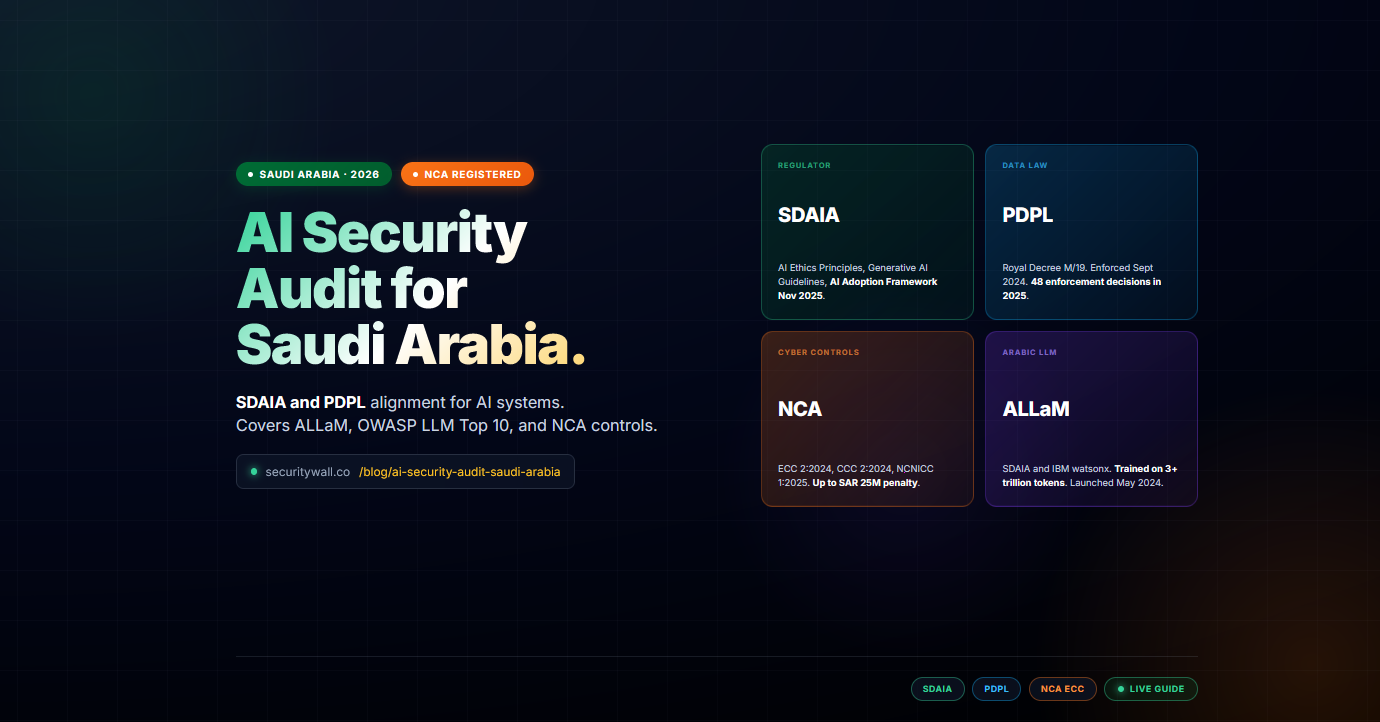
Saudi Arabia has designated 2026 as the "Year of Artificial Intelligence," backed by over $3 billion in AI infrastructure investment, the launch of ALLaM (the Arabic large language model SDAIA developed with IBM on watsonx, released May 2024), and SDAIA's own ISO 42001 certification in July 2024 making it one of the first government agencies globally to achieve it. AI companies operating in or selling into the Kingdom now face a compliance environment unlike any other in the world: rapid regulatory development, three overlapping authorities, fines actively enforced (SDAIA's adjudication committees issued 48 PDPL violation decisions in 2025-2026 alone), and a dedicated AI law expected within the next two years.
This guide explains what an AI security audit in Saudi Arabia actually covers, how SDAIA's principles translate into specific technical controls, how PDPL applies to AI training data, and how AI security audits differ from standard penetration tests. It is written for founders, CTOs, CISOs, and product owners at AI companies that either operate in Saudi Arabia or sell AI-powered products into Saudi customers.
What Regulates AI Security in Saudi Arabia: The Three-Way Overlap
AI security in Saudi Arabia is governed by three overlapping regulatory regimes, not one. Foreign companies often mistake the landscape for being like the EU (single AI Act) or the United States (sector-specific guidance). Saudi Arabia is structurally different: three authorities, each with binding obligations, with overlapping jurisdiction that frequently applies simultaneously.
SDAIA — Saudi Data and Artificial Intelligence Authority. Established by royal decree in August 2019, SDAIA is the lead authority for both data governance and AI policy. It administers the Personal Data Protection Law (PDPL), operates the National Data Governance Platform, and has published the AI Ethics Principles, Generative AI Guidelines, and AI Adoption Framework. SDAIA achieved ISO 42001 (AI Management System) certification in July 2024 establishing it as the operational reference standard for the Kingdom. The National Data Management Office (NDMO), an SDAIA subsidiary, handles classification, governance policies, and data sovereignty enforcement.
NCA — National Cybersecurity Authority. Established in 2017, NCA sets cybersecurity controls applicable to government, critical national infrastructure, and (as of January 2026 with NCNICC-1:2025) every private-sector organization operating in Saudi Arabia. Its frameworks include Essential Cybersecurity Controls (ECC-2:2024 with 4 domains, 28 subdomains, 108 main controls), the Cloud Cybersecurity Controls (CCC-2:2024), and the National Cybersecurity Controls for the Critical Infrastructure (NCNICC-1:2025). NCA's controls overlap with PDPL's Article 22 security requirements meaning AI companies must satisfy both regimes through unified technical controls. SecurityWall is NCA Registered Firm for Cybersecurity services.
CMA and CITC — Sector regulators. The Capital Market Authority regulates AI used in investment, securities, and capital markets. The Communications, Space and Technology Commission regulates AI deployed by telecom operators and through licensed cloud service providers. If your AI product touches financial markets or operates on licensed cloud infrastructure, additional sector controls apply.
The practical reality: an AI security audit for a Saudi deployment must map the AI system against SDAIA's principles, PDPL's technical and organizational requirements, NCA's relevant control set, and any applicable sector framework. A standard penetration test does not do this. A SOC 2 audit does not do this. ISO 27001 alone does not do this. The Saudi regulatory environment requires an integrated assessment that treats the three regimes as a single compliance posture.
SDAIA's AI Ethics Principles: What They Mean for Technical Controls
SDAIA's AI Ethics Principles, first issued in 2023 and updated in 2025, articulate seven principles that organizations deploying AI must operationalize: fairness, accountability, transparency, privacy and security, reliability and safety, human oversight, and societal and environmental wellbeing. Most discussions of these principles stop at the policy level. For an AI security audit, the relevant question is what each principle requires as a technical control.
Fairness. Translates technically into bias testing across protected demographic dimensions, balanced training data assessment, and model output disparate-impact analysis. For Arabic-language AI systems (including ALLaM-based deployments), this includes dialect coverage testing Saudi, Egyptian, Levantine, Maghrebi dialect performance disparity is a documented bias source in MENA LLM deployments.
Accountability. Requires documented audit trails of every AI lifecycle decision training data selection, model fine-tuning, prompt template versions, deployment changes, output corrections. SDAIA's AI Adoption Framework explicitly requires organizations to establish an "AI unit" with defined responsibility chains. An AI security audit verifies that these audit trails exist, are immutable, and capture the decisions needed to reconstruct any model output six months later.
Transparency. Requires explainability mechanisms for high-risk decisions. For LLM applications, this means disclosed system prompts where the model takes consequential actions, output attribution to sources for RAG systems, and confidence scores where decisions affect users.
Privacy and Security. The deepest technical layer. Encompasses PDPL Article 22 (security measures), encryption at rest and in transit, access controls aligned with data classification, prompt injection defenses, training data poisoning prevention, model extraction attack defenses, membership inference attack mitigation, and inference API security. This is the principal focus of most AI security audit engagements.
Reliability and Safety. Requires adversarial robustness testing, output filtering against harmful content generation (especially relevant for ALLaM-based generative deployments processing Arabic content), failure mode analysis, and degradation testing under load.
Human Oversight. Technical implementation requires human-in-the-loop checkpoints for consequential decisions, override mechanisms, and escalation pathways when model confidence drops below thresholds.
Societal and Environmental Wellbeing. Increasingly translates to compute efficiency reporting and water/energy disclosure for large-scale model training, particularly relevant given Saudi Arabia's emphasis on sustainability in NEOM and Vision 2030.
For an AI security audit, each of these seven principles maps to between three and twelve discrete technical control areas. A compliance-only audit might check whether your policies mention these principles. A security audit verifies the controls are actually implemented and tests them adversarially.
PDPL and AI Training Data: When Personal Data Enters the Model
The most operationally complex question for any AI company in Saudi Arabia is what happens when personal data as defined under PDPL enters the training pipeline. PDPL Article 1 defines personal data broadly: any data, of whatever form, that may lead directly or indirectly to identification of an individual. This includes data that would be considered anonymized in other jurisdictions if re-identification remains technically feasible.
For AI training data, this creates three distinct obligations:
Lawful basis for processing. PDPL Article 6 requires a lawful basis (consent, legal obligation, vital interests, public interest, or legitimate interests with balancing test) for every processing activity. Training an LLM on personal data is a processing activity. Most foreign AI companies have no documented lawful basis for the Saudi personal data in their training corpus because it was never identified as such during initial training. This is a critical gap in nearly every audit we have conducted.
Cross-border transfer controls. PDPL Article 29 and the Regulation on Transfer of Personal Data Outside the Kingdom (latest version September 2024) restrict moving personal data outside Saudi Arabia. Training a model in the United States or Europe using Saudi personal data triggers transfer obligations. The transfer requires either SDAIA-determined adequacy (no countries have been formally designated adequate as of June 2026), Standard Contractual Clauses, Binding Corporate Rules, or explicit SDAIA authorization with documented Transfer Impact Assessment.
Data classification. NDMO's four-tier classification framework (Public, Internal, Confidential, Top Secret) applies to all data assets, including training datasets. The classification determines which protection controls are required. Tier 4 personal data including health information, biometric data, credit information, and behavioral data of minors requires the highest controls, restricted access, and explicit lawful basis for AI training use.
The practical implication: AI security audits for Saudi-relevant systems must include a training data lineage audit. This asks: Where did each dataset originate? What lawful basis applies? Was Saudi personal data included? Were the transfer obligations met? Is the classification accurate? Can re-identification be ruled out, or does residual risk remain? For RAG systems (Retrieval-Augmented Generation), the same questions apply to the retrieval corpus.
This is the dimension that distinguishes a Saudi-relevant AI security audit from a generic AI red team engagement. Without this layer, the audit cannot answer the question that matters to the regulator: is the AI system processing Saudi personal data lawfully?
What an AI Security Audit Covers in Saudi Arabia
| Aspect | App Pentest | LLM Pentest | AI Security Audit |
|---|---|---|---|
| Focus | Web, API, network | Model attack surface | Lifecycle plus compliance |
| Prompt injection | Not covered | Yes | Yes |
| Training data review | Not covered | Partial | Yes |
| SDAIA mapping | Not covered | Not covered | Yes |
| PDPL Article mapping | Not covered | Not covered | Yes |
| Governance review | Not covered | Not covered | Yes |
| Typical duration | 1 to 3 weeks | 2 to 4 weeks | 4 to 8 weeks |
| Saudi regulatory fit | App layer only | Model layer only | Full SDAIA + PDPL + NCA |
A complete AI security audit in Saudi Arabia covers eight technical assessment domains, mapped to the regulatory regimes above. Engagement scope varies, but a thorough audit addresses each:
1. Prompt Injection Testing. Direct and indirect prompt injection assessment against OWASP LLM01:2025 standards, including multi-turn injection, jailbreak resistance, and Arabic-language injection variants (specific dialect-based attacks that bypass English-only filters).
2. Model Output Handling. Verification that model outputs do not leak training data (membership inference defense), do not reveal system prompts (prompt extraction defense), do not generate harmful content (output filtering), and do not bypass access controls when integrated with downstream systems.
3. Training Data Provenance and PDPL Mapping. Audit trail of all training and fine-tuning data sources, lawful basis documentation, cross-border transfer verification, and PDPL data classification.
4. Inference API Security. Authentication, authorization, rate limiting, input validation, output encoding, audit logging for the inference endpoints. Many AI applications fail Saudi audits at this layer because their inference APIs were built without auth or with API keys exposed to clients.
5. RAG and Vector Database Security. For Retrieval-Augmented Generation deployments, this includes vector store access controls, embedding poisoning defenses, retrieval boundary enforcement (preventing cross-tenant data leakage), and source attribution mechanisms.
6. Agentic AI Security. For AI systems with tool-calling, action-taking, or autonomous decision capabilities mapped against OWASP Agentic AI Top 10 (released December 2025): ASI01 Goal Hijack, ASI02 Memory Poisoning, ASI03 Tool Misuse, ASI04 Identity Abuse, through ASI10 Rogue Agents. Saudi deployments using agents need full ten-risk coverage.
7. Infrastructure Security. The hosting infrastructure for the AI system cloud configuration, network segmentation, secrets management, monitoring assessed against NCA ECC-2:2024 controls applicable to the deployment classification.
8. Data Residency and Sovereignty. Verification that data classified as requiring Saudi residency is in fact stored and processed within the Kingdom, that backups respect the same constraints, and that any incident response process does not inadvertently exfiltrate data through telemetry or support workflows.
The output of an AI security audit in Saudi Arabia is not just a list of vulnerabilities. It is a compliance evidence package that maps each finding back to the relevant SDAIA principle, PDPL article, and NCA control allowing the organization to demonstrate to SDAIA, customers, and procurement teams that the AI system has been independently assessed and remediated.
AI Security Audit vs LLM Penetration Testing: Which Do You Need?
These two engagement types are frequently confused. They serve different purposes and produce different deliverables.
LLM Penetration Testing is a focused technical engagement that adversarially tests the AI system against attack patterns. It produces a vulnerability report. It is appropriate when you have a specific application chatbot, RAG system, agentic platform and want to know whether it can be exploited. Our LLM penetration testing guide details the methodology. Typical duration: 1-3 weeks. Typical price range: $8,000 to $30,000 depending on scope.
AI Security Audit (Saudi-specific) is a broader engagement that includes penetration testing as one component, but also covers governance, training data lineage, PDPL mapping, SDAIA principle alignment, NCA control verification, and produces a compliance evidence package. It is appropriate when you need to demonstrate compliance to SDAIA, win a Saudi government tender, satisfy a customer's procurement requirement, or prepare for a dedicated AI law that is expected within two years. Typical duration: 3-8 weeks.
The simplest decision rule: if your only goal is "find vulnerabilities in our AI product," start with a penetration test. If your goal includes "be able to operate or sell in Saudi Arabia," you need the full audit. Most Saudi government tenders, PIF-backed company procurement processes, and giga-project supplier qualification programs now require evidence equivalent to the full audit.
| Dimension | SDAIA (Saudi Arabia) | EU AI Act | NIST AI RMF |
|---|---|---|---|
| Legal status | Non-binding principles, dedicated law expected 2026 to 2028 | Legally binding, high-risk enforcement 2 August 2026 | Voluntary framework, non-binding |
| Risk classification | AI Adoption Framework: 4 maturity levels | 4 risk tiers: minimal, limited, high, unacceptable | Govern, Map, Measure, Manage functions |
| Personal data link | PDPL binding, SAR 5M max fine | GDPR binding, €20M or 4% turnover | Separate sectoral US laws |
| Mandatory pre-deployment audit | SDAIA self-assessment for high-risk; ISO 42001 emerging baseline | Conformity assessment required for high-risk | Voluntary self-assessment |
| Cross-border transfer | SDAIA authorization or SCC | GDPR Chapter V, SCC, BCR | Sector-specific (HIPAA, COPPA, etc.) |
| Breach notification | 72 hours to SDAIA, without undue delay to subjects | 72 hours to DPA, without undue delay to subjects | Varies by state law |
| Sovereignty signal | Strong: data residency, SDAIA accreditation increasingly required | Moderate: market access through CE marking | Voluntary signal, no procurement gate |
The three frameworks converge on risk-based governance but diverge on enforcement mechanism. Saudi-relevant audits should map findings against all three when serving multinational AI products, with SDAIA and PDPL as the binding regimes.
Vision 2030 and Saudi AI Compliance Expectations
Vision 2030 Saudi Arabia's economic transformation programme launched in 2016 has consistently treated AI as central infrastructure. PIF's partnership with Google Cloud to establish an AI hub near Dammam (announced October 2024) is projected to contribute $71 billion to Saudi GDP over the following eight years. The Saudi AI market is projected to add $135 billion to Middle East GDP by 2030, with the Kingdom accounting for nearly half of that figure per PwC analysis.
This level of investment creates structural demand for AI compliance services. The trajectory:
2024-2025. SDAIA published AI Ethics Principles (2023, updated 2025), achieved ISO 42001 certification (July 2024), released the Generative AI Guidelines (2024), and the AI Adoption Framework with four maturity levels (September 2024). SDAIA accreditation became a competitive advantage in government tenders.
2026 (current). Saudi Arabia designated the "Year of AI." Cloud Computing Regulatory Framework (CCRF) compliance, NCNICC-1:2025 extension to private sector, and active SDAIA enforcement (48 PDPL decisions issued) have made compliance a market-entry requirement, not an optional differentiator. The Draft Global AI Hub Law (2025) proposes Virtual Hubs and Private Hubs as new regulatory categories, signaling the Kingdom's ambition to host international AI workloads under Saudi regulatory authority.
2027-2028 (anticipated). A dedicated AI law is expected within the next two years, likely consolidating SDAIA principles into binding obligations and aligning more closely with the EU AI Act's risk-tiered structure. Companies that establish compliance posture now will face lower transition costs than competitors who delay.
For AI companies considering Saudi market entry, the operational implication is unambiguous: compliance is the gate, not the obstacle course after it. SecurityWall's compliance services include AI security audits scoped specifically against SDAIA, PDPL, and NCA. For Arabic-language LLM deployments and ALLaM-based systems, see our companion guide on Arabic LLM security testing.
AI security audit for Saudi Arabia, scoped against the regulators that actually matter.
SecurityWall audits AI systems for SDAIA, PDPL, and NCA alignment. Prompt injection testing, model security, training data provenance, compliance evidence mapping. NCA-registered. 20+ certified professionals across Riyadh, Dubai, Abu Dhabi, London, and Amsterdam.
✓ OSCP, OSWE, CREST, CRT, CISM, CISSP certified team
Related reading:
- LLM Penetration Testing: How to Test AI Applications
- OWASP Top 10 for Agentic AI 2026
- Prompt Injection Testing Guide
- LLM Security Audit Cost 2026
- NCA Compliance for Saudi Arabia
Frequently Asked Questions
Does SDAIA require security audits for AI companies?
SDAIA does not currently mandate independent third-party security audits for every AI system, but it strongly recommends and increasingly expects them for high-risk deployments. The AI Adoption Framework's four maturity levels require progressively more rigorous controls including documented audits at higher levels. SDAIA self-assessment is increasingly required for government tenders and PIF-backed company procurement processes. A dedicated AI law expected within the next two years is likely to make independent audits mandatory for high-risk AI systems.
What is the difference between PDPL for AI and standard PDPL?
PDPL applies uniformly to all personal data processing, with no separate AI-specific provisions in the current law. However, AI processing intensifies several PDPL obligations: lawful basis must be established for training data (often overlooked), cross-border transfer controls apply when models are trained outside Saudi Arabia, automated decision-making provisions in PDPL Article 18 give data subjects rights regarding AI-driven decisions, and the 72-hour breach notification window applies if an AI system inadvertently exposes personal data through outputs.
Do foreign AI companies selling into Saudi need SDAIA compliance?
Yes. PDPL applies extraterritorially to any organization processing personal data of individuals located in Saudi Arabia, regardless of where the organization is based. A US-based AI company offering services to Saudi customers triggers PDPL obligations including the cross-border transfer controls, SDAIA registration requirements (for certain categories of controllers), and the security obligations under Article 22. SDAIA accreditation is increasingly required for government and PIF-backed customer procurement processes, making it a market-entry requirement.
What does an AI security audit cost in Saudi Arabia?
AI security audit pricing in Saudi Arabia ranges from approximately $15,000 to $75,000 depending on system complexity, deployment scope, and depth of compliance evidence required. Standalone LLM penetration testing engagements (without full compliance mapping) range from $8,000 to $30,000. Full audits for regulated entities including financial services and healthcare can exceed $100,000. See our LLM Security Audit Cost guide for detailed pricing models.
Does NCA also regulate AI systems?
Yes, indirectly through cybersecurity controls that apply to the infrastructure hosting AI systems. NCA ECC-2:2024 controls apply to government entities and critical national infrastructure. NCNICC-1:2025 (released January 2026) extends mandatory NCA controls to every private-sector organization in Saudi Arabia. CCC-2:2024 applies to cloud-hosted AI deployments. NCA does not currently issue AI-specific controls, but the cybersecurity baseline it requires (encryption, access controls, monitoring, incident response) applies to the AI system's hosting environment regardless of the AI-specific layer.
How is an AI security audit different from a penetration test?
A penetration test is a focused technical engagement that adversarially tests a system for vulnerabilities and produces a vulnerability report. An AI security audit is a broader assessment that includes penetration testing as one component, plus governance review, training data lineage analysis, PDPL compliance mapping, SDAIA principle alignment verification, NCA control verification, and a compliance evidence package mapped against Saudi regulatory frameworks. The audit produces evidence that satisfies regulators and procurement teams, not just a vulnerability list.
Tags
About Babar Khan Akhunzada
Babar Khan Akhunzada leads security strategy, offensive operations. Babar has been featured in 25-Under-25 and has been to BlackHat, OWASP, BSides premiere conferences as a speaker.